Petro questions transparency in Ecuador elections

Petro demands clarity in the Ecuadorian elections while pointing out irregularities that could change the game.

The Colombian president does not bite his tongue

Gustavo Petro, the president of Colombia who never goes unnoticed, has decided to put his hands in the political hornet’s nest of Ecuador. This Tuesday, with the elegance of a tweet at midnight, he asked the Ecuadorian government to show the minutes of the elections where Daniel Noboa won the jackpot with 55% of the votes. Reason? His observers gave him some reports that, according to him, are shadier than an episode of House of Cards.

Elections under magnifying glass (and rifles)

Petro not only wants to see the minutes, but he dropped pearls like that the polling stations were more militarized than a Call of Duty. “Hooded faces, uniformed men with weapons and an Argentine observer who was not allowed to leave the country”—sounds like the plot of a political thriller, but according to him, it is reality. Even Leónidas Iza, former candidate for Pachakutik, was reportedly arrested before the elections. Coincidence? He says no.

RelatedPetro challenges the US on anti-drug policy

Of course, he clarified that it is not personal against Noboa (“I have good memories of him”), but that, as with Venezuela, he wants everything to be clarified. Because, in his words, “things must be transparent to the point of exhaustion.” Translation: he doesn’t want to be called a nosy without proof.

Colombia is not saved either

And like a good multitasker, Petro took the opportunity to say that they are not playing fair in his yard either. He denounced an alleged coup d’état in the making, with the Electoral Council trying to prosecute him and parties of the Historical Pact being investigated “without reason.” Basically, his summary was: “There’s a singe smell here too.”

What’s next? While governments measure themselves with diplomatic statements, citizens expect clear answers. If you are interested in the future of the region, share this note and continue exploring more content on Latin American politics. Because the drama never stops!

Tourism in Cuba plummets: arrivals fall 41.6% in May

Cuba registered only 30,800 tourists in May, a drop of 41.6% year-on-year.

May confirms the downward trend

Cuba received only 30,800 foreign tourists in May, according to the National Office of Statistics and Information (ONEI). The figure represents a year-on-year drop of 41.6% and a slight rebound compared to April.

In the first five months of the year, 359,491 international visitors arrived, 505,706 less than in the same period in 2025. Canada continues to be the main issuing market, with 126,239 tourists. They are followed by Cuban emigrants (60,874) and travelers from the United States (25,572).

Russia, Mexico, Argentina and China also show sharp declines. European countries such as Italy, Portugal and Germany left the top 10. Spain and France only contributed 8,106 and 7,525 visitors, respectively.

The drop has been constant: from 184,833 tourists in January, it fell to 77,663 in February and 35,561 in March.

Factors that aggravate the crisis

Starting in June, the situation will worsen with the departure of foreign hotel companies that operated alongside Gaviota, from the GAESA conglomerate. Dozens of facilities will be out of service. The hotel occupancy rate in the first quarter of 2026 fell to 12.9%, well below the 23.7% of the previous year.

In addition, most international airlines canceled flights due to critical fuel shortages, following the end of shipments from Venezuela and Mexico, and in the face of threats of sanctions from Washington.

In 2025, Cuba received just over 1.8 million foreign visitors, far from the projected 2.6 million. In 2024, 2.2 million arrived and in 2023, 2.4 million. The figures reflect a sustained deterioration in the sector, hit by the lack of fuel, the departure of international companies and lower global demand.

Continue reading

US and Iran reach provisional agreement to reopen Hormuz

The US and Iran agree to reopen the Strait of Hormuz and extend the truce.

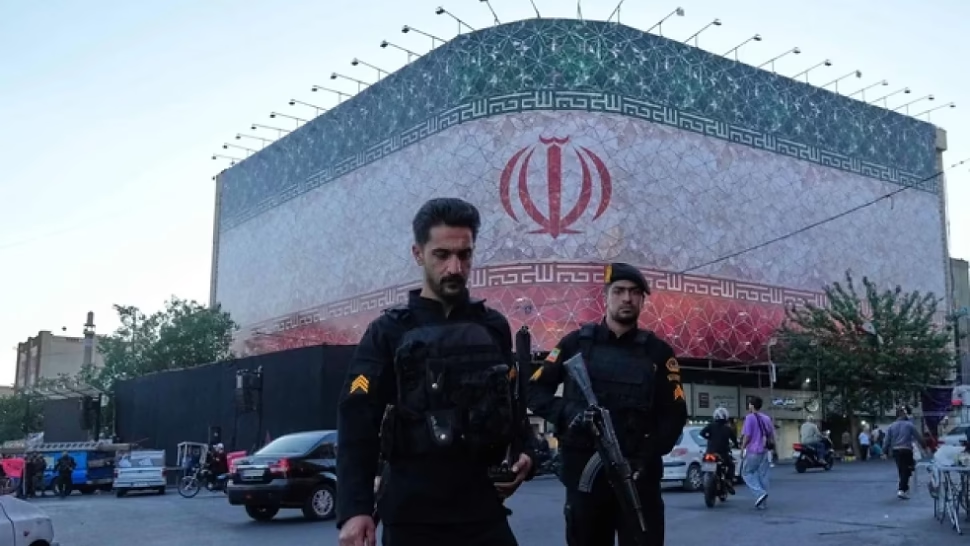
The United States and Iran closed a provisional agreement that seeks to end the armed conflict and reopen the Strait of Hormuz, one of the most strategic maritime routes on the planet. The understanding also contemplates extending the fragile ceasefire in force in the region, amid years of military and political tension.

What does the pact contemplate?

The announcement opens the door to a formal signing next Friday in Switzerland, although authorities acknowledge that previous similar attempts have failed. As of Monday, the final content remained in dispute, especially on issues of regional security, nuclear verification and conditions for the lifting of sanctions.

The crisis between both nations has deep roots, from the Iranian nuclear program initiated with international cooperation to the Islamic Revolution of 1979. Since then, relations have been marked by diplomatic ruptures, economic sanctions and indirect clashes in the Middle East. The new agreement could mark a turning point, but doubts remain over its implementation.

Continue reading

Israel criticizes Netanyahu over US-Iran deal

The provisional pact between the US and Iran sparks internal criticism against Netanyahu for possible loss of influence.

Reactions in Israel

Israel is experiencing an intense internal debate after the provisional agreement between the United States and Iran. The pact has generated widespread criticism across the political spectrum, who consider it a strategic setback.

Prime Minister Benjamin Netanyahu has not yet issued an official position. Meanwhile, opposition figures, former officials and analysts react harshly. They point out that the Israeli government overestimated its ability to influence Washington’s strategy during the conflict with Tehran.

Another point of complaint is that the agreement could limit Israel’s freedom of military action, especially on the Lebanon front, where tensions with Hezbollah persist. Government sectors warn that resuming attacks could complicate the relationship with the United States.

International analysts point out that the pact alters the power dynamics in the Middle East. Israel would come under greater strategic pressure. Furthermore, the eventual partial lifting of sanctions on Iran would strengthen its economic and military capacity in the medium term.

Continue reading