UN recognizes work of human rights defenders in Sinaloa

The UN Office in Mexico reinforces its collaboration with the defense of individual guarantees in the state.

The UN Sets Its Eye on Sinaloa: It is Not a Human Rights Drill

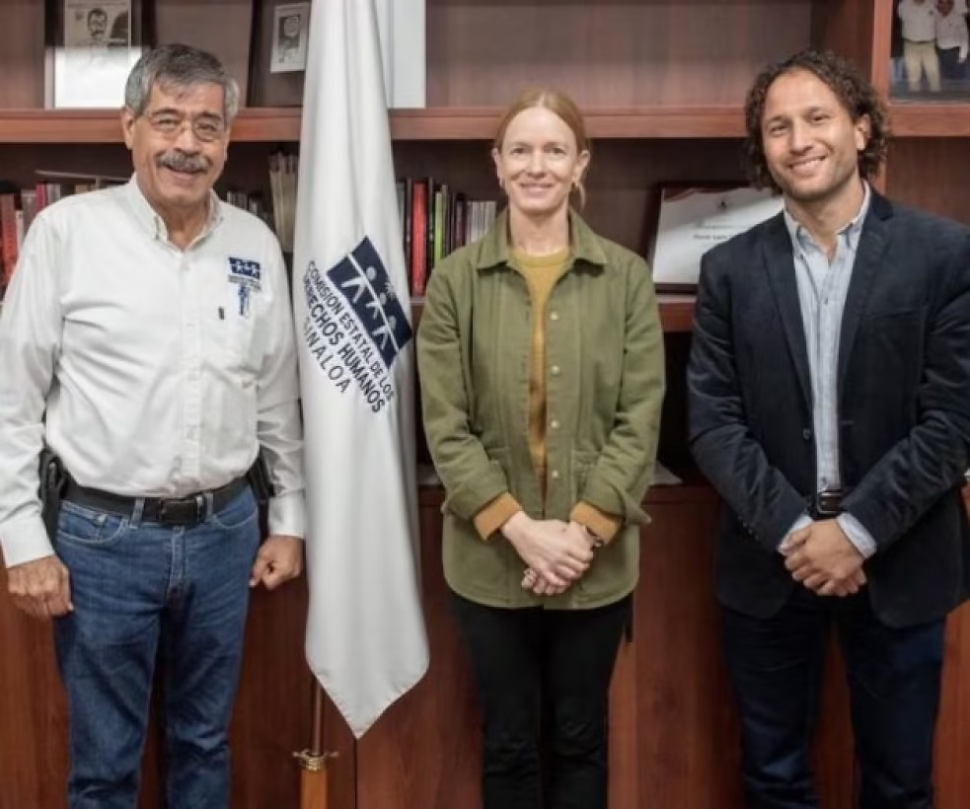
Imagine the scene: the offices of the State Human Rights Commission in Sinaloa, on any given Thursday, and suddenly, Dr. Maia Campbell, deputy representative of the Office in Mexico of the UN High Commissioner for Human Rights, appears as if she were an international superhero of individual guarantees, but with a better outfit. Their mission: to recognize the titanic work of the state ombudsman and his squad, because, let’s be honest, defending human rights in this country sometimes feels like trying to assemble an IKEA piece of furniture without instructions and with missing screws.

It was received by the owner, Oscar Loza Ochoa, in what we could describe as the most important institutional crossover of the year for Sinaloa. They did not come alone; The UN squad also included Ricardo Cancela Neves, Human Rights Officer. Basically, the social justice Avengers made a pit stop to give props to the local team that every day faces the challenge of making things better.

RelatedForced disappearances and homicides collapse justice in Sinaloa

A Shoutout They Didn’t Expect

In a gesture that broke boring protocol, Campbell not only delivered the usual diplomatic speech. No no. She extended her genuine respect and admiration, understanding that her work at the entity is not a bed of roses. What’s more, it is a road full of potholes, Kafkaesque bureaucratic procedures and, at times, a lack of resources that would make anyone cry. He recognized the performance of all the staff of the autonomous organization, that first line of defense that receives people when everything else has failed. They are the first responders in the crisis of human dignity.

For her part, Loza Ochoa, in her welcome speech, highlighted that there has always been an excellent relationship between the organization she presides over and the Office of the UN High Commissioner in Mexico. He said, with all the intention in the world, that he wants to deepen those ties. Translation: we need more of your support, because there is a lot of work and international spotlights always help governments pay more attention. It’s like when you tag a brand in a problem, but on a geopolitical level.

Ricardo Cancela Neves was the one who revealed the uncomfortable but necessary truth: the reason for the visit was, simply, to live with the staff. Yes, knowing first-hand the anonymous heroes who have the first contact with the victims, those who listen to the stories of pain and try to find a solution in a sea of ​​complications. It is that human recognition that is often lost in reports and statistics.

Beyond the Protocol Visit

But this was not just a photo for the institutional Instagram and a handshake. Dr. Campbell made the underlying objective clear: strengthen alliances with international organizations to guarantee the implementation of public policies that translate into real and tangible respect for human rights in Sinaloa. He did not come with detours; He wants actions, results and, above all, an impact that is felt in the streets, not just in speeches.

In a world where the news is often a bottomless pit of misfortune, this visit is like a small respite, a reminder that there are people doing the heavy lifting, often without recognition. The UN putting its eyes on Sinaloa is a powerful message: what happens here matters on the global stage. It is a validation that, hopefully, will be converted into concrete resources and structural changes.

At the end of the day, this story is about the importance of collaboration. About how networking, from local to international, can be the key to unlocking significant advances. The CEDH team in Sinaloa received its well-deserved recognition, and now the challenge is to translate that energy into more effective protection mechanisms for all citizens. The message is clear: the defense of human rights is a shared responsibility and a fundamental pillar for any society that aspires to be just.

Do you think this type of international collaboration is important? Share this note on your social networks to give visibility to the work of human rights defenders and explore more related content on our site.
Semar says goodbye to ‘Niko’, ‘Hunter’ and ‘Hidra’, his elite dogs

Three Belgian Malinois were recognized for their work in rescues and security.

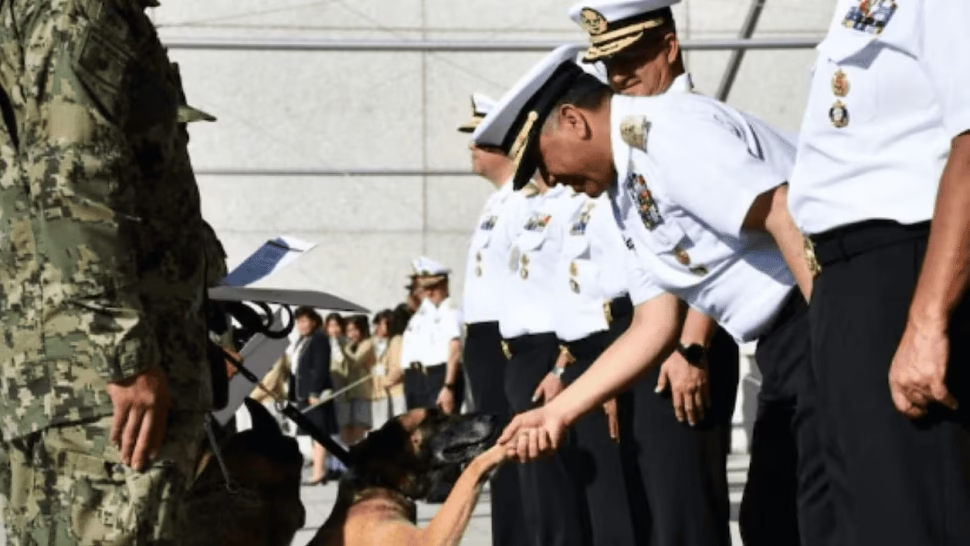
The Secretary of the Navy (Semar) held the “Four-Legged Heroes” ceremony to retire three canine elements: Niko, Hunter and Hidra. The Belgian Malinois were part of the Canine Binomial Operations and Control Group.

The honorees and their missions

During their active stage, these dogs worked in search and rescue, explosives detection and location of illicit substances. Each one formed a pairing with their handler, based on trust and constant training.

Niko was deployed in February 2023 to Adiyaman, Türkiye, after the earthquakes that hit the region. As part of the USAR-MARINA team, he helped locate a person alive in the rubble. His work reflected the preparation of the Navy in international humanitarian aid missions.

Hunter and Hydra participated in security operations together with the Search, Location and Neutralization of Explosive Ordnance (Blonae) team. They carried out inspections at strategic facilities and high-level national and international events. They also collaborated in actions against drug trafficking.

Semar highlighted the loyalty, discipline and dedication of these canines during years of service. The ceremony recognized the bond with their handlers and the impact of their work in protecting Mexican society.

Continue reading

Last Friday in June without classes due to Technical Council

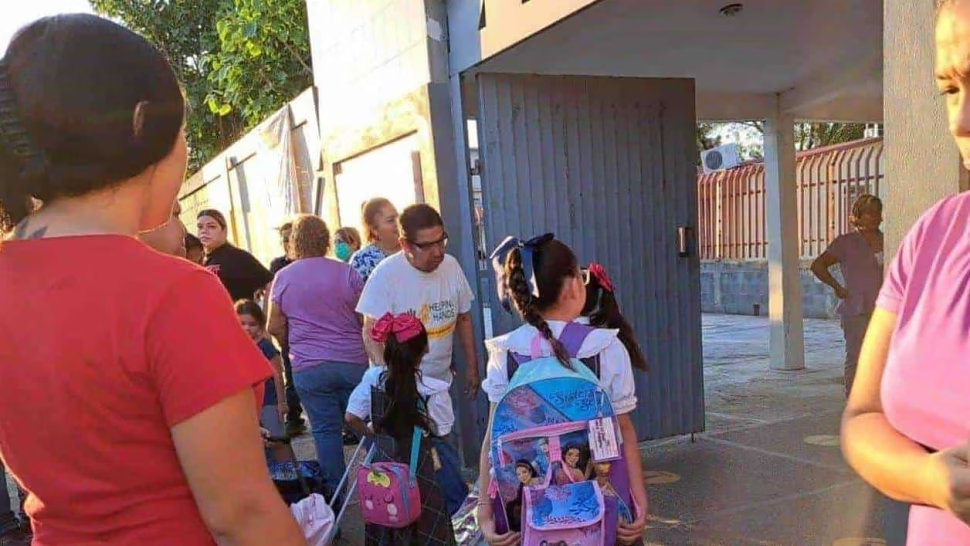
On Friday, June 26, there will be no classes for the last session of the School Technical Council, according to the SEP.

Classes on June 26? The SEP clarifies the calendar

With the arrival of summer, parents and guardians are looking for answers about the closure of the school year. A recurring question: should preschool, primary and secondary school students go to school on Friday, June 26?

The answer is in the official calendar of the Ministry of Public Education (SEP). That day the last ordinary session of the School Technical Council (CTE) is scheduled. Teachers evaluate the period; Students do not attend classrooms. It’s a long weekend for the minors.

States can adjust

The SEP allows entities to make modifications in the event of extreme weather conditions or closure adjustments. These changes are published in the official state newspapers. The federal authority supervises that the effective school days are met, as established by the General Education Law.

The final weeks of June concentrate the delivery of ballots and the completion of contents. The delivery of grades is carried out in an orderly manner to ensure registration in the national educational system.

Summer break

Any vacation advance requires official validation. The priority is child well-being in the face of climatic phenomena or contingencies. The formal recess begins after the last scheduled school day.

Continue reading

Third edition of the Health Journalism Award already has winners

The winners were announced in five categories of the health journalism contest.

Winners of the National Health Journalism Award 2026

The third edition of the National Health Journalism Award, awarded by Opinión 51 and Merck, recognized journalistic works on physical and mental health. The jury was made up of representatives from TV UNAM, El Economista, EL UNIVERSAL and Síntesis TV.

The contest seeks to “inform, raise awareness and generate greater understanding about the health issues that impact the lives of millions of people in Mexico,” the organizers said.

Written Category

  • Inés Gutiérrez Jaber won for “For decades we ignored menstruation; now we know that it changes the brain”, published in TecScience.
  • Honorable mention: Claudia Patricia Villalobos Monroy for “Skin substitutes for the treatment of diabetic foot and burns”, from the IPN.

Video Content

  • Andrés A. Solís Álvarez for “Security under stress. Police, military and psychological care”, in Meganoticias.
  • Honorable mention: Arturo Ramírez Hernández for “This is the reality of doctors residing in Mexico”, in Siete24Mx.

Audio Content

  • Collaborative work “The Dragon’s Recipe”, by Aleida Rueda, Luis Fernando Vargas, Camila Segura, Andrés Azpiri, Rémy Lozano and Ana Turian, on Radio Ambulante.
  • Honorable mention: Maricarmen Climent for the episode “Forbidden to get pregnant”, from Pan Pal Susto Podcast.

Social Networks

  • Jimena Férez Vidal for “Why not try alcohol as a teenager”, in Madrehadisima.

University Category

  • Ximena Guadalupe Guerrero Medina for “Early detection of HPV: a biosensor that seeks to save lives in Mexico”, on TV UNAM.

The organizers highlighted the quality of the works received and the high level of the applications, which led to several honorable mentions being awarded. The award seeks to encourage the production of journalistic content that contributes to the dissemination of information relevant to public health.

Continue reading