October registers 50 homicides daily in Mexico

Homicidal violence shows a national downward trend, but key states like Sinaloa are experiencing an alarming spike amid criminal conflicts.

National Panorama of Homicidal Violence

According to the preliminary figures provided by the Secretary of Security and Citizen Protection (SSPC), the month of October 2025 concluded with a record of one thousand five hundred and fifty-three victims of intentional homicide nationwide. This statistic translates into an average of fifty people murdered every day, placing this month as the period with the lowest crime incidence of this type in the year 2025. However, the annual cumulative total from January to September exceeds fifteen thousand victims, according to official data from the Executive Secretariat of the National Public Security System (SESNSP). This apparent monthly decrease requires a deeper contextual analysis, as it masks extremely complex and worrying regional realities.

The Particular Case of Sinaloa: A Contrary Trajectory

While the national trend appears to reflect an improvement, the state of Sinaloa experienced a 20% increase in intentional homicides during October. The entity went from 106 cases in September to 127 in the last month, which is equivalent to an average of four murders a day. This uptick in violent crime is framed in a context of disputes between criminal groups, specifically the struggle between the factions known as “Los Chapitos” and “La Mayiza.” October 22 stood out as the most violent of the period, with a total of 11 victims of intentional homicide registered in a single day, evidencing the intensity of the conflict and the persistent challenges in terms of public security and containment of organized crime.

RelatedMexico reports 1,553 homicides during October 2025

Regional Breakdown: The States with the Highest Incidence

The SSPC daily report, prepared based on information provided by state prosecutors, identifies the five states with the highest homicide rates in October. The list is topped by Guanajuato with 147 victims, closely followed by Sinaloa with 127. Chihuahua and the State of Mexico share third place, each with 120 intentional homicides, while Michoacán completed the group with 101 murders. The situation in Michoacán acquired special relevance after the murder of businessman Bernardo Bravo Manríquez, who served as president of the Association of Citrus Growers of the Apatzingán Valley. This crime motivated a high-level response from the federal government, with the visit to the Tierra Caliente region of the Secretary of Security, Omar García Harfuch, and the Secretary of National Defense, General Ricardo Trevilla Trejo, with the objective of reviewing the security strategy to combat criminal cells dedicated to the extortion of lemon producers.

The disparity in numbers between the national trend and localized outbreaks of violence underscores the multifaceted nature of the security challenge in Mexico. Although a decrease at the macro level is a positive fact, the intensification of violence in specific regions, often linked to dynamics of territorial control and illicit markets, requires differentiated and intelligence strategies. The ability of criminal groups to adapt and the persistence of illegal economies continue to be significant obstacles to the pacification of the country. The government response, like the one observed in Michoacán, must be agile, coordinated between instances and sustained over time to generate tangible and lasting results in the protection of citizens and the fight against impunity.

Do you find this analysis on national security relevant?Share this report on your social networks to keep your community informed and explore more content related to public security policies on our portal.
PRI urges to reinforce prevention in the face of intense rains

PRI senators ask to reinforce warning and preparation for the heavy rain season.

Call from the PRI due to risks of heavy rains

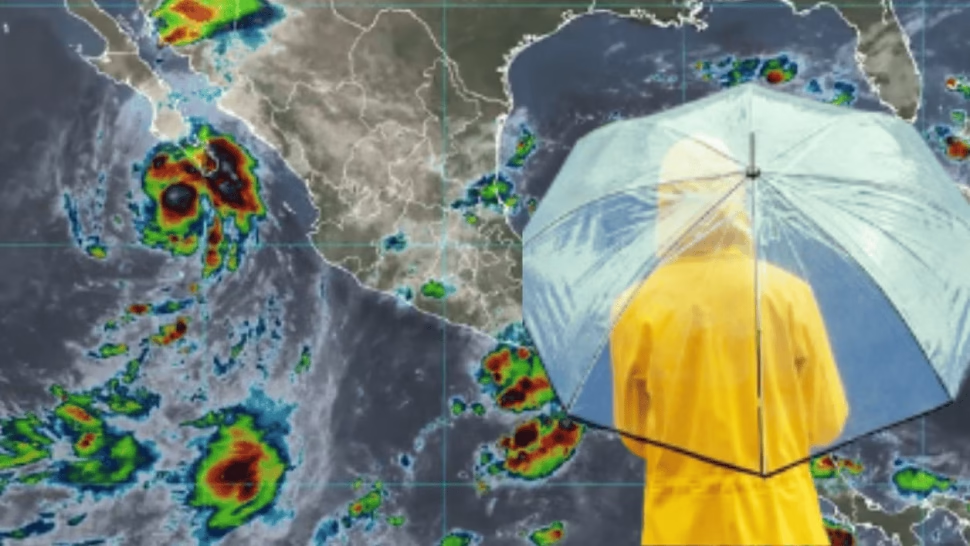
PRI senators requested to strengthen prevention, monitoring and dissemination of early warning actions to face possible emergencies due to heavy rains. The request arises after the failures of federal Civil Protection during Hurricane Otis in Acapulco, where the population and tourists were not adequately alerted.

The point of agreement, published in the Gazette of July 22, is based on forecasts from the National Meteorological Service (SMN) of Conagua. For the next few days, the interaction of the Mexican monsoon, low pressure channels, humidity from the Pacific, Gulf of Mexico and Caribbean Sea is expected, in addition to the possible development of cyclonic systems.

These conditions, they warn, will favor intense rains with electric shocks, gusts of wind and high waves. The risk includes urban flooding, overflowing of rivers and streams, landslides in mountainous areas, severe flooding, falling trees and interruptions in communication routes.

Concrete actions requested

The PRI group requests that the National Civil Protection Coordination (CNPC), together with state and municipal authorities with heavy rain forecast, reinforce the identification of vulnerable areas, cleaning of channels, sewers and drainage systems. They also request to enable temporary shelters when necessary and disseminate self-protection measures.

In addition, they propose that the Ministry of Infrastructure, Communications and Transportation intensify the supervision and preventive maintenance of highways, bridges and federal roads susceptible to damage due to rain, floods, landslides or landslides.

Continue reading

Senate will review regulation of militarized schools after fatal cases

Senator promotes review of 1943 regulations after deaths of minors in private military-type schools.

Review of regulations after fatal cases

Given the death of a 13-year-old girl in a private militarized school, Senator Guadalupe Chavira announced that the Senate will review the Regulations for Private Military-Type Academies, in force since 1943. The legislator described the ordinance as anachronistic and incompatible with the current protection of children’s rights.

The regulations allow military instruction from primary to technical levels, including shooting classes in secondary school and the use of grades that grant authority to certain students over others. Chavira pointed out that these are not isolated cases; In 2025, another 13-year-old minor died at the Ollin Militarized Academy, in Morelos, after suffering serious abuse during a camp.

“The tragedy that occurred with Dafne, whose suffocation under water is being investigated, should call us to reflection and action. These schools do not have the power to organize summer camps or to authorize practices such as hazing, which ended in the death of a 13-year-old girl,” declared the senator.

The Ministry of Public Education (SEP) reported that the academy where the case occurred was operating with a 2022 incorporation agreement. After being closed for investigations, the school resumed online classes claiming the students’ right to continue their training. The agency faces at least eight additional complaints of mistreatment.

Chavira demanded a new legal framework that grants the SEP clear regulatory powers, since the 1943 regulation leaves responsibility to the Secretariat of National Defense. Specialists warn that in these private schools discipline is imposed through violence and hierarchical submission, unlike official schools where there are human rights areas and supervision of the CNDH.

Continue reading

Defense distances itself from the academy after death at a young age

The agency cited the Internal Regulations to justify its position

The Secretariat of National Defense (Sedena) disclaimed any responsibility for the “Marina Doenitz” Militarized Academy, in Ciudad Madero, Tamaulipas, after the death of the young Dafne Zapata.

Through a statement, the agency stated that it lacks the power to authorize, supervise, inspect or regulate educational institutions of this type.

“It is reported that the Secretariat of National Defense lacks the power to authorize, supervise, inspect or regulate the operation of educational institutions of this nature, in accordance with the Internal Regulations of this agency, issued by the Presidency of the Republic through its publication in the Official Gazette of the Federation, on December 29, 2008, where any administrative provision that contravenes this order was repealed,” the agency wrote.

He added that, in accordance with these regulations, Sedena “has no relationship with the aforementioned academy, nor with any other establishment of this type.”

No clear supervision

The case has put the operation of private militarized schools under scrutiny. In several states of the country they have proliferated without there being a federal body that explicitly regulates them.

To date, no state or federal authority has assumed the responsibility of supervising these schools. The Tamaulipas Prosecutor’s Office investigates the events.

Continue reading