The Beginning of a Day Full of Political Electricity
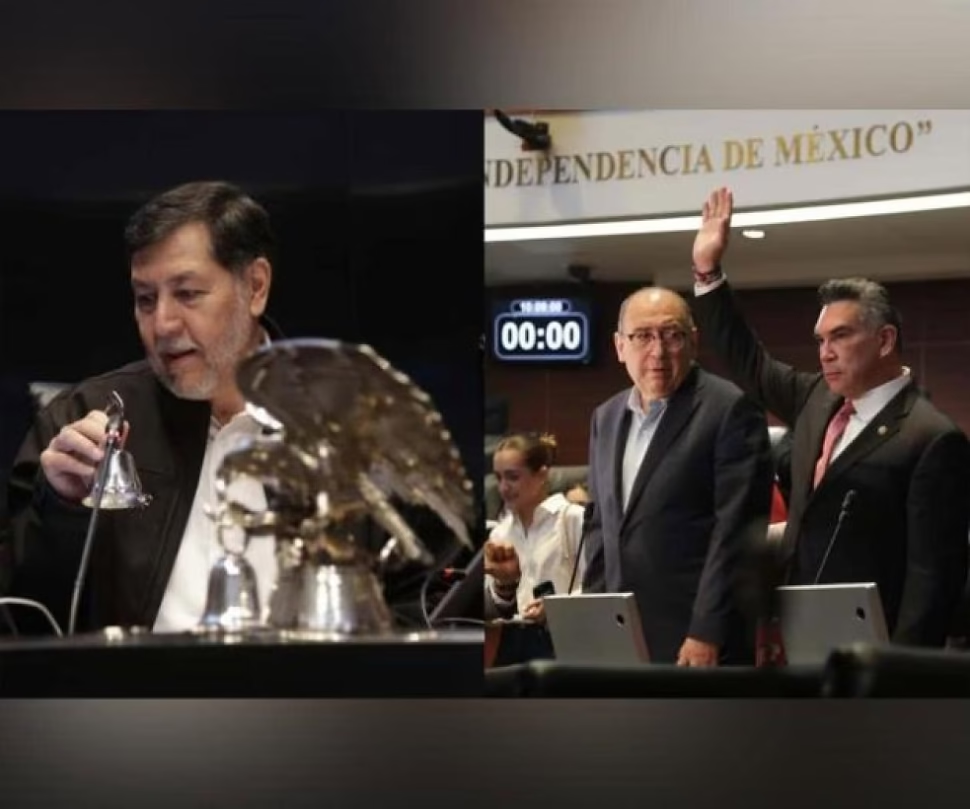
MEXICO CITY.- The heart of the Mexican legislative branch beat with a feverish and anticipatory rhythm. In an environment so dense that it could be cut with a knife, the extraordinary session of the Permanent Commission of the Congress of the Union, a call that resonated like a challenge launched by the still president of the Board of Directors, the always controversial Gerardo Fernández Noroña, began. But it wasn’t just any beginning; It was a scene woven with the threads of suspense and confrontation, dramatically marked by the absolute absence of the PAN, a void that screamed louder than any speech.
In contrast to this calculated silence, the physical presence of the leader of the Institutional Revolutionary Party, Alejandro Moreno, stood as a bastion of opposition. Since his arrival, he did not waste a single moment to launch a poisoned dart, vehemently questioning Morena’s bold proposal to evict from the sacred precinct the tricolor deputies who, according to the fine letter of the regulations, were not part of that legislative body. Each of his words fell like a glove of defiance on the floor.
A Scenario of Absences and a Battle of Narratives
The stage was set for an epic political battle. Watching weapons in a duel of titans, with the disturbing presence of only 20 of the 37 legislators who were to occupy their seats, the atmosphere was a mixture of expectation and contained tension. Fernández Noroña, the central protagonist of this drama, entered the plenary hall around 10 am. Breaking all predictions and completely contradicting his habit of facing the press, this time he did not offer any conference. His silence, enigmatic and heavy, fueled the intrigue that floated in the air.
However, the silence was broken with the reading of a statement, a document prepared by his own handwriting that carried the weight of indignation. With a voice that mixed pain and firmness, he condemned the brutal aggression of which he was a victim along with his photographer, the brave Emiliano González, transforming the venue into a court of honor. It was not only limited to the conviction; He reported, with the solemnity of someone demanding justice, that the corresponding complaints had already been filed with the authorities, a movement that elevated the struggle from the political to the judicial sphere.
Like a narrator reconstructing the chapters of a tragedy, he proceeded to give a detailed account of the events that shook last Wednesday’s session. Every detail, every gesture, every word spoken that day was revisited, giving an almost theatrical dimension to the events. Finally, he read out in full a statement of condemnation, a manifesto that sought not only to narrate the events, but also to fix in the collective memory a version of the events loaded with emotionality and drama. The session, far from being a mere legislative procedure, became the scene of a fight for narrative, power and legitimacy, where each actor played their cards with the mastery of a chess player in a game whose end no one dares to predict.
Do you think this episode will mark a turning point in the country’s political dynamics?Share this story on your social networks and join the conversation about the future of our democracy. Explore more content about the ins and outs of power in our politics section.