NGOs demand to stop expansion of works on Quintana Roo beaches

Environmental groups warn about a project that would modify 33.5 km of coastline without current studies, putting already vulnerable ecosystems at risk.

A Wake-up Cry in Paradise: The Battle for the Mexican Caribbean

In the heart of the dazzling Mexican Caribbean, where turquoise waters kiss white sands, an epic battle for the future is currently being waged. It is not a fight with conventional weapons, but with documents, laws and a citizen cry that reverberates from the depths of environmental consciousness. Civil society organizations and citizen groups have launched an urgent and dramatic call to the Ministry of Environment and Natural Resources (Semarnat), demanding that it deny an expansion that could trigger an ecological tragedy of incalculable proportions.

The object of this dispute is a phantom authorization, a permit issued in the distant days of 2009 for the rehabilitation of beaches in the iconic destinations of Cancun, Playa del Carmen and Cozumel. Now, the state government intends to resurrect and expand this decree, incorporating the virgin stretches of Puerto Morelos in a colossal project that would affect 33.5 kilometers of coastline. The danger, alert voices denounce, is that these monumental works could be carried out without the evaluation of a new executive project, and what is more serious, without an updated Environmental Impact Statement (MIA), a fundamental legal requirement.

RelatedExpansion of the Port of Veracruz challenges Supreme Court ruling

A Permission from the Past for a Present in Crisis

While Óscar Rébora, head of the Secretariat of Ecology and Environment of Quintana Roo, confirms the agonizing wait for a response from Semarnat for the first quarter of 2026, the organizations deploy their arguments like an army of reason. Giants of environmental defense such as the Mexican Center for Environmental Law (CEMDA), Greenpeace México, the Grupo Ecologista del Mayab (GEMA) and Healthy Reefs for Healthy People have joined forces. His statement is clear and forceful: the decision must be based on science, legality and transparency, not on ancient authorizations that are relics of a world that no longer exists.

And the coastal landscape has changed in a dramatic and heartbreaking way since 2009. The relentless rise in sea level, the accelerated erosion that devours the coasts, the massive sargassum invasions that suffocate the beaches and the silent deterioration of the reefs of the Mesoamerican Reef System are open wounds in the ecosystem. Executing pharaonic works without a comprehensive and regional environmental evaluation is not only negligence; It is, according to the groups, an act that could aggravate the problem to the point of no return, fatally affecting emblematic species such as sea turtles, lobsters, corals and coastal birds.

The shadow of legal and administrative risk also hangs over the project. The groups warn with a firm voice that the initiative does not comply with the sacred requirements of citizen participation established in the General Law of Ecological Balance and Environmental Protection (LGEEPA) and the transcendental Escazú Agreement, international treaties that Mexico has sworn to honor and that protect the human right to a healthy environment. The demand is a manifesto of hope: absolute transparency, application of the best available science and strict and reverential compliance with current environmental legislation.

The final call is a plan of salvation. They ask that any intervention consider, as a priority, the mitigation of impacts, sacrosanct respect for protected natural areas and constant and vigilant monitoring. Only in this way can we guarantee, in the midst of this historical crossroads, the protection of the fragile coastal ecosystem and the overflowing biodiversity that makes the Mexican Caribbean a miracle of the planet. The fate of this paradise hangs in the balance, and the authorities’ next move will write the next chapter: will it be one of conservation or irreversible loss?

Do you think that the voice of citizens and science should prevail over projects that threaten our natural heritage? Share this crucial story on your social networks to amplify the alert and explore more content about the defense of ecosystems on our platform.


Automotive employment recovery is shaping up for the third quarter

The Mexican automotive sector anticipates a rebound in hiring for the third quarter.

The automotive industry in Mexico projects an increase in personnel hiring between July and September. After several months of caution due to tariff adjustments with the United States, companies in the sector see signs of stabilization.

Reactivation signs

Data from Inegi indicate that in April the sector had 742 thousand workers, a reduction of 50 thousand jobs compared to the same month in 2025 and 107 thousand compared to two years ago. Despite the drop, recent indicators point to a recovery trend.

ManpowerGroup survey reveals that 37% of major automotive companies expect an increase in hiring during the third quarter. This figure exceeds the national average of 28% and reflects an operational reactivation after the uncertainty of previous quarters.

Key factors are new investments in the country: General Motors in Coahuila, KIA in Nuevo León and Audi in Puebla, in addition to the expansion of suppliers. These projects generate thousands of jobs in production, engineering and logistics.

Specialists warn that the recovery is still moderate and faces risks such as weakness in domestic consumption, trade uncertainty and a slowdown in investment. However, the growth in exports and vehicle sales in the first months of the year reinforces the expectation of a gradual improvement.

Continue reading

Prohibition Law in CDMX by match Mexico vs Ecuador

Alcohol restriction from 3:00 p.m. on June 30 until the morning of July 1.

Alcohol restriction measure in the Historic Center

The Government Secretariat of Mexico City published an agreement that suspends the sale of alcoholic beverages at all levels within a perimeter of the Historic Center and five surrounding neighborhoods. The measure applies from 3:00 p.m. this Tuesday, June 30 to 7:00 a.m. on Wednesday, July 1.

The affected areas are the “A” perimeter of the Historic Center and the Centro, Tabacalera, Juárez, San Rafael and Cuauhtémoc neighborhoods. The restriction applies to convenience stores, grocery stores and supermarkets that sell take-out drinks.

Exceptions and previous results

The consumption of alcohol in glasses with food inside establishments such as restaurants, party halls, hotels, private clubs, cinemas, theaters and auditoriums is exempt from compliance, as long as they have a neighborhood impact area in accordance with the law.

The Secretary of Government, César Cravioto, reported that the same measure applied during the match between Mexico and the Czech Republic last week was effective. He announced that the routes with the capital Police will be reinforced to avoid the consumption of alcohol in public during the meeting and subsequent celebrations.

Continue reading

Ten rescues in Mazatlán despite wave alerts

Adolescents from Coahuila, among those rescued by strong waves in Mazatlán.

Rescues on Mazatlán beaches

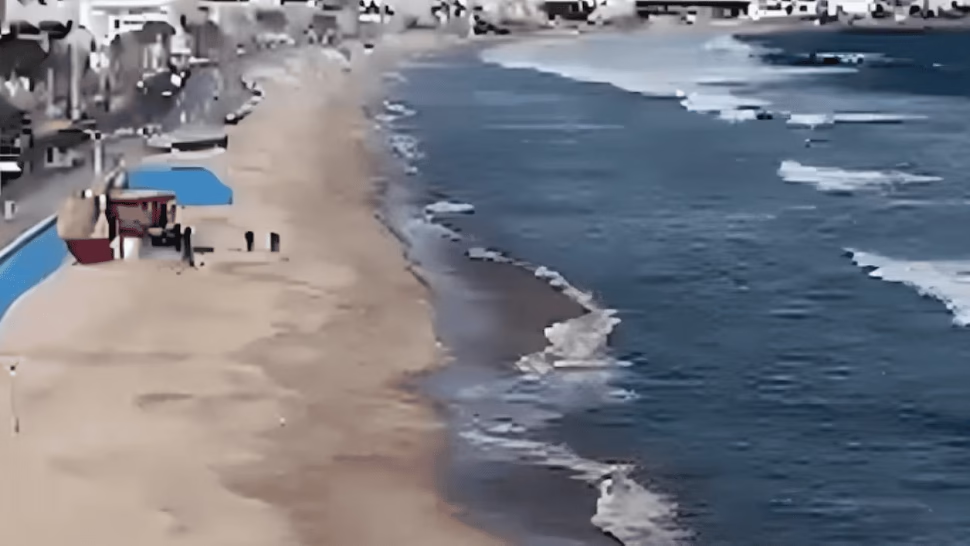
Despite warnings about intense waves and return currents, the Aquatic Rescue Squadron carried out ten new rescues of visitors in Mazatlán. Among those rescued, three minors from Coahuila.

On Sábalo Dos beach, witnesses saw the teenagers – ages 13, 14 and 17 – struggling to return to shore. They notified the authorities, who activated an operation. The young people were taken from the sea and treated by paramedics. They only presented exhaustion and anxiety attacks, according to Commander Gustavo Espinoza Bastidas.

The commander reiterated the importance of respecting the warning flags. “The strong waves are a real danger; they drag people out to sea,” he explained.

The rescues occurred on the beaches of Sábalos Uno and Dos, Norte Tres and Brujas. Five of those rescued were from Mazatlán. Two more visitors required medical attention for anxiety attacks.

In addition, seven men and one woman were arrested for disobeying the instructions of the lifeguards and disturbing public order. They spent the night on the railing.

Continue reading