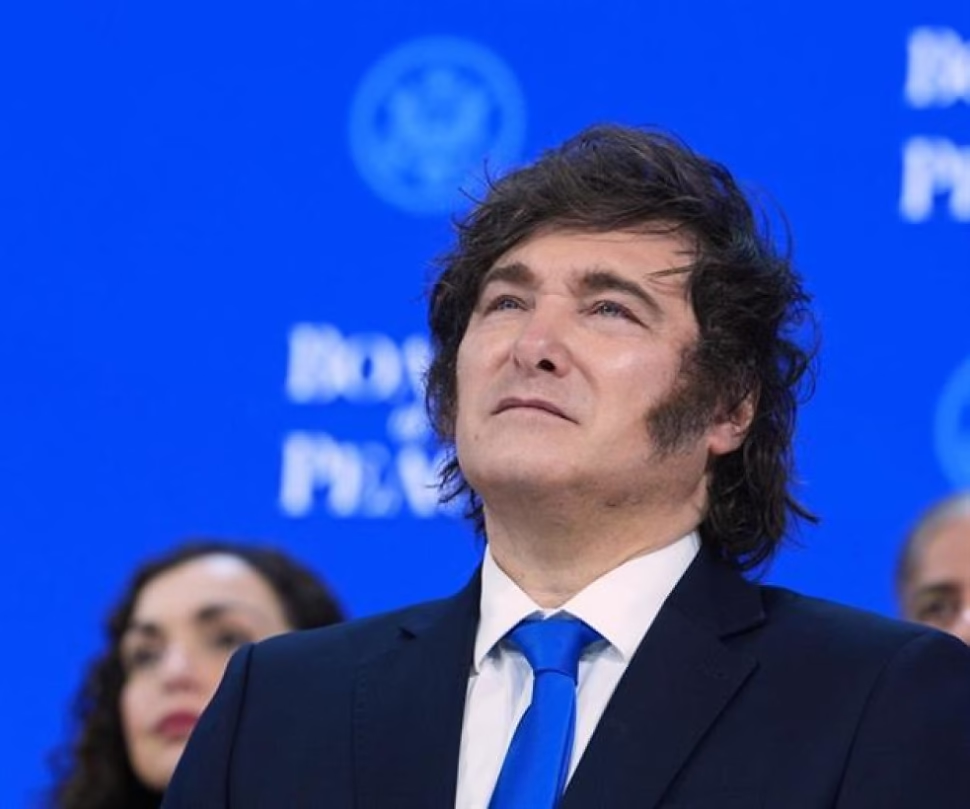
Milei and Trump sign trade agreement amid criticism

Argentina and the US seal a key trade pact, strengthening the alliance between Milei and Trump.

A pact with a personal seal

The photo of Argentine Foreign Minister Pablo Quirno’s smiling selfie in Washington says it all. This Thursday, Argentina and the United States announced a broad trade agreement that marks another milestone in the close—and very personal— alliance between Javier Milei and Donald Trump.

“Congratulations to our team and thanks to the team of the United States Trade Representative for building this great agreement together,” Quirno wrote on social media.

What really changes?

The framework, agreed to in November, is clear: Argentina lowers barriers for a long list of US imports. We talk about livestock, dairy, medicines, machinery. A direct blow to local industries that have been protected by high tariffs for decades.

RelatedMilei meets with Trump in a diplomatic turn to Washington

In exchange, the US would eliminate taxes on certain Argentine natural resources and pharmaceutical components. The final details of the pact signed this Thursday are not yet known. But the pattern is the same as always: Washington seeks to open Latin American markets for its products.

What is clear is the political context. This agreement is the most recent chapter in an ideological and strategic romance. Milei has completely reoriented Argentine foreign policy towards Washington.

Trump has reciprocated with enormous gestures. Last year it extended a $20 billion credit line that calmed markets at a critical time. The US Treasury even bought Argentine bonds considered ‘junk’ by rating agencies.

Criticism is not long in coming

This extraordinary intervention did not go unnoticed. It generated rejection throughout the North American political spectrum.

Trump’s base of followers questions rescuing a distant country that is also a direct competitor in grains and meat. Democratic legislators see a political use of taxpayer money to benefit an ideological ally.

Senator Elizabeth Warren, a powerful voice on financial issues, asked this Thursday to put an end to that million-dollar line of credit. In a letter, he argued that what was sold as urgent, short-term help appears to have become permanent.

Meanwhile, the personal relationship continues. Milei is scheduled to attend a gala at Trump’s Florida estate next week. The trade agreement is another piece on this geopolitical board where the economic and the personal are hopelessly mixed.
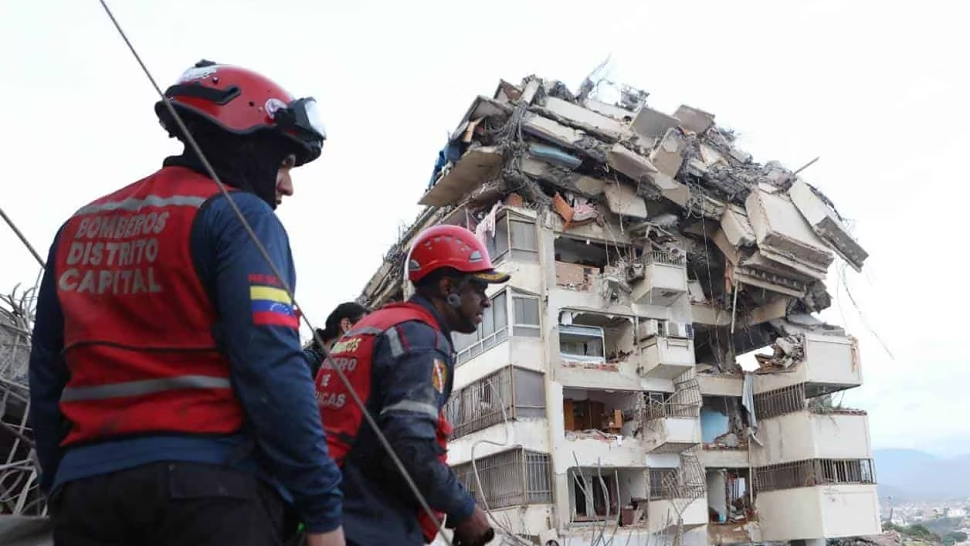
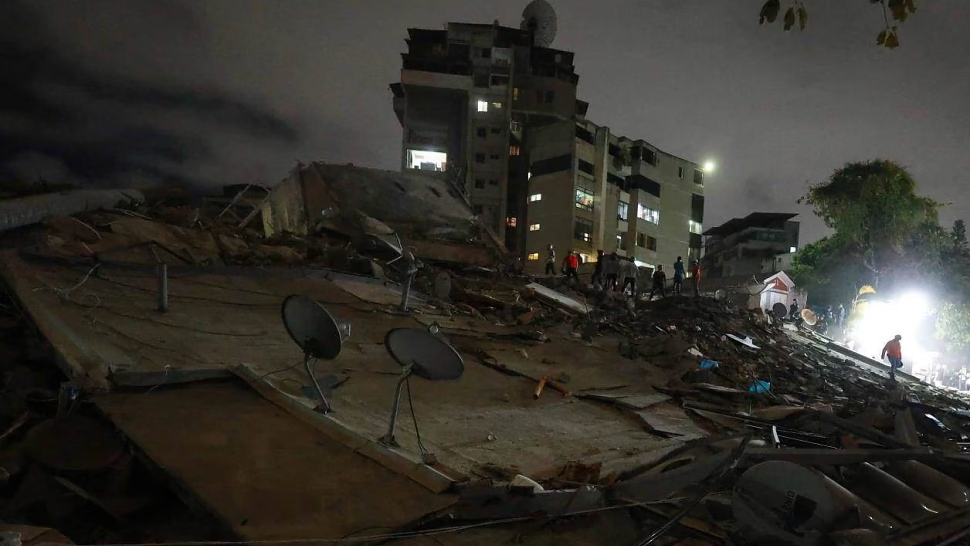
Rescuers improvise due to lack of equipment in La Guaira

Neighbors dig with their hands to rescue those trapped after the earthquake.

Freehand rescue in La Guaira

Twenty-seven hours after the earthquake, desperation is growing among the relatives of those still under the rubble. Rescue teams are scarce and lack machinery to move the mountains of concrete. In various parts of the city, the residents themselves dig with their bare hands, together with firefighters and volunteers.

Many of them maintained communication with their trapped loved ones, speaking to them to keep them conscious. As the hours passed, the voices became weaker until they died out forever.

“My wife couldn’t get there. She was bathing when the tremors hit. We tried to escape. I managed to get out of the building, but she fell, hit her head and was trapped. I know she was left naked, I would like to reach her, at least to cover her body,” said a visibly affected man through tears.

Urgent call

The situation is critical. Rescuers urgently need tools, heavy machinery and logistical support to continue their work. Meanwhile, the community organizes as best it can, moving debris with their own hands, in a race against time to find survivors.

Continue reading

UN reports 6.8 million people affected by earthquakes in Venezuela

UN preliminary evaluation estimates 6.8 million people affected in Venezuela.

UN Evaluation

After the two strong earthquakes that shook Venezuela on Wednesday, the International Organization for Migration (IOM) estimates that up to 6.8 million people could have been affected. According to the UN, approximately two million people reside in the Caracas metropolitan area alone. This is a preliminary evaluation that will be updated as work continues in the affected areas.

The IOM notes that the collapse of buildings and damage to essential infrastructure limits access to basic services. The priority remains the search for survivors in the rubble. UN agencies warn that the number of displaced people will increase as new damage is detected and the hardest hit areas are evacuated.

Government actions and international response

During a press conference, UN agencies reported that around twenty emergency hospitals in the states of La Guaira, Miranda, Aragua, Carabobo, Falcón, Zulia, Yaracuy and Lara, as well as in the Capital District, suffered structural damage.

The government of interim president Delcy Rodríguez requested the United Nations to send three emergency medical teams with surgical capacity. One of them has already left from the United States. Caracas also requested medicines, equipment and medical supplies, which the UN is acquiring and preparing for transfer via Panama or directly to Venezuela.

Continue reading

Double earthquake shakes Venezuela: more than 200 victims

Two consecutive earthquakes of magnitude 7.2 and 7.5 left 235 dead and thousands injured in northern Venezuela.

Venezuela faces emergency after double earthquake

Two powerful consecutive earthquakes shook northern Venezuela on Wednesday night, leaving at least 235 people dead and more than 4,300 injured, according to Health Minister Carlos Alvarado. The number could rise as rescue teams search for survivors in the rubble.

The United States Geological Survey (USGS) reported a first earthquake of magnitude 7.2 with an epicenter west of Morón, 170 kilometers from Caracas. Barely a minute later, a second magnitude 7.5 earthquake struck at a shallow depth, amplifying the destruction. The combination of surface movements intensified the damage, explained geophysicist Marcos Ferreira.

“It’s like I’m screaming and then someone starts screaming too. That amplifies the vibration and increases the potential danger,” Ferreira said.

The coastal region of La Guaira, north of Caracas, suffered the worst damage. The country’s main airport closed due to damage, complicating the arrival of aid. Residents like Dayana Delgado, a mother of three, asked about heavy machinery that the government had promised. Neighbors dug with their own hands.

“I would like to know where my child is, if he is trapped there or is he hanging around in a shelter,” she said about her 8-year-old son, who is still missing.

The president in charge, Delcy Rodríguez, declared a state of emergency and announced a reconstruction fund of 200 million dollars. He requested heavy machinery from private companies for rescue efforts. Teams from the Dominican Republic were already arriving, and more international help was expected.

The United States, through Secretary of State Marco Rubio, offered search teams, medical resources and logistical assistance. The Treasury Department temporarily waived sanctions until Oct. 23 to facilitate aid transactions. Governments of Mexico, Brazil, Spain, Qatar and others also promised shipments.

In Caracas, hundreds of people spent the night in open spaces for fear of aftershocks. Classes were suspended and some school buildings were converted into shelters. Electricity and cell service failed in several areas. Families began publishing lists of the missing while rescuers continued their work.

Continue reading