Microsoft begins the race for humanistic artificial superintelligence

The race for the most advanced AI intensifies with a new project that promises to put humanity at the center of technological control.

A New Dawn in the Battle for Artificial Intelligence Supremacy

In an epic twist that shakes the very foundations of the technology industry, Microsoft has drawn its sword and entered the arena, determined not to allow Meta to claim alone the titanic title of forging the first Artificial Superintelligence. From the shadows of Redmond, a new bastion of innovation has emerged: a cutting-edge laboratory whose sole and momentous purpose is to unravel the deepest mysteries of AI and achieve what many consider the holy grail of modern computing. The fate of humanity hangs in the balance, and this corporation has decided that it will be the one to weave it.

At the head of this technological crusade stands the figure of Mustafa Suleyman, a visionary whose mandate is clear and overwhelming: to direct this legion of brilliant minds towards the achievement of what they have baptized, with an almost prophetic resonance, as Humanistic Superintelligence (HSI). In a statement that reverberates with the force of a manifesto, Suleyman proclaimed: “At Microsoft AI, we are working to achieve Humanistic Superintelligence: incredibly advanced AI capabilities that always work in the service of people and humanity at large.” This is not a simple software update; It is an iron oath to the future of our species.

RelatedMicrosoft boosts AI in Windows 11 after ending Windows 10 support

The Humanist Oath: Control and Benefit for Humanity

But what secrets does this promise of superhuman intelligence hide? The manager revealed that this digital entity will have the ability to emulate, and even surpass, human performance in any conceivable field. However, in a twist that separates its vision from the most feared dystopias, its fundamental mission will be to solve real and concrete problems of human existence. This will not be an unbridled and autonomous force; It will be a meticulously calibrated instrument, an intelligence with defined limits and a deeply human context. “We want to explore and prioritize how the most advanced forms of AI can keep humanity in control,” Suleyman declared, drawing a line in the sand against fears of a machine rebellion. This is the path to confront our most pressing global challenges, a path where man, not machine, holds the reins of power.

The spark that lit the fuse of this monumental company was the previous announcement of Meta and its own ambitious SuperIA laboratory, an initiative backed by million-dollar investments and the recruitment of the most precious talents in the sector. Microsoft, with the elegance of a master chess player, not only admits that this is a competition, but raises the ante by proclaiming a higher purpose: forging a “humanistic” superintelligence. A beacon of hope whose name says it all, designed not for domination, but for the unquestionable benefit of humanity.

In a forceful rejection of apocalyptic narratives, the firm stated: “We reject narratives about a race towards Artificial General Intelligence (…) we reject the dichotomies of boom and bust; we are committed in the long term to providing tangible, specific and secure benefits to billions of people.” To realize this oath, Microsoft is assembling an elite team, a vanguard of experts whose skills span the entire spectrum of product development. The game has begun, and the world watches with a heavy heart.

Do you think this is the right path for the future of artificial intelligence?Share this news on your social networks and join the global conversation about the destiny of technology. Explore more content on the advances that are shaping our tomorrow.
World Cup 2026: the technology that will transform how you watch football

Data, AI and 3D avatars will change the fan experience at the trinational tournament.

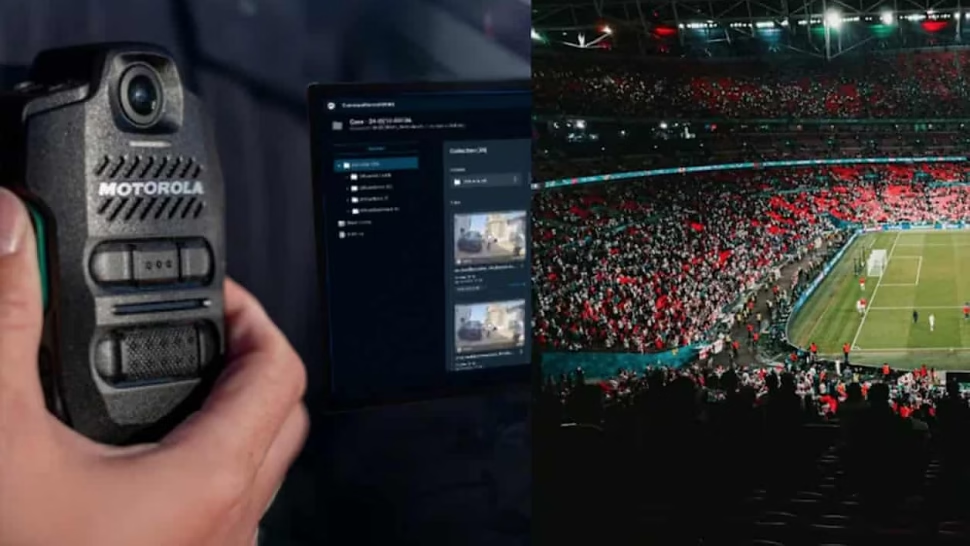
Almost 50 teams, three countries and more than one hundred matches. The 2026 World Cup will not only be the largest in history, but it will also transform the way we watch football from home. Artificial intelligence and advanced statistics will be the protagonists.

Tools like Football AI Pro, created with Lenovo, will help coaches prepare for matches and detect weak points. For the viewer, the data will be converted into graphs and summaries that explain what is happening on the court.

How the experience changes

In Qatar 2022, 12 cameras were already used to track the ball and 29 body points of each player 50 times per second. By 2026, that level of detail will be the norm. Stats will no longer be cold numbers: defensive lines, heat maps and movement patterns will be displayed.

In addition, the organization announced 3D avatars to recreate plays and referee decisions. Thus, tactical concepts such as high pressure or compact block will be visual and easy to understand.

The 2026 World Cup will maintain the excitement of goals and surprises, but with tools that allow us to better understand the game. Technology does not take away passion, but rather adds context.

Continue reading

Meta faces failures on Facebook, Instagram and WhatsApp

Users report intermittencies in Meta applications during the morning.

Failures in Meta services

Since this Wednesday morning, users of Facebook, Instagram, WhatsApp and Messenger reported interruptions in the operation of these platforms. The DownDetector site, which compiles crash reports, recorded an increase in complaints starting at 7:41 a.m.

According to the data, Facebook reached its peak of reports at 8:11 with 5,245 incidents. The main problems were concentrated in the application (47%), login (33%) and connection to the server (16%).

Messenger also had bugs. Its highest peak occurred at 7:48 with 260 reports. The most common difficulties were logging in (67%), the app (24%) and messaging (7%).

In the case of Instagram, reports increased until 8:20 with 326 complaints. 68% of users reported problems with the app, 14% with the connection to the server and another 14% with the login. The Tech Bit team confirmed difficulties when trying to publish stories, which could be related to the same bug.

WhatsApp, for its part, also suffered interruptions. 47% of the reports indicated problems with the web version, while 23% mentioned errors in the app and 16% in the login.

So far, Meta has not issued an official statement about the causes of these failures. Users are advised to stay tuned for updates.

Continue reading

Google integrates Gemini into Chrome for all of Latin America

Google expands its Gemini assistant in Chrome for users in the region.

Smart assistant comes to the browser

Google confirmed the expansion of Gemini, its assistant based on artificial intelligence, in Chrome for all of Latin America. Mexico is among the countries that already have access to this function, designed to simplify tasks within the search engine.

According to the company, Gemini helps users “understand information, stay organized, and complete tasks more easily.”

What does it allow you to do?

The integration eliminates the need to switch tabs to use the AI. In the upper right corner of Chrome the legend “Ask Gemini” appears.

With connections to Gmail, Maps, and Calendar, you can compose emails, check locations, and schedule meetings without leaving the current page. You can also compare products or summarize data from multiple open tabs. Google explains that “Gemini can understand the context between tabs and help you bring all the information together in one place.”

Additionally, Chrome incorporates AI-powered image editing tools, allowing you to transform photos directly from the browser with simple instructions.

Security and control

Google assures that these capabilities were “designed to always keep you in control” and developed with security as a priority. The models were trained to detect known threats, such as attempts to inject malicious instructions, in order to offer safer browsing.

The feature is now available for Chrome users in the region.

Continue reading