Mexico suffers a historic heat wave with temperatures of up to 45 degrees

The thermometer rebelled: this is how the heat will suffocate half the country, while the north gets wet.

Hell on earth (or why your fan can no longer cope)

If you thought that climate change was an invention of Netflix to sell documentaries, Conagua has just released a forecast that seems like an apocalyptic movie script: half of Mexico will become a convection oven this week, with temperatures that will make the Sahara look like a refreshing spa. Spoiler: your 2-liter water bottle won’t be enough.

States where the sun thirsts for revenge

From Sinaloa to Yucatán, passing through Guerrero and Chiapas, the thermometer will read between 40 and 45 °C. Yes, you read that right: enough to melt your ice cream before you get to Instagram it. And for the lucky ones in Baja California or Quintana Roo, don’t claim victory: 35-40 °C isn’t exactly an “autumn breeze” either.

RelatedMexico melts under historic heat wave

Meanwhile, the north of the country—always rebellious—decided to go against the (literal) current. Polar jet currents will bring heavy rains to Coahuila, because what would Mexico be without a climate chaos that no one understands?

CDMX: from the cool morning to the evening sauna

In the capital, the day will start with a chilly 14-16°C (perfect for that sweater you were no longer wearing), but by the afternoon, prepare for a sweltering 32°C and rain that could include hail—because nothing says “welcome to summer” like a hail on the head. Toluca, in an act of originality, will repeat the formula but with 10 °C less, confirming that Edomex continues to be that rare friend that never follows the trend.

The moral? If you don’t want to melt like ice cream on the pavement, hydrate yourself, seek shade as if you were a vampire and, for the love of your cell phone, don’t expose it to the sun. And if you see someone talking about “nice warmth,” ignore them: they’re clearly a reptilian.

Did you survive the heat wave? Share your photos of the thermometer on networks (with hashtag #AyCalor) and discover more climate content to plan your escape to the next city with public air conditioning.


Court analyzes whether decree on Frida Kahlo violates private property

The SCJN will review whether the 1984 decree that protects Kahlo's works is constitutional.

The SCJN reviews the decree that protects Frida Kahlo

The Supreme Court of Justice of the Nation (SCJN) will analyze the legality of the 1984 presidential decree that prevents the definitive export of works by Frida Kahlo. The plenary session admitted an injunction from the Ve por Más bank, owner of the oil painting Self-portrait with medallion, painted in 1948. The dispute pits the protection of cultural heritage against the right of private property.

Magistrate Giovanni Azael Figueroa promoted the case to establish whether the restrictions exceed the powers of the Executive. The Court will determine if the decree is constitutional.

Background: the Gelman collection

The review occurs in the midst of the debate over the Gelman collection, which includes 11 works by Kahlo loaned to Banco Santander. The Court’s resolution will set limits for future disputes over cultural property.

The ruling will be key to defining to what extent the State can intervene in the ownership of works considered national heritage.

Continue reading

IMSS and Fonacot update agreement to improve services for workers

IMSS and Fonacot renew their alliance until 2030 to streamline procedures and protect labor rights.

Strategic alliance for labor rights

The Mexican Social Security Institute (IMSS) and the National Fund for Workers’ Consumption (Fonacot) signed a collaboration agreement that updates their exchange of information and services. The objective: respond to the current operational, technological and regulatory needs of both agencies.

The agreement was signed by Wendolyne Retana Alarcón, general director of Fonacot, and Luisa Obrador Garrido Cuesta, director of Incorporation and Collection of the IMSS. It will be valid until September 30, 2030, with the possibility of extending it for two more years.

The relationship between both institutions dates back to 2007. Since then they have maintained a constant flow of data to facilitate procedures and guarantee better credit and social security conditions for working people.

With this update, the aim is to streamline processes, reduce response times and strengthen the protection of the rights of the country’s formal workers.

Continue reading

Energía Costa Azul makes first shipment of LNG in the Pacific

First shipment of liquefied natural gas from the Mexican Pacific marks an energy milestone.

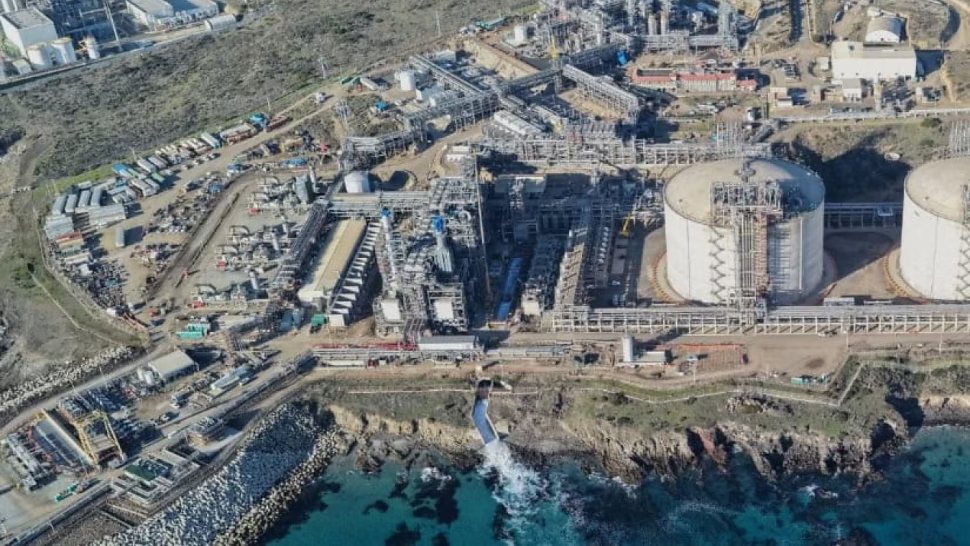
The Energía Costa Azul project, in Ensenada, Baja California, completed the first shipment of liquefied natural gas (LNG) from the Mexican Pacific coast. The Sempra Infrastructure company confirmed that the shipment is part of the tests prior to the start of commercial operations.

International context

This movement occurs in a context of high demand for energy security. Tensions in the Strait of Hormuz, through which nearly 20% of global LNG trade passes, have accelerated the search for new supply routes.

Strategic advantage

Sempra Infrastructure noted that phase 1 of the project will connect North American gas with Asian markets, taking advantage of the strategic location of the Mexican Pacific coast. Researcher Adrián Duhalt highlighted that the proximity to the gas-producing basins of the United States represents a competitive advantage for Mexico.

Continue reading