Mexico continues to be an amusement park for insecurity

The numbers don't lie: living in Mexico is still an extreme sport according to the latest survey.

Insecurity in Mexico? What a surprise! (nobody ever said)

It turns out that 61.9% of adults in Mexico’s main cities believe that living here is as safe as playing Russian roulette with a loaded revolver. INEGI data confirm what your common sense already screamed: the National Urban Public Security Survey (ENSU) is basically a scrapbook of our collective traumas.

Statistics that do not change… like hopelessness

Joy! The percentage barely rose 0.9% compared to last year. Progress? No, because statistically significant is what it is not. Like when your ex promises to change and only changes his phone number. Of course, in 18 cities there were movements worth mentioning: 7 improved (miracle) and 11 worsened (ah, tradition).

RelatedVerstappen reduces the gap but the title remains a mystery

And here is the most predictable fact since avocados are expensive: women feel more insecure (67.5%) than men (55%). Is it because we can’t walk two blocks without being hissed at like we’re lost dogs? Mysteries of life.

Top 6 cities where adrenaline is free

On the podium of places to think “will I be mugged today?” It is the daily bread:
Villahermosa (90.6% insecurity, almost an Olympic record)
Culiacán (89.7%, where drug traffickers are the official sponsor)
– Fresnillo, Uruapan, Irapuato and Chimalhuacán (because misery loves company)

Meanwhile, in San Pedro Garza García (10.4%) people must think that insecurity is a myth… or they simply live in a money bubble. Who knows?

Where do they rob you the most? Let’s play guessing!

ATMs (69.1% insecurity) win by a landslide, followed by public transportation (62.8%), where paying the ticket is the second most common way to lose money. The roads (56.1%) and even the banks (53.2%) complete this tour of fear. The message? In Mexico, even going to withdraw money is a high-risk sport.

And to top it off: 31.6% believe that insecurity will remain just as bad, 22.9% that it will get worse (optimistic, right?), and only 27.5% expect improvements. In other words, faith moves mountains, but it doesn’t even move statistics.

Did it outrage you? Did you identify yourself? Share it and let them know that we are not alone in this circus! Or better yet, discover more data that confirms what you already suspected in our related notes.
Massive security reinforcement and alcohol ban at the Azteca

56,000 police officers and alcohol restriction for the game at the Azteca.

Measures for the Mexico-Czech Republic match

The government of Mexico City announced an unprecedented security operation for this Wednesday’s game at the Azteca stadium. 56,000 personnel will be deployed, five times more than the 11,219 employed last week.

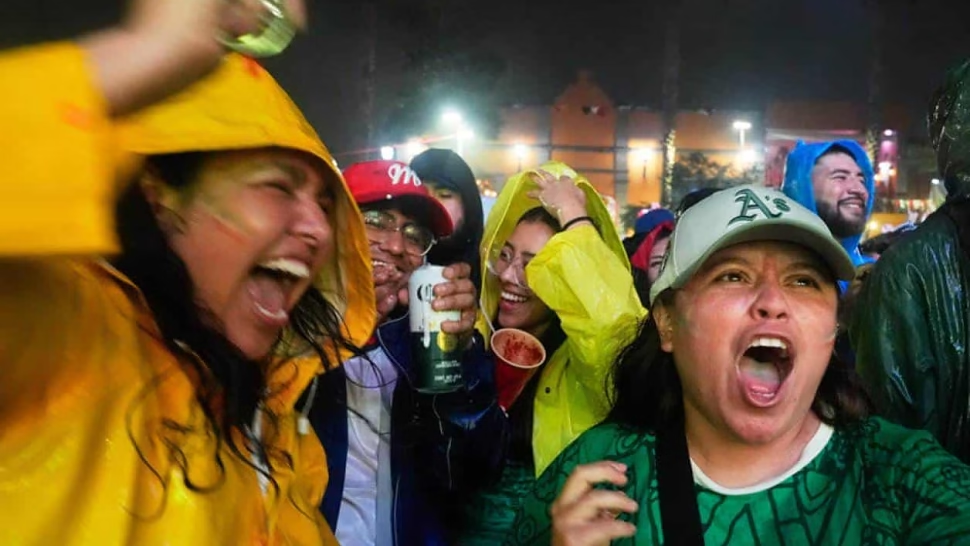
The decision responds to the celebrations of the previous Thursday, when some 700,000 people gathered in the capital after Mexico’s victory over South Korea. Although there were no injuries, nearly 40 tons of garbage were collected in the Ángel de la Independencia and the Zócalo.

The Secretary of Security, Pablo Vázquez, detailed that 7,500 police officers will guard the Azteca stadium. Another 3,275 will be in the Zócalo and 4,200 on Reforma Avenue. The objective is to protect players, referees, authorities and fans.

In addition, the Secretary of Government, César Cravioto, reported that starting at 3 p.m. on June 24, a ban on the sale of alcohol will take effect for sixteen hours. Applies to the Historic Center and five neighborhoods of Cuauhtémoc.

Sales will only be allowed in restaurants, hotels and private clubs, accompanied by food. Convenience stores and supermarkets are excluded. The fines for non-compliance amount to up to 293,275 pesos (about $17,251).

The Mexican Alliance of Transporters Organization (AMOTAC) called for mobilizations on highways in the 32 states and blockades in the capital to protest against the violence. The operation also considers these protests.

Continue reading

UNAM, new WHO collaborating center in oral health

The WHO recognizes UNAM as a reference in oral health and aging.

International recognition for UNAM

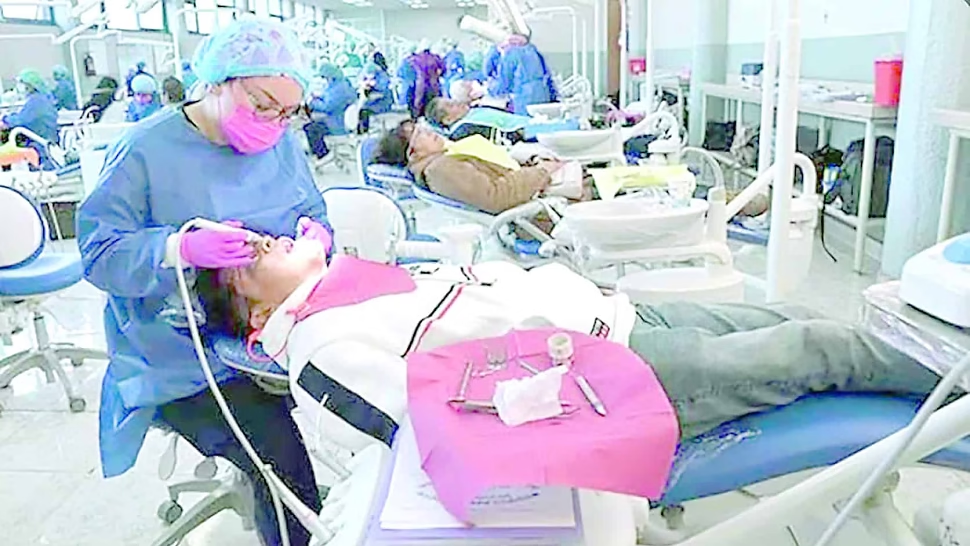
The World Health Organization (WHO) designated the Department of Oral Public Health of the UNAM Faculty of Dentistry as a Collaborating Center in Oral Health and Aging. The distinction is valid for four years.

With this appointment, the highest educational institution consolidates itself as a regional reference in the comprehensive care of older adults.

Implications of the appointment

The recognition will allow university specialists to participate in the development of public policies focused on improving the quality of life of the elderly.

In addition, they will promote strategies to promote among older adults and caregivers the importance of maintaining adequate oral health as an essential part of general well-being.

The designation places UNAM on a level of technical cooperation with the WHO, which opens opportunities to influence global guidelines on aging and oral health.

Continue reading

Digital sexual exploitation affects 1.6 million adolescents in Mexico

1.6 million adolescents in Mexico suffer online sexual exploitation every year.

The report reveals alarming figures

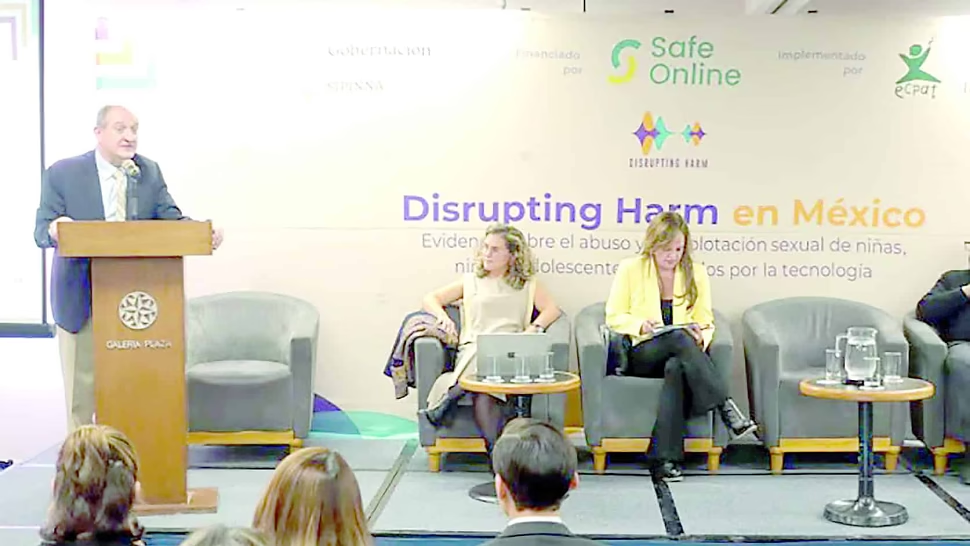
Unicef, ECPAT International and Interpol published the study “Disrupting Harm México”, which indicates that one in eight adolescent Internet users in the country – around 1.6 million – experienced sexual exploitation facilitated by digital technologies for a year.

67% of cases occurred online only, mainly on social networks and platforms. However, violence is not limited to the virtual sphere: in almost two out of every three situations, the victims knew their attackers, who were usually friends, partners or family members.

The report documents serious under-reporting. 32% of victims did not tell anyone what happened out of shame or fear, and less than 1% filed a formal complaint. This reflects normalization and silence around these attacks.

Consequences and call to action

In mental health, the consequences are profound. Those who suffered this type of violence are 15 times more likely to self-harm and 12 times more likely to have thoughts about their own death, compared to those who did not have that experience.

Fernando Carrera, Unicef ​​representative in Mexico, asked to reinforce prevention and responsibility of digital platforms. Lorena Villavicencio Ayala, from SIPINNA, stated that the State must guarantee the safety of girls, boys and adolescents in digital environments.

Continue reading