Mexico seeks tariff agreement for the automotive sector

Specialists analyze trade dependence and propose a strategic solution to US tariff pressure.

Analysis of the export reconfiguration of the Mexican automotive sector

For the Mexican automotive industry, reorienting the destination of its international shipments has represented a challenge of limited progress. Given the growing trade pressures from the United States, analysts agree that the most viable strategy is to negotiate a bilateral agreement of understanding on tariff matters, instead of attempting short-term market diversification, a task that has proven to be complex and with gradual results.

The most recent quantitative data from the Bank of Mexico (Banxico) offers a clear perspective on the situation. In the category of passenger cars and vehicles designed primarily for the transportation of people, the value of exports in June of this year constituted 76.7 percent of total shipments. This figure contrasts markedly with the 70 percent recorded in the same month of 2024, evidencing concentration, not diversification.

RelatedThe Mexican automotive industry is experiencing a rollercoaster of figures in 2025

Commercial dependence and slight variations in the markets

The analysis goes deeper by examining automotive parts and accessories such as bumpers, braking systems and gearboxes. Over the course of a year, the share of the United States as the main recipient of Mexican exports of these components experienced a moderate decrease, going from 92 percent to 88.2 percent. While this indicates a small movement, dependency remains overwhelmingly high.

In contrast, other international markets have remained practically static or have even seen their participation reduce as destinations for products of the Mexican automotive sector. A paradigmatic case is that of Canada, a nation with which Mexico shares the T-MEC agreement. June statistics for passenger vehicle exports remained unchanged, ranging between 11.2 and 11.8 percent.

The viability of an understanding agreement against market substitution

Osmar Zavaleta, research professor at the Egade Business School, provides a crucial strategic vision. Consider that in highly integrated and complex sectors such as the automotive industry, it is extremely difficult to consider replacing the destination of exports. Logistics infrastructure, just-in-time supply chains and regulatory frameworks are deeply interconnected.

Therefore, Zavaleta argues that it is more realistic and viable to concentrate efforts on finding an understanding with the United States. This position is based not only on the Mexican reality, but also on the evident American need for supplies, components and vehicles manufactured in Mexico, which are fundamental for its own industry. A tariff war would hurt both sides of the border.

The researcher emphasizes the need for a focused analysis: “I think what we should be observing is how demand is behaving for the products in which Mexico has developed excellent capabilities. There is the automotive sector, metal-mechanical, household goods, medical devices and, in some way, the agro-industrial sector.”

This perspective leads to a strategic conclusion. For the academic, the key lies in precisely identifying those specific sectors in which Mexico has established itself as a world-class specialist cluster. This diagnosis must be combined with the identification of the needs of the countries with which there are already trade agreements and which, simultaneously, are also subject to the vagaries of the trade policy of the United States. Only through this detailed mapping of capabilities and demands will it be possible to achieve genuine growth in new export markets in the medium and long term, without neglecting the essential relationship with the main trading partner.

Did you find this analysis of the complex Mexico-United States trade relationship useful?Share this article on your social networks to expand the conversation and help others understand these crucial economic issues.Explore more content related to international trade and the USMCA on our website.

Intentional injuries against women in Mexico reach historical record

June recorded the second highest number of female victims of intentional injuries: 7,476.

Violence against women: intentional injuries at their highest point

June closed with 7,476 women victims of intentional injuries throughout the country. It is the second highest figure since the National Public Security System began this registry in 2015. In May alone, the entire record was surpassed with 7,940 victims.

On average, every day last month 249 women aged 30 or older suffered this crime. The entities with the highest rate per 100 thousand inhabitants are: State of Mexico (148.9), Guanajuato (135.8), Aguascalientes (128), Baja California Sur (100), Hidalgo (92), Michoacán (86) and Sinaloa (77.9).

42 thousand victims in six months

From January to June of this year there are 42,021 women intentionally attacked. The report is prepared based on the investigation folders initiated by the state prosecutor’s offices. Ministerial authorities and human rights organizations consider that intentional injuries are a preliminary step to homicide or feminicide.

Family violence is also increasing

In June, 25,031 investigation folders for family violence were opened, the second highest number in the same period. Among the cases, that of the former director of Pemex, Víctor Padilla, stands out, who was linked to proceedings for attacking his wife and his minor son. However, he regained his freedom after a few days in the Atlacholoaya prison, Morelos.

The report from the National Public Security System reveals that violence against women does not subside. The figures demand urgent measures from the states with the highest incidence.

Continue reading

They discover a tunnel to extract illegal fuel in Mineral de la Reforma

They find clandestine infrastructure connected to the Pemex pipeline in a state operation.

Tunnel found for hydrocarbon theft

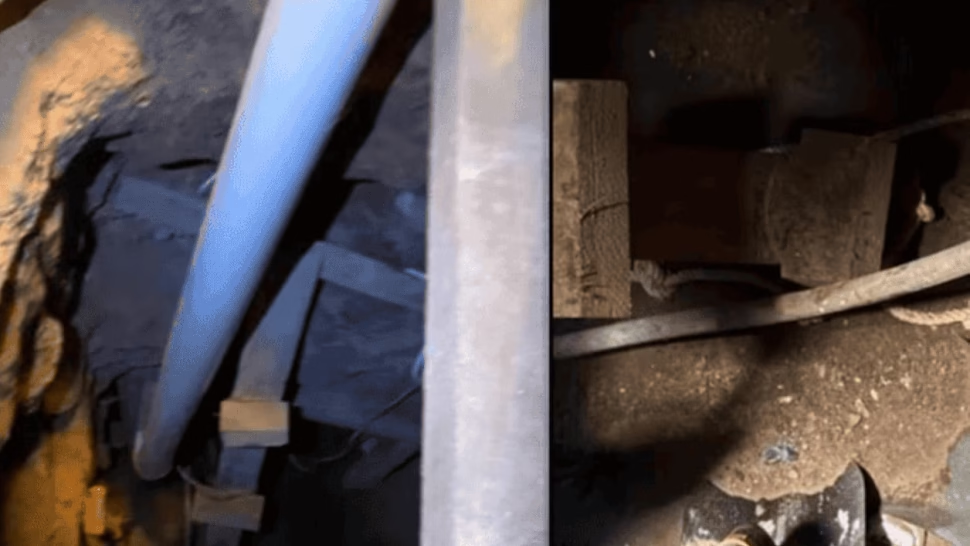
Elements of the Hidalgo Public Security Secretariat (SSPH) located a tunnel used for the illegal extraction of fuel on a property in the El Saucillo neighborhood, in Mineral de la Reforma.

The discovery occurred after a citizen complaint. Agents carried out an operation that led to the arrest of five people and the seizure of three properties. They also seized approximately 500 meters of high-pressure hose and doses of alleged drugs.

The detainees tried to flee when they noticed the police presence, but were captured. As part of the investigations, three searches were carried out. In one of the properties, a tunnel six meters deep and 50 meters long was found, connected to a Petróleos Mexicanos (Pemex) pipeline to illegally extract hydrocarbons.

In another property there was a warehouse that was allegedly used to store the extracted fuel. The secured hose was used for clandestine intakes.

The actions were coordinated by the SSPH, the Attorney General’s Office of the State of Hidalgo (PGJEH), the Secretariat of National Defense and the National Guard. The detainees were placed at the disposal of the Federal Public Ministry, which will integrate the corresponding investigation folders.

With this discovery, during the current state administration there are 19 tunnels located in Hidalgo intended for the theft of hydrocarbons. These have been detected in municipalities such as Cuautepec, Pachuca, Tepeji del Río, Tlanalapa, Tlaxcoapan, Tula, Mineral de la Reforma, Tepeapulco, Tepetitlán, Nopala and Atitalaquia.

Continue reading

SEP rejects militarized education after tragedy in Tamaulipas

The SEP clarifies that militarized education is not authorized after the death of a minor in Tamaulipas.

SEP reiterates ban on military education

The Ministry of Public Education (SEP) stated that education under military or military modalities is not permitted in Mexico. The statement came after the death of a teenager at a summer camp with military characteristics in Ciudad Madero, Tamaulipas.

The head of the SEP, Mario Delgado Carrillo, condemned attempts to justify acts of violence or mistreatment with the argument of a supposed military education. He pointed out that these practices are not training methods and violate the human rights of children and adolescents.

Through a statement, the agency clarified that no basic education institution is authorized to teach teachings labeled as military or military. He explained that military education is exclusive for personnel of the Armed Forces and the National Guard.

Regarding the incident, state educational authorities will take measures to protect the rights of minors. According to family testimonies, the teenager entered the camp on July 13 in good health and days later she was reported fainted after a fall. The minor died inside the facilities.

The SEP reiterated its rejection of any practice of abuse or degrading treatment against minors. The case has generated a call to review supervision mechanisms in extracurricular activities.

Continue reading