Mexico recovers 17 thousand archaeological pieces from abroad

The pace of repatriations exceeds that of Peña Nieto's six-year term by ten times.

Record repatriation and museum reopening

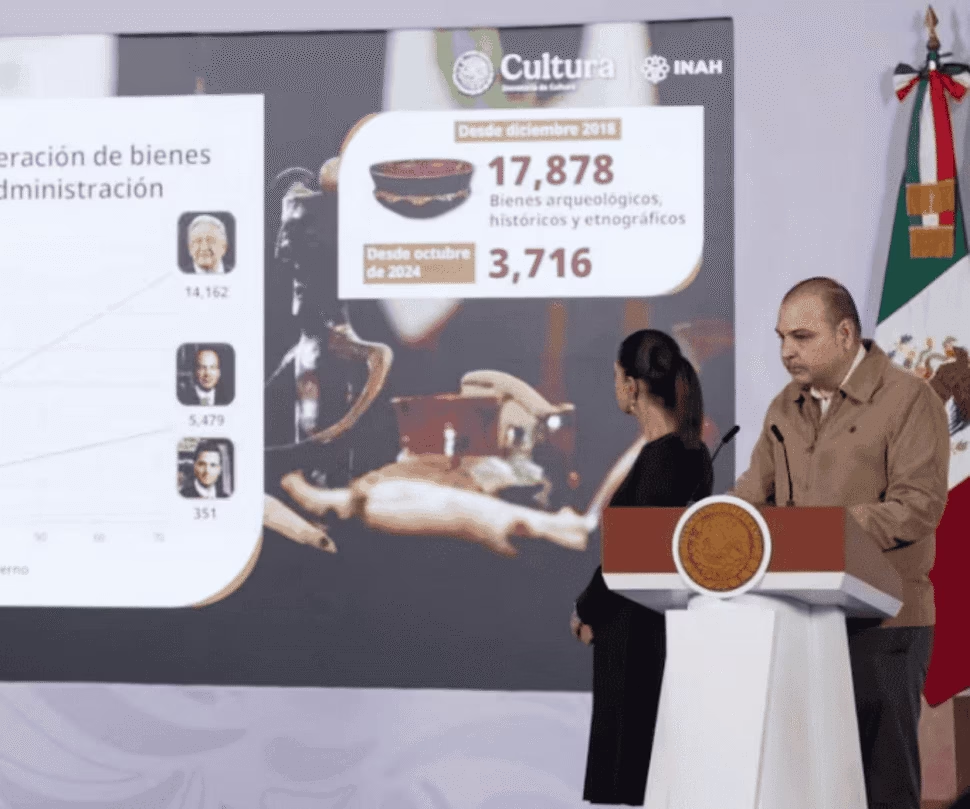
President Claudia Sheinbaum highlighted that archaeological pieces recovered abroad are being returned to their communities of origin. According to the INAH, under federal foreign policy, 17,878 cultural assets have been recovered, of which 3,716 correspond to the current administration.

The Secretary of Culture, Claudia Curiel de Icaza, pointed out that the restitution is carried out in coordination with the Ministry of Foreign Affairs through international alliances.

RelatedMexico recovers 3,716 archaeological and historical pieces in 21 months

The director of the INAH, Joel Omar Vázquez Herrera, explained that the rate of repatriations exceeds that registered by Enrique Peña Nieto’s six-year term by ten times and that carried out under Felipe Calderón by 68 percent. From 2024 to date, the countries that have returned the most objects are the United States (3,369 pieces), followed by Italy, Canada, France and Spain.

As part of strengthening the heritage, the Museum of Teotihuacan Grandeza reopened its doors after being closed for two decades. The investment was 7 million pesos for architectural and museum restoration. It exhibits 174 pieces—80 percent never shown before—and has received more than 25,000 visitors since June.

Finally, the Undersecretary of Cultural Development, Marina Núñez Bespalova, presented the “Original Workshop” project, which will train artisans to sell their works at the Los Pinos Cultural Complex starting in November, under a fair trade tabulator designed by the communities.

Intentional injuries against women in Mexico reach historical record

June recorded the second highest number of female victims of intentional injuries: 7,476.

Violence against women: intentional injuries at their highest point

June closed with 7,476 women victims of intentional injuries throughout the country. It is the second highest figure since the National Public Security System began this registry in 2015. In May alone, the entire record was surpassed with 7,940 victims.

On average, every day last month 249 women aged 30 or older suffered this crime. The entities with the highest rate per 100 thousand inhabitants are: State of Mexico (148.9), Guanajuato (135.8), Aguascalientes (128), Baja California Sur (100), Hidalgo (92), Michoacán (86) and Sinaloa (77.9).

42 thousand victims in six months

From January to June of this year there are 42,021 women intentionally attacked. The report is prepared based on the investigation folders initiated by the state prosecutor’s offices. Ministerial authorities and human rights organizations consider that intentional injuries are a preliminary step to homicide or feminicide.

Family violence is also increasing

In June, 25,031 investigation folders for family violence were opened, the second highest number in the same period. Among the cases, that of the former director of Pemex, Víctor Padilla, stands out, who was linked to proceedings for attacking his wife and his minor son. However, he regained his freedom after a few days in the Atlacholoaya prison, Morelos.

The report from the National Public Security System reveals that violence against women does not subside. The figures demand urgent measures from the states with the highest incidence.

Continue reading

They discover a tunnel to extract illegal fuel in Mineral de la Reforma

They find clandestine infrastructure connected to the Pemex pipeline in a state operation.

Tunnel found for hydrocarbon theft

Elements of the Hidalgo Public Security Secretariat (SSPH) located a tunnel used for the illegal extraction of fuel on a property in the El Saucillo neighborhood, in Mineral de la Reforma.

The discovery occurred after a citizen complaint. Agents carried out an operation that led to the arrest of five people and the seizure of three properties. They also seized approximately 500 meters of high-pressure hose and doses of alleged drugs.

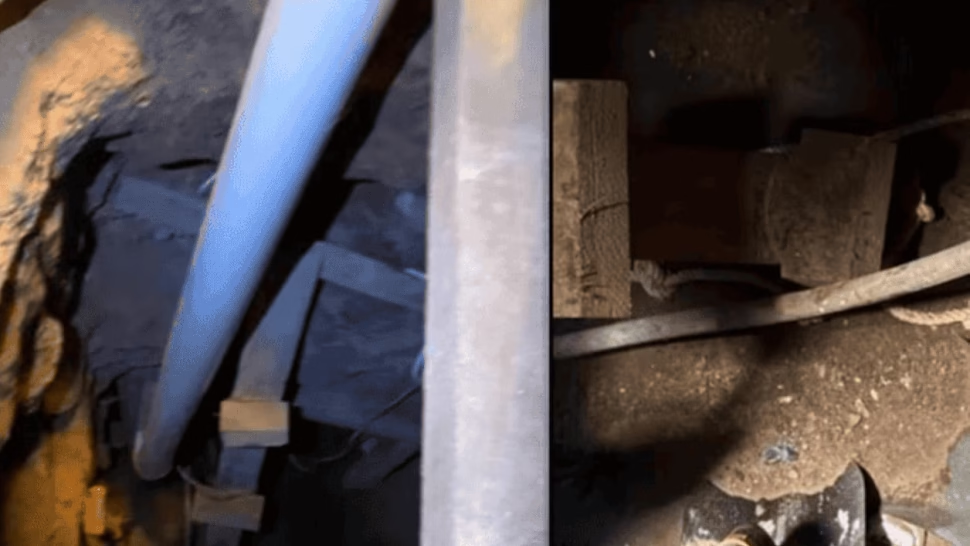
The detainees tried to flee when they noticed the police presence, but were captured. As part of the investigations, three searches were carried out. In one of the properties, a tunnel six meters deep and 50 meters long was found, connected to a Petróleos Mexicanos (Pemex) pipeline to illegally extract hydrocarbons.

In another property there was a warehouse that was allegedly used to store the extracted fuel. The secured hose was used for clandestine intakes.

The actions were coordinated by the SSPH, the Attorney General’s Office of the State of Hidalgo (PGJEH), the Secretariat of National Defense and the National Guard. The detainees were placed at the disposal of the Federal Public Ministry, which will integrate the corresponding investigation folders.

With this discovery, during the current state administration there are 19 tunnels located in Hidalgo intended for the theft of hydrocarbons. These have been detected in municipalities such as Cuautepec, Pachuca, Tepeji del Río, Tlanalapa, Tlaxcoapan, Tula, Mineral de la Reforma, Tepeapulco, Tepetitlán, Nopala and Atitalaquia.

Continue reading

SEP rejects militarized education after tragedy in Tamaulipas

The SEP clarifies that militarized education is not authorized after the death of a minor in Tamaulipas.

SEP reiterates ban on military education

The Ministry of Public Education (SEP) stated that education under military or military modalities is not permitted in Mexico. The statement came after the death of a teenager at a summer camp with military characteristics in Ciudad Madero, Tamaulipas.

The head of the SEP, Mario Delgado Carrillo, condemned attempts to justify acts of violence or mistreatment with the argument of a supposed military education. He pointed out that these practices are not training methods and violate the human rights of children and adolescents.

Through a statement, the agency clarified that no basic education institution is authorized to teach teachings labeled as military or military. He explained that military education is exclusive for personnel of the Armed Forces and the National Guard.

Regarding the incident, state educational authorities will take measures to protect the rights of minors. According to family testimonies, the teenager entered the camp on July 13 in good health and days later she was reported fainted after a fall. The minor died inside the facilities.

The SEP reiterated its rejection of any practice of abuse or degrading treatment against minors. The case has generated a call to review supervision mechanisms in extracurricular activities.

Continue reading