Mexico provides 60% of the agricultural workforce in the United States

Mexican labor supports much of American agricultural production, even in conservative states.

US dependence on Mexican workers in the agricultural sector

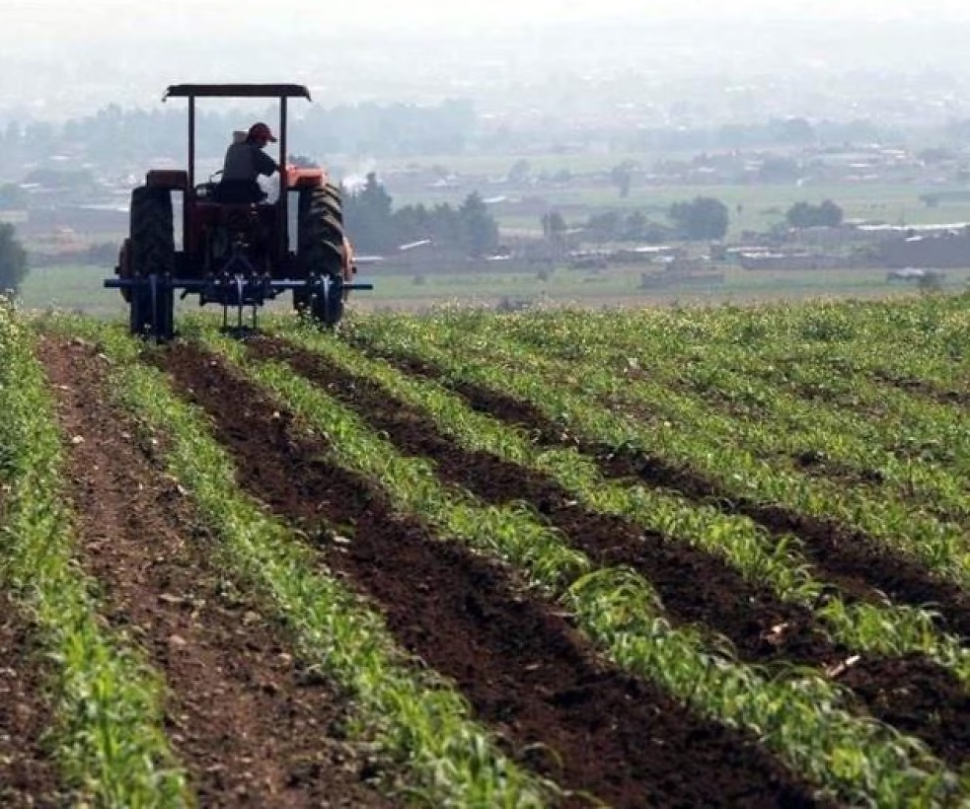
According to data revealed by Julio Berdegué, Secretary of Agriculture and Rural Development of Mexico, 60% of employees in the American countryside are of Mexican origin. This figure underlines the critical dependence of the northern neighbor on migrant labor to keep its agricultural sector operational.

Republican states lead the demand for H-2A visas

It is paradoxical that traditionally conservative states such as Florida, Louisiana and Kentucky top the list of territories that most request foreign workers through the H-2A temporary visa program. In 2024 alone, these three states granted 103,965 permits, equivalent to 26.2% of the national total, according to records from the United States Citizenship and Immigration Services (USCIS).

RelatedTrump’s immigration crackdown impacts the US labor market

Berdegué highlighted on social networks: “American agriculture depends largely on honest Mexicans who contribute to its economy and feed their families. They are not criminals, they are workers!”. This message seeks to counteract the anti-immigrant narrative prevalent in certain political sectors.

Exponential growth of the H-2A program

Between 2018 and 2024, the issuance of temporary agricultural visas experienced an increase of 79%. The ten states with the highest demand were:

  • Florida
  • California
  • Georgia
  • Oregon
  • North Carolina
  • Washington
  • Virginia
  • Michigan
  • Louisiana
  • Kentucky

Republican officials such as Sid Miller, Texas Agricultural Commissioner, have publicly expressed their interest in expanding this program, recognizing its importance for the economic viability of the sector.

Political context and migratory tensions

This debate occurs amid growing protests against former President Donald Trump’s immigration policies. The previous Sunday, protesters in Los Angeles blocked roads and set vehicles on fire, which led to the deployment of 2,000 National Guard troops, who used tear gas and rubber bullets to disperse the protesters.

Analysts point out that this contradiction between economic need and political rhetoric could intensify in the electoral context, where the immigration issue continues to be polarizing.

Economic impact and future prospects

Without the participation of Mexican day laborers, estimates indicate that The United States would face losses of more than 15% in its annual agricultural production, with cascading effects on consumer prices and exports. Experts recommend:

  1. Modernize temporary hiring processes
  2. Establish binational agreements to protect labor rights
  3. Delink immigration policies from electoral cycles

Are you surprised by this economic reality? Share this analysis to make visible the essential contribution of migrant workers. Explore more content on global economy and migration on our portal.

Merlin Duck already has a commemorative National Lottery ticket

Merlin the duck, symbol of the 2026 World Cup, immortalized on a National Lottery ticket.

The National Lottery presented the commemorative ticket of the Superior Draw No. 2891 with the image of the Merlin duck, the bird that became a symbol of Mexican culture during the 2026 World Cup celebrations. The head of the organization, Olivia Salomón, unveiled the design together with the owner of the duck, Karla Ivette Gómez López, and her children Cristian and Carlos Gómez.

The bill shows Merlin, a two-year-old Peking duck, with his characteristic Mexican National Team shirt and white plumage. The institution explained that the image seeks to represent collective memory and national identity.

“Merlin ended up representing something much bigger: the joy of a people and that nearby Mexico that conquered the heart of the world,” said Olivia Salomón.

Merlin went viral when he was filmed wearing his t-shirt while accompanying his family to sell water on the streets of the capital. Its popularity reached President Claudia Sheinbaum, who recognized the bird. In addition, the duck is already a registered trademark: on June 26, its owner received the certificate from the Mexican Institute of Industrial Property (IMPI) and the Ministry of Economy.

“Merlin never conquered people because he was a duck, he conquered them because there was always a Mexican family behind him,” added Salomón, who paid tribute to Karla Ivette for representing many working women.

Raffle details

The Superior Draw No. 2891 will be held on Friday, July 24, 2026. 2.4 million pieces went on sale, with a Grand Prize of 17 million pesos in two series and a distributable bag of 51 million pesos in prizes.

Karla Ivette thanked the affection and highlighted that this tribute represents all the working families in Mexico who seek daily sustenance.

Continue reading

Mexico recovers 3,716 archaeological and historical pieces in 21 months

In less than two years, Mexico has repatriated 3,716 pieces, surpassing previous efforts.

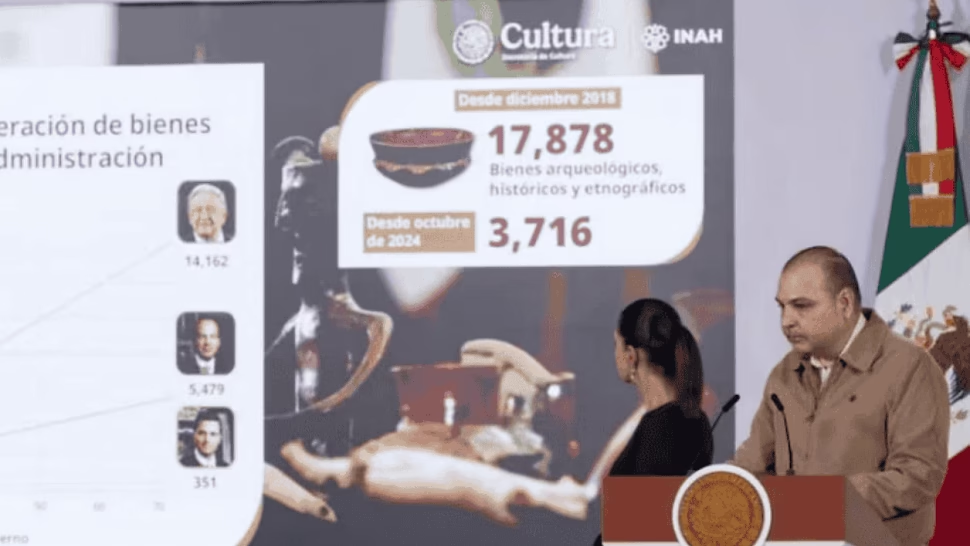
The National Institute of Anthropology and History (INAH) reported the recovery of 3,716 archaeological and historical assets in one year and nine months of the current administration. This was reported by its director, Joel Omar Vázquez Herrera, during the morning conference at the National Palace.

The official attributed the achievement to the coordinated work between the government of Mexico, the Ministry of Culture and the Ministry of Foreign Affairs. The strategy promoted by President Claudia Sheinbaum has strengthened dialogue with other countries to return pieces that are part of the national memory and identity.

“We are working hard to recover and repatriate the memory, the identity of the people of Mexico based on permanent dialogue with different governments of the world,” said Vázquez Herrera.

Figures that make a difference

The current numbers contrast with previous administrations. During the six-year term of Enrique Peña Nieto, 351 pieces were recovered; the current figure is 10 times higher. It also represents 68% of what was obtained during the Felipe Calderón government, when 5,479 assets were returned. During the six-year term of Andrés Manuel López Obrador there were 14,162, adding since the beginning of the Fourth Transformation a total of 17,878 repatriated objects.

The United States is the main country of origin, with 3,369 recovered pieces. They are followed by Italy (174), Canada (133), France (19) and Spain (7).

Emblematic pieces

Among the most relevant assets is a skull covered with turquoise mosaics, of Mixtec origin, repatriated from the Netherlands and already on display in Villa de Tututepec, Oaxaca. Also a Mayan carved panel from Yaxchilán, Chiapas, depicting the ruler Pájaro Jaguar, recovered in New York. Also, a Mexican basalt sculpture, also from New York.

In historical heritage, the “Manual of ceremonies of the Province of the Holy Gospel of Mexico” was recovered, a Franciscan document printed at the beginning of the 18th century, secured by the Federal Police of Argentina and returned to Mexico.

“We are going to continue with this effort and determination to recover the memory, identity and belonging of the ancient peoples that give meaning to contemporary generations,” stated the director of INAH.

Continue reading

Sheinbaum announces telephone alert for El Niño rains

Federal government activates telephone alert due to intense rains due to El Niño. Coordination with 32 states.

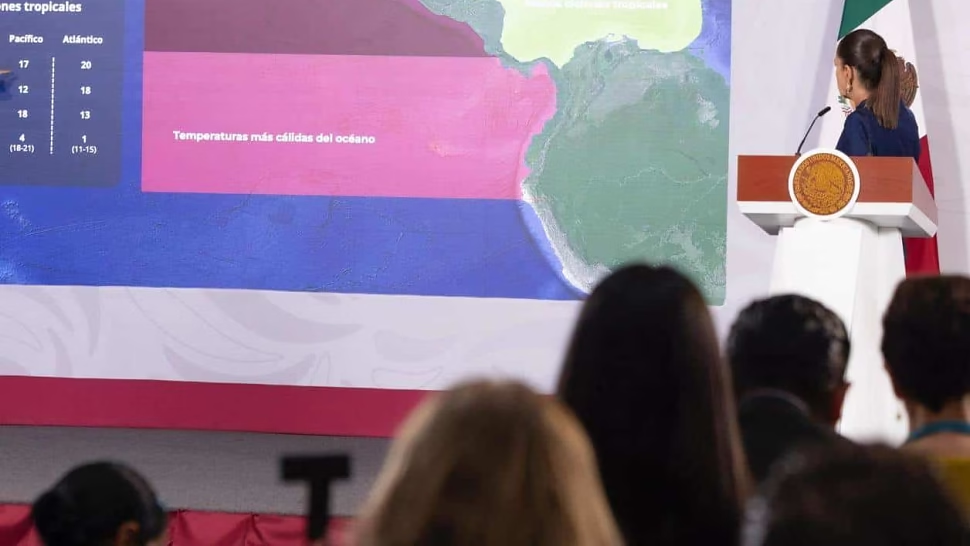
President Claudia Sheinbaum reported that in approximately two months a telephone alert system will be ready to notify the population about meteorological phenomena. The measure is part of the preventive actions against the intense rains that the El Niño phenomenon will bring.

“The objective is that in two months or so we will have the telephone alert ready so that all people, all Mexicans, can be informed,” he stated during the morning conference.

The system is developed in coordination with the Digital Transformation and Telecommunications Agency, the National Civil Protection Coordination and the National Meteorological Service.

Risks of the climate phenomenon

Fabián Vázquez Romaña, coordinator of the SMN, explained that El Niño—an interaction between atmospheric and oceanic temperatures that repeats every two to seven years—has a 63% probability of being very intense. The highest peak is expected to occur in December of this year and continue until 2025.

The consequences include heavier rain in the north of the country towards the end of the year, a greater probability of intense cyclones and possible drought in the center during the next year. “Whether the cyclones are going to reach the coast or not, we cannot know until a few days before,” he warned.

Actions in territory

Laura Velázquez, head of Civil Protection, explained that Command Posts are installed in the 17 coastal states. So far there are 11 formed; the rest will be completed next week. In addition, river and dam desilting, channel opening and barrier placement are carried out.

The agency maintains updated maps, monitors shelters and deploys teams throughout the country to serve the population. Coordination includes the 32 states, legal and expanded cabinets, and the National Water Commission.

Continue reading