Mexico extradites alleged CJNG launderer to the United States

An alleged cartel financier travels to Kentucky to face US justice for moving illicit capital.

A Knight of Illicit Finance Takes an International Flight

It seems that the American dream is more alive than ever, even for certain entrepreneurs… in the non-conventional financial services sector. In a move that surely surprised absolutely no one, the Attorney General’s Office (that institution that we sometimes remember exists with news like this) decided to play international parcel players. Your package today, labeled “fragile” and “handle with care, contains broken illusions of impunity,” was Mr. Carlos Erick Vázquez González. The recipient: none other than the United States Government. The reason? An alleged and very creative career as an accountant for the Jalisco New Generation Cartel (CJNG). Because, let’s face it, what is a drug trafficking empire without a good laundry department… of money?

Our protagonist, Carlos Erick, was not a mere hitman. Oh no. Those are cannon fodder, the rabble. He operated in the elegant and ethereal corridors of banking transactions. Their alleged specialty: making millions of dollars, earned from the gleeful sale of substances that brighten and destroy lives, look as legitimate as a bakery business. His story is a reminder that in modern organized crime, he who distributes the merchandise is as important as he who gives the profits a wash, ironed and ready to use without arousing suspicion.

RelatedThey capture an alleged money launderer linked to the El Chapo cartel

The Unfinished Talent in the Art of Money Laundering

Mr. Vázquez González is urgently required by a federal court in Kentucky. Not for a horse derby contest, but to answer for two most sophisticated crimes: criminal association and money laundering. His alleged modus operandi was almost poetically beautiful in its simplicity: receiving the dirty bills resulting from drug trafficking and then, with the elegance of a juggler, making them disappear in a choreography of transfers between accounts. The objective, the boring court records tell us, was to “conceal its illicit origin.” Come on, I wanted to give that money an accelerated master’s degree in respectability, a crash course in appearing clean when deep down it smelled of gunpowder and desperation.

It’s funny, isn’t it? While you and I are racking our brains declaring every last cent to the Treasury, there are financial geniuses like Carlos Erick who turn money laundering into an art. Or, at least, in a job that, until you get caught, seems much more lucrative than being an influencer. American justice alleges that our hero was a key link in a laundering network that served the powerful Jalisco Nueva Generación Cartel. An organization so “new generation” that, apparently, it has its own and very efficient shadow bank.

The Bureaucratic Machinery in Motion: A Treaty with Results

This entire media-judicial-international circus would not have been possible without the diligent (this time) collaboration between nations. The Government of Mexico, in a fit of efficiency, granted the extradition. The arrest of the aforementioned financial gentleman had occurred in the picturesque municipality of Zapopan, Jalisco, back in May. One imagines the scene: was he enjoying a quiet coffee when he was detained, or perhaps reviewing his Excel spreadsheets filled with columns with creative concepts such as “revenue from the sale of chemical happiness”?

The legal basis for this forced trip was not a whim, but the always useful Extradition Treaty between Mexico and the United States. That document that allows alleged criminals to travel without having to pay for their plane ticket, although with much less comfort than tourist class. The final act of this delivery took place at the Mexico City International Airport, where some designated agents acted as private hostesses for our man, ensuring that he boarded the flight to his new life in front of a federal judge in Kentucky.

It is almost moving to see how, in the midst of the complex and often frustrating fight against organized crime, sometimes the pieces of the geopolitical chess move and an alleged financial operator is sent to account. A small victory, a nod to transnational justice, or simply another day in the endless war against the cartels. Meanwhile, the CJNG, that thousand-headed monster, is probably already training its next deputy accountant. Because business, alas, must continue.

Do you think extraditions are an effective blow to organized crime or just a temporary patch?Share this gem of international justice on your social networks and make your wall reflect on the surrealism of modern drug trafficking.Explore more related content to understand the complex machinery behind the cartels.
INEHRM becomes a research and teaching center

The INEHRM is transformed into a research and teaching center under the new secretariat.

Transformation of the INEHRM

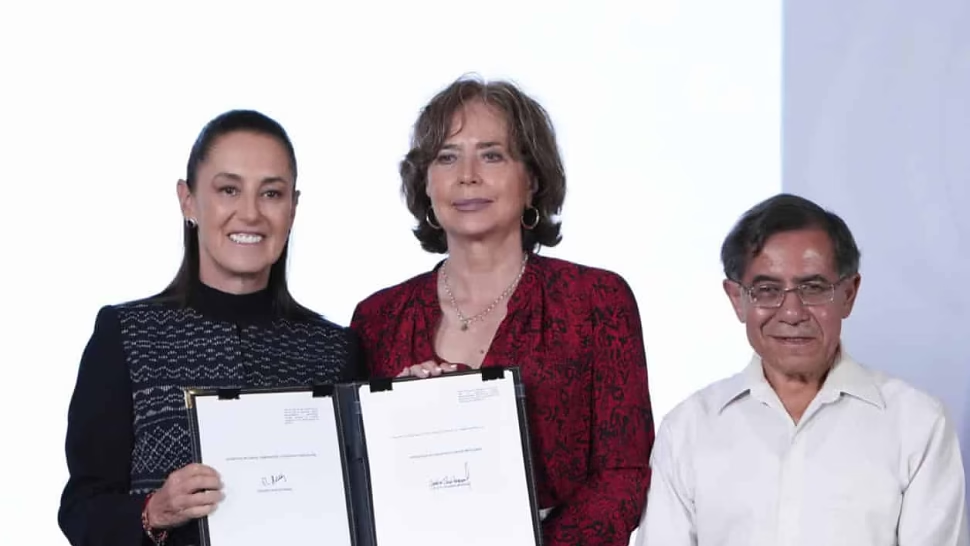
President Claudia Sheinbaum signed the decree that transfers the National Institute of Historical Studies of the Revolutions of Mexico (INEHRM) to the Secretariat of Science, Humanities, Technology and Innovation (SECIHTI). The institute becomes a decentralized public body with an academic focus.

Rosaura Ruiz Gutiérrez, head of SECIHTI, explained that the new scheme will train specialists in history to strengthen national capacities in social sciences and humanities.

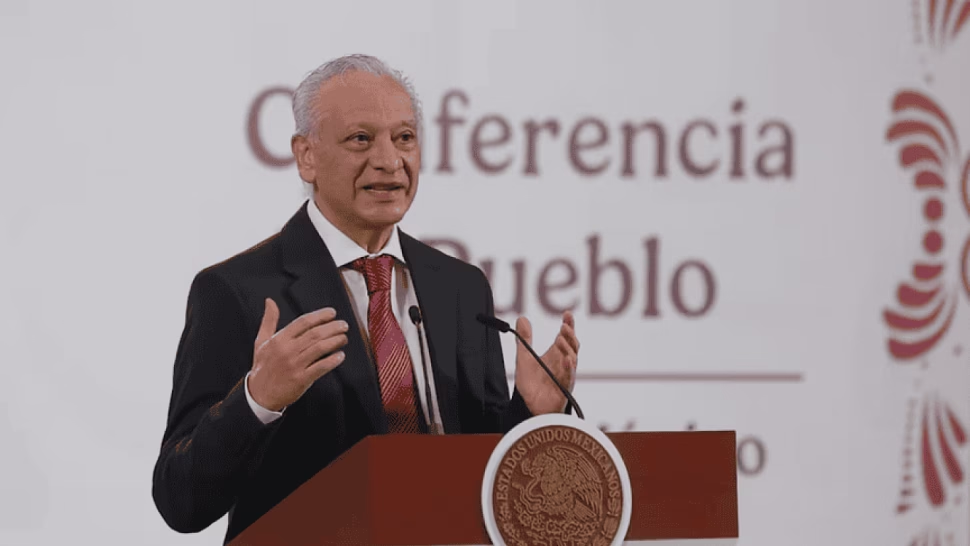
Felipe Arturo Ávila Espinosa, director of the INEHRM, explained that the study plans will link historical knowledge with social, economic, political and cultural problems of the country, and will address the needs of the Federal Public Administration.

Hybrid educational offer

The offer will include bachelor’s degrees in History, Social Sciences and Humanities, and Public Administration and Good Government. In postgraduate studies, master’s degrees will be added in Mexican Humanism, Gender and Feminism Studies, and Social Movements and Rescue of Historical Memory. There will also be specialties in Political Communication and History Teaching.

Graduates will cover topics such as agrarianism, health, migration, artificial intelligence, violence and human rights.

Headquarters and call

The new headquarters will be at 80 Guatemala Street, Historic Center of Mexico City. The first admission call will be launched in July, and classes will begin in September.

Continue reading

Prosecutor’s Office grants protection measures to victim of family violence

The Morelos Prosecutor's Office issued protection measures after a complaint of family violence against the former director of Pemex.

The Morelos Attorney General’s Office activated protection measures in favor of Felicia Jiménez Lavie, who filed a complaint for family violence against her husband, Víctor Rodríguez Padilla, former director of Pemex. This was reported by prosecutor Fernando Blumenkron Escobar.

The measures, the official explained, will be available when the victim requires them. The complaint was filed in Mexico City and the Women’s Secretariat of the Government of Mexico directly follows up on the case.

Investigation in progress

Until now, Jiménez Lavie has not gone to the local Public Ministry to contribute more elements to the investigation folder. This was initiated ex officio last Friday, June 26, after a video was broadcast with images of attacks against the woman.

Blumenkron assured that the portfolio continues its integration. “The proceedings have not stopped and we are going to continue to guarantee justice for the victim,” he said. In addition, he indicated that there is coordination with the Women’s Secretariat and the capital’s Prosecutor’s Office, under the care route for victims of family violence.

Among the actions carried out, the Morelos Prosecutor’s Office seeks to locate the address where the physical assault occurred, to carry out expert reports in accordance with the images of the video broadcast by the victim herself.

Continue reading

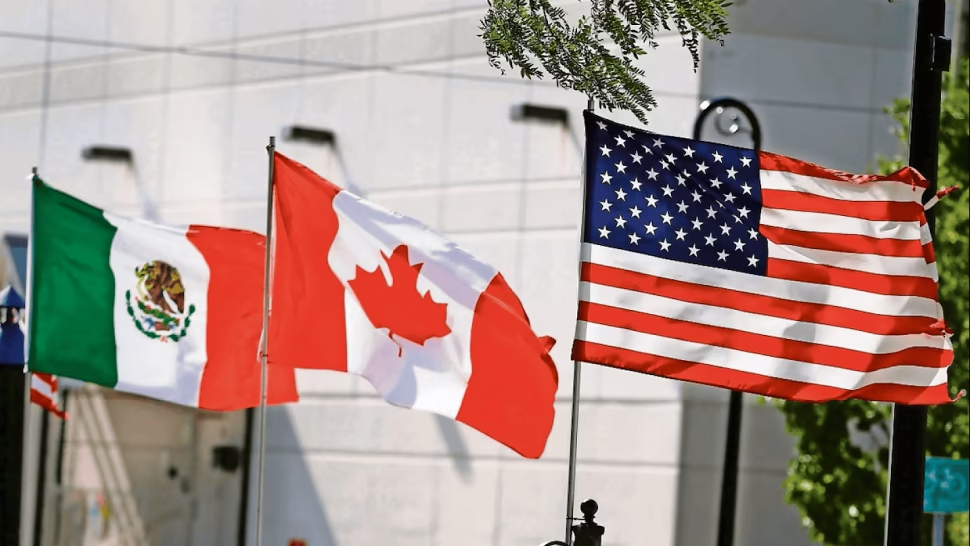
Trump does not extend T-MEC: Mexico faces annual review

US rejects automatic extension of the T-MEC; validity is reduced to 10 years with annual review.

Rejection of automatic extension

The United States decided not to automatically renew the Treaty between Mexico, the United States and Canada (T-MEC) for 16 years. This reduces its validity to a decade with an annual review. The measure generated concern among Mexican legislators.

Ricardo Monreal, coordinator of Morena in San Lázaro, explained that the treaty remains in force for another 10 years, but subject to evaluation each year. He noted that the United States presented 54 observations, including issues such as the vaquita porpoise and piracy. Mexico, for its part, raised 13 points, including clause 232 on tariffs.

“Only it will be reviewed year after year, but the Treaty is not finished, it continues for another 10 years because that is how it was signed six years ago,” declared Monreal.

The legislator warned that Donald Trump has been a constant critic of the USMCA and called for considering the benefits it has brought to the three nations.

Reactions of the opposition

Héctor Saúl Téllez, vice economic coordinator of the PAN, considered that the US position shows a lack of strategic anticipation on the part of the federal government.

“The US decision not to automatically extend the USMCA for 16 years in today’s review is not the end of the treaty, but it does reveal a lack of strategic anticipation by the federal government,” he stated.

Téllez recalled that Article 34.7 of the agreement had been known since 2018. Reaching July 1 without a clean extension represents a risk that, he said, should have been avoided.

The annual review will allow adjustments, but uncertainty about the future of regional trade persists. Mexico and Canada will seek to maintain the stability of the agreement for the next ten years.

Continue reading