Institutional support in the midst of administrative controversy
The Liga MX has issued an official statement strongly supporting Club América against the decision of the Mayor Benito Juárez to impose a match behind closed doors. The governing body of Mexican professional football described the measure as an “excessive sanction” that directly harms the fans and the sporting spectacle, setting a significant precedent in the relationship between civil authorities and sports institutions.
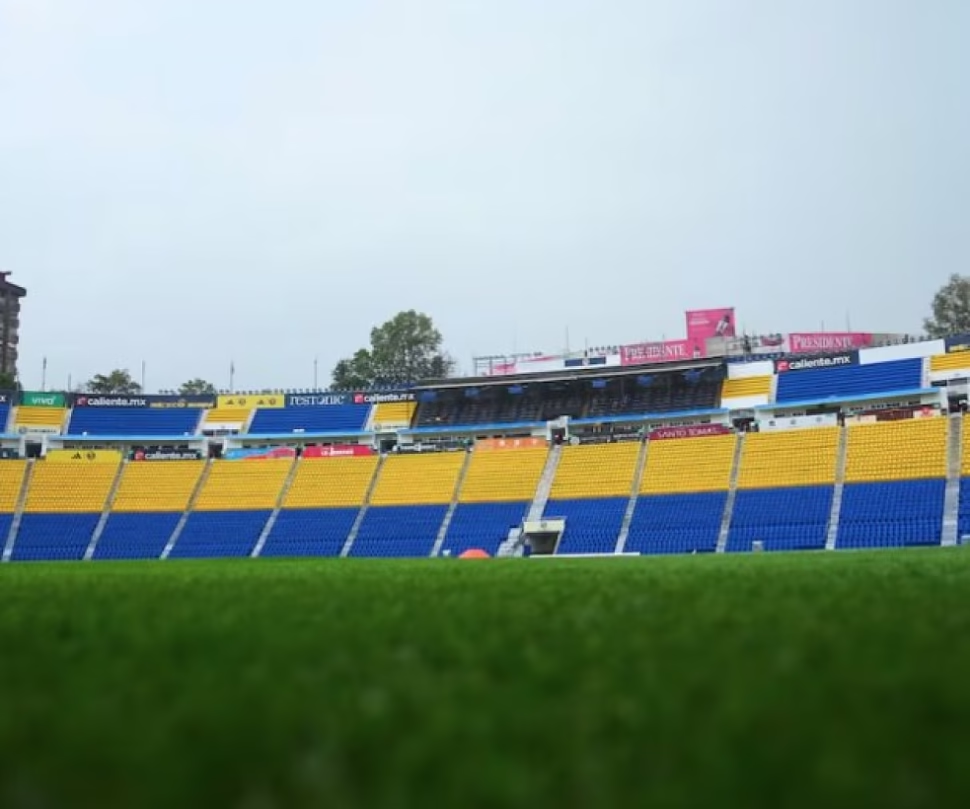
The conflict arose after the unilateral decision of the territorial demarcation to force the match corresponding to the seventh date of the Apertura 2025 Tournament between the Águilas del América and the Tuzos del Pachuca to be played without fans in the stands of the Ciudad de los Deportes Stadium. This sanction, according to the official position of the League, was applied without a prior trial process and without granting the opportunity to the club involved to present its defense, which constitutes institutional arbitrariness.
The arguments of the mayor and the club’s response
The justification given by the capital authorities for implementing this corrective measure focuses on an alleged infraction committed by the club. According to their version, América would have proceeded to the unauthorized closure of Indiana Street, a public road adjacent to the sports facility, during a previous match. This action, they stated, generated significant effects on the mobility and quality of life of the residents of the area, violating the coexistence agreements and established security protocols.
However, the azulcrema board, acting through the Azteca Stadium and its operational arm, Grupo Ollamani, has vigorously refuted these accusations. The club’s institutional position argues that, far from acting on its own, the closure of the road was carried out by elements of the Mexico City Police, who followed to the letter the security and road plan previously approved and coordinated with the Benito Juárez mayor’s office itself. This contradiction points to an apparent lack of internal coordination within the local administration.
El América culminated its public positioning with a message addressed to the authority: “I hope the local authority rectifies an arbitrary act. If it affects the fans, we reserve the right to take the appropriate legal action.” This statement underlines the club’s willingness to escalate the conflict to the legal field if the sanction is upheld, which could lead to prolonged administrative litigation.
Implications and the way forward
With the explicit support of Liga MX, the Club América leadership will intensify its efforts to reverse the decision and ensure that the match against Pachuca is played with the presence of its fans. The League’s statement concludes by stating that the institution “…will support the club so that the match scheduled for August 30 takes place in the best possible way”, which suggests that all available avenues of dialogue and institutional pressure are being explored.
This episode transcends a simple dispute over a soccer game; brings to the table the delicate interaction between the autonomy of sports organizations and the regulatory power of local governments. The application of sanctions of this nature, without due process, can set a worrying precedent for other clubs and for the very operation of massive events in the city. The resolution of this conflict will be closely watched by all actors involved in the sports industry in Mexico, as it could define the limits of authority in the regulation of public entertainment.
Do you support the position of Liga MX? Share this note on your social networks and debate with your community about this crucial issue for the future of football.Explore more content related to the administration and regulation of professional sports on our portal.