Maduro’s three controversial visits to Mexico in the AMLO era

The Venezuelan president set foot on Mexican soil on three key occasions, each one more controversial than the last, under the shelter of the López Obrador government.

A trio of stellar appearances under the Mexican sun

It seems that Venezuelan President Nicolás Maduro liked the political climate in Mexico so much during the administration of Andrés Manuel López Obrador that he decided to make not one, but three courtesy visits. All this, of course, in the midst of an international panorama so tense that it made his passport more sought after by some agencies than by immigration stamps. While the United States pointed its finger at him and offered amounts of money that would make a lottery jackpot blush, Maduro found a comfortable and fraternal refuge in Mexico. What a coincidence, right?

The diplomatic tour (or how to be the most uncomfortable guest)

The first function of this tour was the most formal: on December 1, 2018, Maduro went to Mexico City for AMLO’s inauguration. A gesture of support between left-wing leaders, so moving that it almost makes one forget the small domestic problems. The second time, in September 2021, things got more interesting. The Venezuelan president appeared at the VI CELAC Summit. By then, the US State Department had already put a price on his head: 15 million dollars for information leading to his capture, accusing him of links to terrorism and drug trafficking. But oh, the details. Maduro landed, smiled and rubbed shoulders with other regional leaders. One can almost imagine the conversation: “The flight? Well, thanks. The multimillion-dollar reward for my arrest? Oh, that’s foreign policy minutiae.”

RelatedThe United States carries out a military operation and captures Maduro in Venezuela

The third and final visit, in October 2023, was the most picturesque. Maduro traveled to Chiapas for a meeting on fraternal neighborhood and well-being, because nothing says “fraternity” like meeting to talk about the regional migration crisis. There, among representatives of Cuba, Colombia, Honduras, Haiti, Guatemala, El Salvador, Belize, Panama and Costa Rica, the Venezuelan leader declared that this was “a correct first step to unify Latin America.” A correct step, no doubt, although some outside viewers might wonder if the unit is built by ignoring international arrest warrants. They are just details.

The great absentee and a movie epilogue

For the inauguration of Claudia Sheinbaum, the first president of Mexico, Maduro was conspicuous by his absence. What a disappointment. Of course, he was not rude: he sent a congratulatory message talking about the history of brotherhood between peoples and of carving out a world in this new era of multipolarity. Nice words that, in retrospect, sound like goodbye. Because the script took a dramatic turn: in the early hours of a random Saturday, the United States Government managed to capture him in Venezuela, formally accusing him of illicit activities such as narcoterrorism and corruption. So, while the messages of brotherhood still resonated, international justice knocked on their door with less diplomacy and more handcuffs. Ironic that his trips to Mexico now seem like a perfect prologue to this final chapter.

In short, this triptych of official visits paints a fascinating portrait of Mexican foreign policy and its controversial alliances. Three acts where geopolitics, irony and controversy danced an uncomfortable waltz, leaving analysts wondering what is really said in the hallways of those meetings for “fraternal neighborliness.”

Were you surprised by this tour of the controversial diplomatic visits?Share this analysis on your social networks and explore more content on the ins and outs of international politics in our foreign relations section.
Earthquake in La Guaira: 2,295 dead and thousands missing

Families seek to identify their loved ones in the rubble before mass graves.

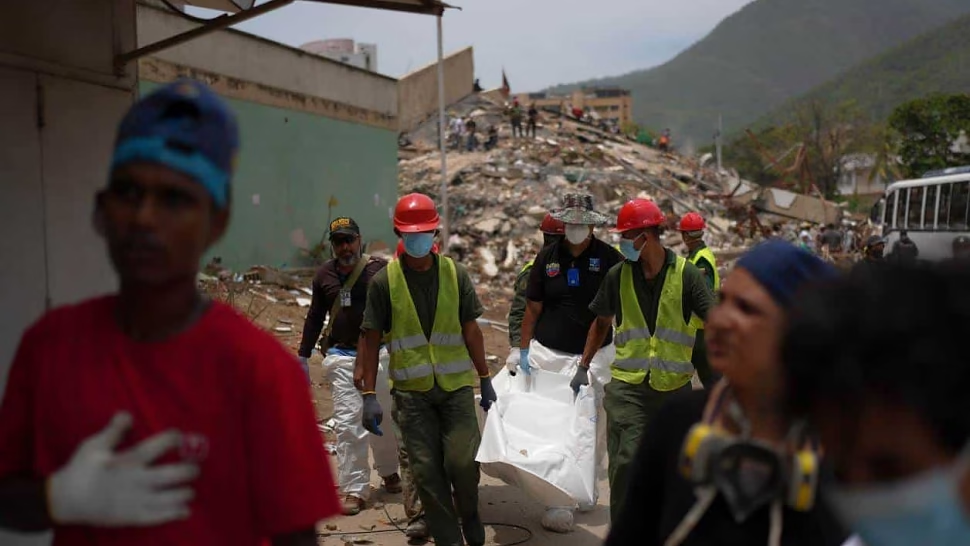
The tragedy of the June 24 earthquake in the Venezuelan state of La Guaira leaves at least 2,295 dead. Thousands of people remain missing. Hundreds of families tour hospitals and makeshift morgues to identify bodies before they are sent to mass graves.

Number of victims and rescue efforts

The forensic teams, led by technician Joel Mirabal, work tirelessly. According to specialists, between 60 and 70 percent of the victims are recognized by family or neighbors. The advanced state of decomposition complicates tasks. Refrigerated containers have been installed due to the increase in bodies. The authorities do not rule out opening mass graves.

Around the port of La Guaira and the temporary morgues, dozens of families remain formed for hours. They use tattoos, scars or clothing to confirm identities. The uncertainty about the fate of the missing aggravates the pain.

The drama of families

Rosa López recounted the difficult process of finding the body of her son-in-law, José Antonio Toledo, who died when the building where he worked as a security guard collapsed. After visiting several sites, the family managed to identify his remains. Without resources for a funeral service, the mayor’s office gave them a free space to bury him.

Rescuers estimate that recovery efforts will last at least three months due to the number of collapsed buildings. Thousands of volunteers have joined the search, hoping that families can say goodbye to their loved ones.

Continue reading

Sheinbaum announces investment of 4 billion pesos for the Purépecha people

The president detailed new commitments in health, education and security during her visit to Michoacán.

Justice Plan for the Purépecha people

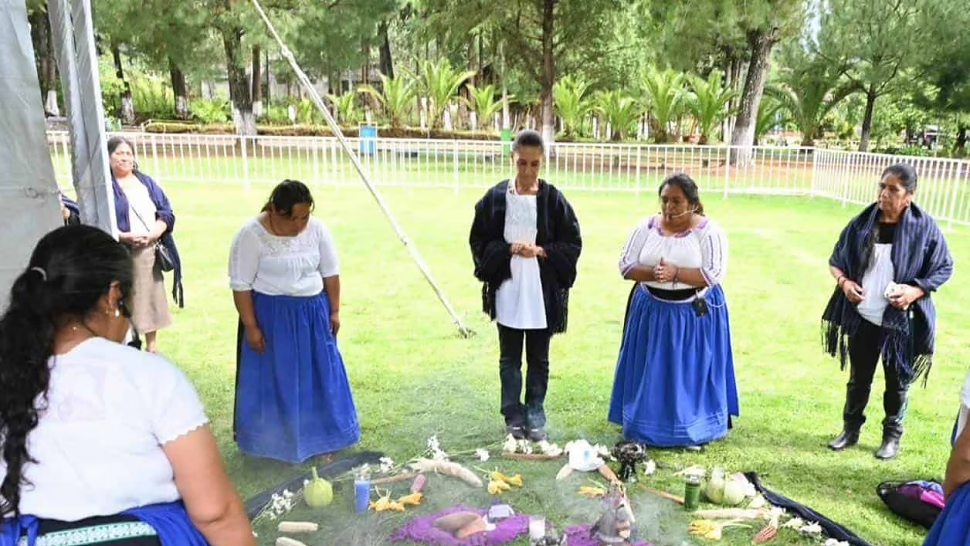
From Cherán, Michoacán, President Claudia Sheinbaum highlighted the progress of the Justice Plan for the Purépecha people. One year and two months after its implementation, more than 4 billion pesos (mp) have been allocated for health, education, roads and security.

“How are the Justice Plans made? With you. They are not made in an office of the federal government, of the State Government, they are made in assemblies,” said Sheinbaum.

The president recalled that, with the Second Floor of the Fourth Transformation, the Constitution was modified to recognize indigenous and Afro-Mexican peoples as subjects of public law. In addition, the Contribution Fund for the Social Infrastructure of Indigenous and Afro-Mexican Peoples (FAISPIAM) went from 12 thousand million pesos in 2025 to 13 thousand 500 million pesos by 2026, with the objective that this resource is established in the Constitution so that it increases each year.

The director of INPI, Adelfo Regino Montes, detailed the distribution of the investment: 27 artisanal paths (74.34 km, 485.01 million pesos), School Houses and Canteens for 527 children, 21 Community Houses of Indigenous Languages, and 161 communities benefited from FAISPIAM (212.74 million pesos in 2025 and 234.47 mdp in 2026).

Sheinbaum announced new commitments: improve the Cherán Hospital with a hemodialysis area, fix the Sports Unit, open degrees in Medicine and Nursing, strengthen community businesses, build a C2 in the community and hold a meeting on security in Mexico City.

The Undersecretary of Sciences and Humanities, Violeta Vázquez-Rojas, reported other advances: construction of an ISSSTE hospital, studies for an IMSS Bienestar hospital, hiring of 646 doctors and more than a thousand nurses, a National Guard barracks for 150 elements, remodeling of 17 highway sections, delivery of 27 thousand efficient stoves, and translation of the Women’s Booklet into Purépecha.

The governor of Michoacán, Alfredo Ramírez Bedolla, supported the initiative and highlighted the defense of the uses and customs of the native peoples.

Continue reading

Colombians arrested for training in the manufacture of explosives in Michoacán

Colombian detainees linked to the manufacture of explosives in Michoacán.

The Security Cabinet has arrested Colombian citizens linked to the training and manufacturing of improvised explosive devices in Michoacán. This was reported by the Secretary of Security and Citizen Protection, Omar García Harfuch, during the morning conference on Friday, July 3 in Morelia.

These arrests are part of investigations that identified the entry of several people involved into the country, mainly through the Mexico City International Airport and other air entry points. The National Intelligence Center monitored these movements.

The entry of foreign people by land was also detected, who allegedly collaborate in the training of members of criminal groups to install these devices. García Harfuch pointed out that there is an ongoing investigation to locate the leaders of these networks in Michoacán, including alleged high-level members of the Jalisco Nueva Generación Cartel.

The head of the SSPC confirmed the participation of citizens from different countries, mainly from Colombia. We are working in coordination with Colombian authorities to strengthen the investigations. In the coming days, the exact number of people arrested related to the manufacture and use of these explosives will be specified.

Continue reading