The Valeria Law classifies stalking as a crime in Mexico

Mexico is moving forward to punish stalking as a federal crime after years of legal vacuum that left victims unprotected.

A legal loophole that cost years and lives

Finally. After years of heartbreaking stories and shadowy legal battles, Mexico takes a historic step. The Chamber of Deputies unanimously approved the Valeria Law, a reform that seeks to classify stalking as a crime in the Federal Penal Code. Now it goes to the Senate.

This is not just another legislative process. It is the response to a silent cry that thousands of people, mainly women, have had to endure. Persecuted, watched, harassed… and without legal tools to defend themselves.

RelatedStalking could become a federal crime in Mexico

The case that changed everything

It all started with Valeria Macías. In 2017, one of her students began stalking her. When he sought help, the authorities gave him the worst possible news:

“There is no specific crime that allows action against this conduct.”

Imagine it. Feeling persecuted, in constant fear, and being told that the law does not protect you. That legal vacuum is what this law aims to fill forever.

What is stalking according to the new law?

The Valeria Law defines it clearly: repeated behaviors without consent such as monitoring, following, observing movements or attempting repeated communication. It becomes a crime when it alters the tranquility, privacy or daily life of the person who suffers it.

The key here is early intervention. The authorities will be able to act before the situation escalates to something worse.

Punishments that hurt (and protect)

The sanctions are not symbolic:

  • 2 to 4 years in prison
  • Fines up to 400 days of salary
  • Penalties increase if the victim is a minor, elderly or vulnerable adult
  • Also if there is a relationship of power or trust with the aggressor

In addition, there will be immediate protective measures: contact restrictions and preventive surveillance from the beginning of the investigation.

What this really means

Beyond the legal articles, this law represents a cultural change. Recognize that constant fear is a form of violence. That feeling observed in your own space is not “exaggeration”, but aggression.

For people like Valeria Macías—and the thousands of anonymous people—this means being able to sleep without looking out the window twice. It means walking down the street without feeling that pain in the back of your neck. It means recovering something as basic as peace.

Political theater sometimes produces real dramas with hopeful endings. This could be one.
Mexico deploys aid brigade to Venezuela after earthquakes

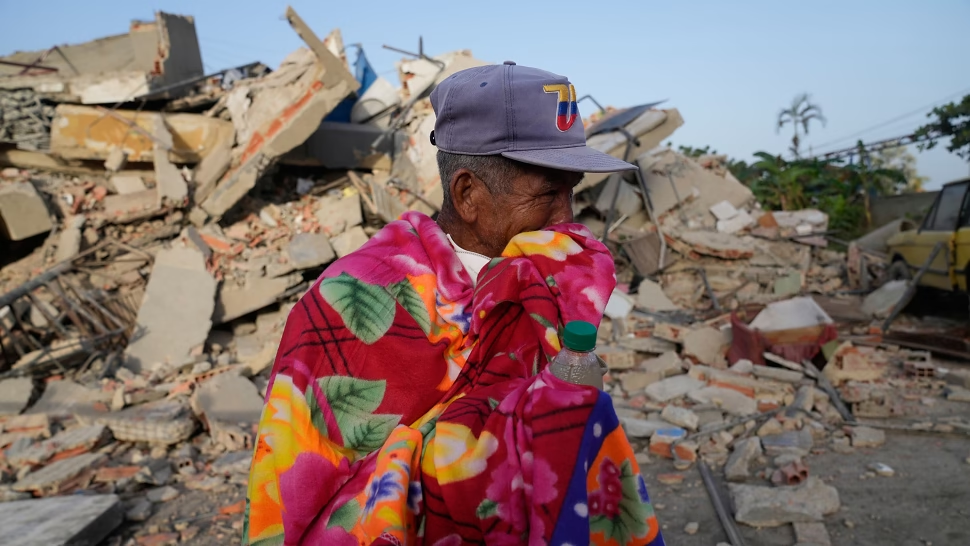
Mexico sent 250 soldiers and medical supplies to Venezuela after the earthquakes.

Humanitarian aid to Venezuela

Mexico sent a support contingent to Venezuela to address the damage caused by two strong earthquakes that shook the north-central region of the country.

President Claudia Sheinbaum confirmed the measure and reiterated the solidarity of her government.

“Our solidarity with the people of Venezuela. A team of rescuers and medical personnel from the Ministry of Defense leaves today. Once they are established there and after talking with the authorities, we will determine the additional personnel necessary.”

The first emergency brigade is made up of 250 soldiers, five canine units, four aircraft, a drone, specialized investigation equipment and medical supplies.

No collection centers for now

When asked about the possible opening of collection centers, the president clarified that “for the moment, they have asked us for rescuers and health support; they have not asked us for food aid.”

Sheinbaum added that so far no compatriots have been injured, missing or died in the tragedy, and that the situation remains under surveillance.

Continue reading

Telephone line registration: new calendar until December

New staggered calendar to register telephone lines in Mexico. Know the dates according to your number.

The Telecommunications Regulatory Commission (CRT) extended the deadline to register telephone lines until December 2026. So far, only 63 million users (39.1% of the total) have completed the process. Of them, 40.2 million are prepaid and 22.8 million are postpaid.

Calendar by last digit

Registration will be done in stages according to the last digit of the telephone number:

  • 0: August 15
  • 1: August 31
  • 2: September 15
  • 3: September 30
  • 4: October 15
  • 5: October 31
  • 6: November 15
  • 7: November 30
  • 8: December 15
  • 9: December 31

Consequences of not registering

If you do not register before the deadline, your operator will suspend the line within 72 hours. You will only be able to make emergency calls, to citizen services and receive seismic alerts. You will lose access to mobile data, although you will be able to use Wi-Fi networks.

After expiration, you can register your line and service will be fully restored. The procedure is carried out with your operator and requires the CURP. Check your company’s official site for more details.

Continue reading

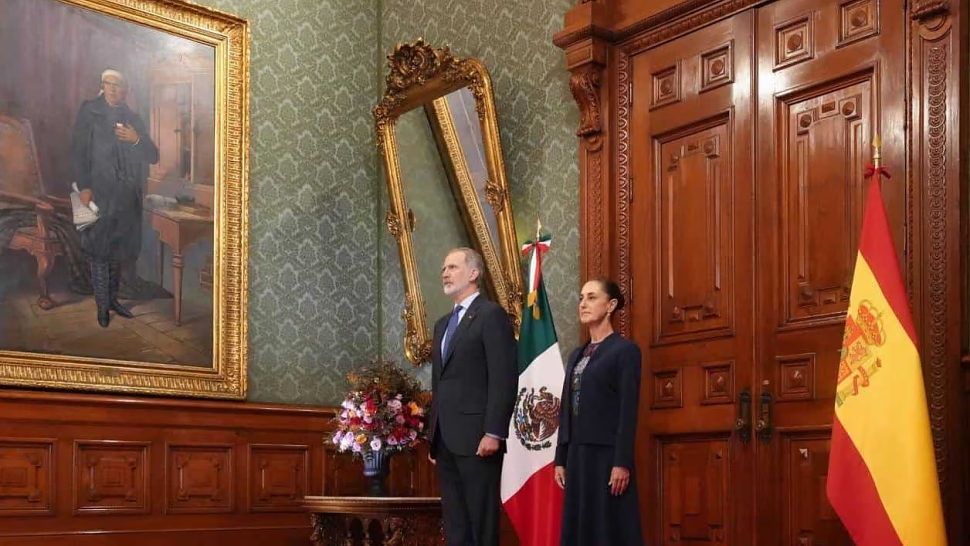
Mexico receives King Felipe VI with honors at the National Palace

Sheinbaum and the Spanish monarch discuss the bilateral relationship in the National Palace.

Welcome ceremony at the National Palace

President Claudia Sheinbaum Pardo received King Felipe VI of Spain this day in the Ambassadors Room of the National Palace. During the official ceremony, the national anthems of both countries were sung, followed by the official photograph of the meeting.

Bilateral meeting

Sheinbaum and the monarch will hold a dialogue about the state of the relationship between Mexico and Spain. Senior officials from both governments attend the meeting.

On behalf of Mexico: the Secretary of Foreign Affairs, Roberto Velasco Álvarez; the head of the Office of the Presidency, Lázaro Cárdenas Batel; and the Mexican ambassador to Spain, Quirino Ordaz Coppel.

For Spain: the Minister of Foreign Affairs, European Union and Cooperation, José Manuel Albares Bueno; the Minister of Education, Vocational Training and Sports, Milagros Tolón Jaime; the head of the King’s House, Camilo Villarino Marzo; the ambassador of Spain in Mexico, Juan Duarte Cuadrado; the diplomatic advisor of the King’s House, Carmen Castiella Ruiz de Velasco; and the head of the Minister’s Office, Sergio Cuesta Francisco.

The visit of King Felipe VI takes place within the framework of his official tour of Mexican territory. Both leaders are expected to address issues of cooperation, trade and culture.

Continue reading