The CNTE pauses its strike but not its union drama

The rebel teachers take a strategic pause, because even revolutions need rest (and consultation with their bases).

Because even revolutionaries need a coffee break

Ah, the CNTE, that union that takes more breaks than a student during exam time. This morning, in a meeting that lasted three and a half hours (yes, the same time that an average bureaucratic procedure takes), the National Representative Assembly decided that, surprise, they need a break. But not just any rest: a “unified” one, after consultation with the bases, because of course, it is not going to be that someone protests against the protest.

Reorganize or reinvent yourself: the eternal dilemma

According to point five of their agreements (which sounds more formal than it really is), the strike is paused to “reorganize.” Translation: count how many teachers are still on the sit-in and see if anyone got lost along the way. Because, let’s be honest, after weeks of protest, even the most fervent social fighter deserves a nap.

RelatedThe CNTE decides to pause its national strike to consult bases

Meanwhile, the government, in an attempt to appear cooperative, postponed its meeting with the CNTE to Wednesday. Reason? They probably needed time to prepare more vague promises and tripartite agendas that sound good on paper but, in practice, dissolve like sugar in cheap coffee.

And it could not be missed: Claudia Sheinbaum is still in the crosshairs of the teachers, because what would a teacher’s conflict be without a pending meeting with the president? Of course, in the meantime, the teachers will continue “without giving up” (favorite word of any self-respecting social movement).

What’s next? Probably another pause, another meeting, another statement. But hey, at least this time they warned. That’s already progress, right?

Are you amused by these union ups and downs?Share it and join the debate. Or better yet, explore more content on how unions write the script of Mexican politics.

Football and diplomacy: this is how Mexico and Spain reconciled

The meeting between the king and the president closed seven years of diplomatic tensions.

A match that sealed diplomatic peace

The Soccer World Cup was the stage to resolve a conflict that lasted seven years. King Felipe VI of Spain traveled to Guadalajara to watch the Spain-Uruguay match and took the opportunity to meet with President Claudia Sheinbaum. For an hour they talked and considered the discrepancies that began in 2019, when Mexico demanded a real apology for the Conquest, overcome.

“Felipe, thank you for coming,” said Miguel Campos, a 41-year-old Spanish bank employee who was attending the game. He considered the controversy “more politicking and making media noise than what people feel.”

“There is no hatred towards Spain and I believe that Mexicans and Spaniards are half cousins-brothers,” he explained while waving a Spanish flag.

Sergio Astorga, a Mexican waiter, agreed: “It was a lack of communication because (the unity between) Mexicans and Spaniards is part of us.”

The gesture that changed everything

The public apology never occurred, but the monarch acknowledged last March “moral and ethical controversies” during the conquest at an exhibition in Madrid. Two days later, Sheinbaum’s invitation to the World Cup was confirmed. “It was a matter of dignity for the people of Mexico,” the president said on Friday, and stressed that without those words from the king the rapprochement would not have been possible.

Sheinbaum sought to be consistent with the position of her predecessor, Andrés Manuel López Obrador, who sent the letter demanding an apology and put relations on “pause” in 2022. She did not invite Felipe VI to her investiture in 2024.

Pragmatism and geopolitics

The commercial, cultural and social ties between both countries are key. In an uncertain global context and with Donald Trump’s administration applying unilateral and anti-immigration policies, strengthening the relationship was necessary. Sheinbaum attended a meeting of progressive leaders in Barcelona where a message of unity against Trump was sent.

On Thursday, Felipe VI and Sheinbaum spoke about trade, the economy and “the situation in the world, how it is important to recognize the Charter of the United Nations,” according to the president, who described the king as “a very simple person.”

Other royals in the World Cup

Felipe VI was not the only member of royalty in Mexico. Princess Hisako of Takamado of Japan visited Monterrey to see her team. And King Willem-Alexander and Máxima of the Netherlands were in Houston and Kansas City supporting Holland and Curacao, which was making its debut in a World Cup.

Continue reading

They arrest alleged tourist thieves in Monterrey

Collaboration with hotels allowed the arrest of four people involved in robberies against foreigners.

Joint operation against tourist robberies

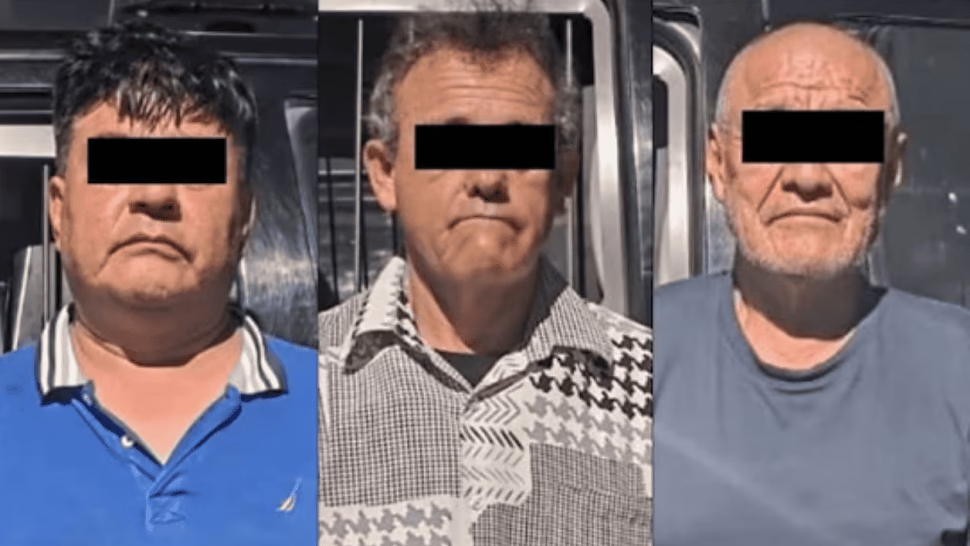
Four people were arrested in Monterrey for their alleged participation in robberies of foreign tourists. The Monterrey Police acted after an alert from the hotel sector.

According to the Monterrey Security Secretariat, the suspects were part of a group known as “Los Peruanos.” Two of them are of Peruvian origin and two are Mexican. They are linked to the theft of handbags and backpacks in restaurants, mainly during tourists visiting the World Cup.

The detainees were identified as Lourdes Natalia N., 50 years old; Jorge Humberto R., 68; Richard Alcides U., 57, and José Juan H., 77 years old. At the time of the capture, the authorities seized 17 bags with a substance similar to marijuana. All were at the disposal of the Public Ministry.

The arrest highlights the importance of collaboration between authorities and hoteliers to guarantee tourist safety in Monterrey, especially during high-traffic seasons.

Continue reading

Sheinbaum recognizes Katia Itzel García, the first Mexican to referee in a World Cup

The president recognized the referee and defended the singer against criticism.

A milestone for women’s refereeing

President Claudia Sheinbaum congratulated Katia Itzel García Mendoza for becoming the first Mexican to whistle a World Cup match. García refereed the match between Tunisia and the Netherlands from the Kansas City stadium.

“Imagine what it cost Katia, in and of herself, a referee, a good referee. Well, to get to a World Cup match requires many exams, having to pass different filters. Now imagine for a woman, being the referee of a men’s match,” Sheinbaum expressed in the morning conference.

García is a student at the Faculty of Law and a graduate of the Bachelor’s Degree in Political Science and Public Administration from the Faculty of Political and Social Sciences (FCPyS) of UNAM. This Friday she led the fifth World Cup match directed by a central referee.

The president also highlighted the efforts of the auxiliary Sandra—without giving a last name—and linked the achievement to the demands of women: “An extraordinary effort by Katia and the auxiliary… speaks of personal effort, but also of the demands of women, that we can be whatever we want to be.”

Sheinbaum took the opportunity to defend the singer Julieta Venegas, who was criticized for the cover “La Niña Futbolista.” He did not give more details, but reiterated his support for the artist.

García’s case opens the conversation about female inclusion in professional arbitration, a field historically dominated by men.

Continue reading