Federal courts face extreme shortages of basic supplies

A critical situation that demands urgent attention Imagine arriving at your workplace and not having even the most essential things to carry out your…

A critical situation that demands urgent attention

Imagine arriving at your workplace and not having even the most essential things to perform your duties. This is how judges, employees and collaborators live today in multiple federal courts in Mexico, where the lack of resources has reached unprecedented levels.

A handwritten cry for help

Judge José Jorge Rojas López, of the Third District in Matters of Domain Forfeiture, stated in a handwritten statement placed at the entrance to his premises: “Due to the lack of inputs… this body will stop delivering physical records”. Incredible but true! Of five printers, three are damaged and two are out of toner.

RelatedFederal employees face layoffs during government shutdown

This reality is repeated in CDMX, Monterrey, Guadalajara, Campeche and Veracruz, where technological equipment is obsolete, paper is scarce even in the bathrooms, and the air conditioning systems have not worked for weeks. How can we expect agile and efficient justice in these conditions?

The root of the problem: reforms and cuts

Internal sources indicate that this operational crisis is due to the budget reduction and the imminent disappearance of the Federal Judiciary Council. Since January, contracts with suppliers have not been renewed, generating a domino effect that puts the entire system at risk.

In the Judicial City of Guadalajara, employees report that they are missing everything from cleaning products to spare parts for elevators. In Monterrey, workers have had to buy paper with their own money. This is not sustainable!

Motivational reflection: In any field, adequate resources are the foundation of success. When a system lacks the basics, we all lose. But every crisis is an opportunity to reinvent yourself, raise your voice and seek creative solutions.

Are you outraged by this situation? Share this article to make visible a problem that affects the entire society. Together we can drive change. Explore more content on transparency and institutional improvement on our networks!

Controversy over an interview with Monsiváis reaches the Senate and the Palace

The republication of a 1999 interview unleashes accusations between the Executive and legislators.

The republication of an old interview attributed to Carlos Monsiváis climbed to the center of the Mexican political debate this Wednesday. The issue was discussed both in the Senate and in President Claudia Sheinbaum’s morning conference.

The original text was written by journalist Edmundo Cázares in 1999 and recently republished by El Universal. It contains statements about the then head of Government Andrés Manuel López Obrador. Its veracity and context have been questioned, generating conflicting positions.

Sheinbaum describes the content as “grotesque”

During her conference, the president harshly criticized the publication. He described the content as “grotesque” and accused the medium of generating a controversy that distorts the tribute to the Mexican intellectual.

Reactions in the Senate

The issue also reached Congress. Senator Lilly Téllez read fragments of the text on the platform. In response, Gerardo Fernández Noroña rejected its use and maintained that it was a false publication with the intention of political attack.

The exchange reflects the polarization around the figure of López Obrador and the use of historical documents as partisan weapons.

Continue reading

PRI demands urgent action against violence in Guerrero

They denounce an incursion of armed civilians in Coyuca de Catalán; party calls for state intervention.

The national leadership of the PRI demanded that the Mexican State intervene urgently in response to the complaint by inhabitants of the Guajes de Ayala ejido, in Coyuca de Catalán, Guerrero. The residents reported the incursion of armed civilians into their community in the Sierra.

Call for safety

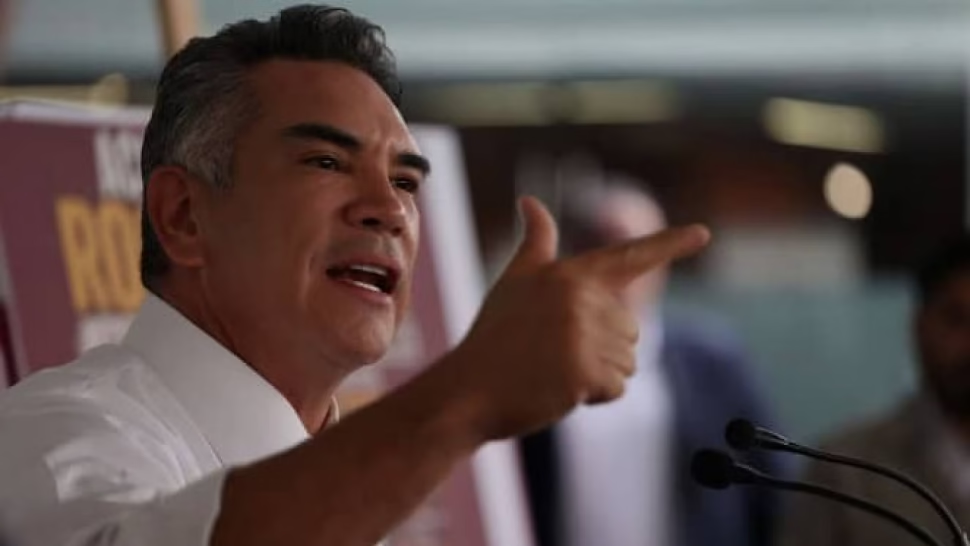
Alejandro Moreno Cárdenas, president of the party, asked the authorities to guarantee the safety of the families. He warned that these events should not be normalized due to the risk they represent for the civilian population.

The leader pointed out that in various communities in Guerrero they live under siege by armed groups. This has caused displacement, confinement of inhabitants and a constant climate of fear and uncertainty. He considered an immediate response from the State necessary.

Moreno Cárdenas also criticized the federal government for minimizing the situation of violence in the country. He affirmed that the population faces conditions of insecurity that require priority attention to restore the rule of law in the region.

Continue reading

Inflation in Mexico slows down and remains at Banxico’s goal

Inflation drops to 3.55% in the first half of June, within Banxico's target range.

Inflation in Mexico continues to decline. According to Inegi, it stood at 3.55% annually during the first half of June. This represents a drop of 0.11 percentage points compared to the second half of May.

With three consecutive months of deceleration, the indicator remains within Banxico’s target range (3% plus/minus one point). This level is key for purchasing power.

Pressures on core inflation

However, pressures remain. Core inflation—which reflects medium and long-term trends—was at 4.12%, with a biweekly increase of 0.19 points. Within this category, merchandise rose 3.65% annually and services, 4.57%.

Non-core inflation and seasonality

In contrast, non-core inflation slowed to 1.61% annually, driven by the drop in agricultural prices. Products such as tomatoes, eggs and poblano peppers recorded significant decreases.

The report also reflected seasonal movements in tourist services, related to the summer and the Soccer World Cup. Air transportation, hotels and tour packages increased. Despite this, analysts foresee a favorable trend towards the end of the year.

Continue reading