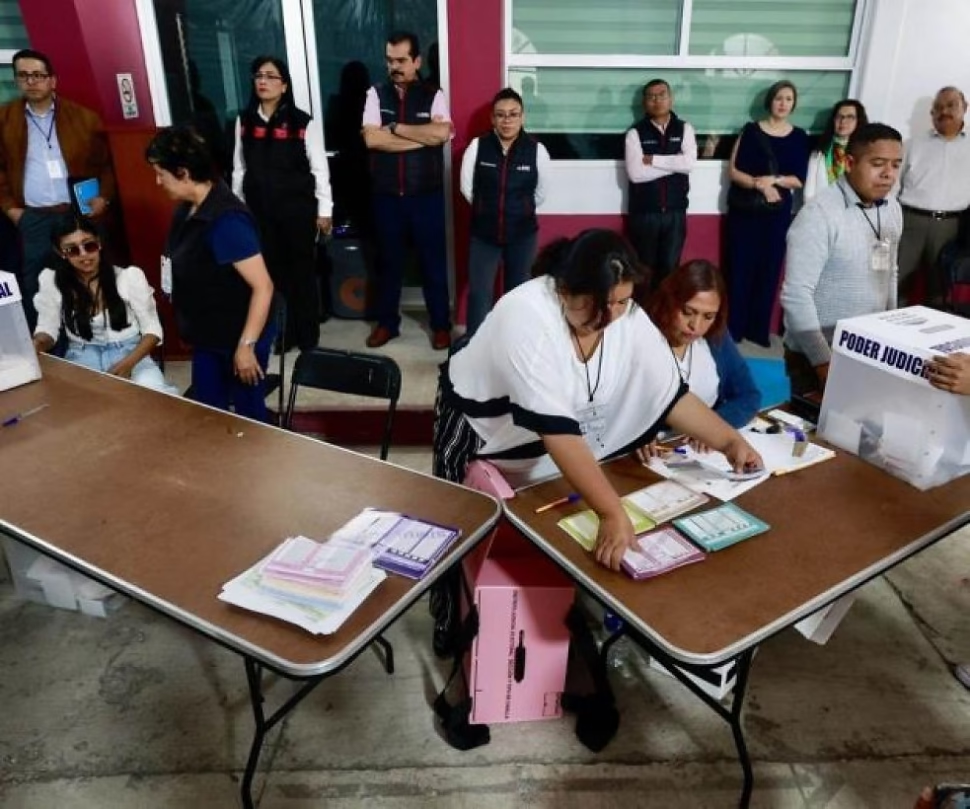
Judicial elections in Mexico could be historic chaos

A report reveals how misinformation and disinterest could turn these elections into a democratic circus.

The democratic circus that nobody asked for (but we will all see)

If you thought that the last elections were a disaster, prepare for the aftermath: this Sunday’s judicial elections promise to be the most chaotic reality show in Mexican democracy. According to a report by Integralia (yes, those experts who always predict the obvious but with pretty graphs), this vote could break records in vote mobilized, purchased and with “accordion” included. Come on, as if democracy were a math test and the parties are the friends who give you the answers.

Low participation + illegible ballots = Democracy or lottery?

The deadly combination: citizens who don’t even know who to vote for, ballots longer than a Twitter thread and candidates so unknown that they could be failed influencers. “It will be the election with the highest proportion of mobilized and induced vote”, warns Integralia. That is, basically a “vote for whoever they tell you or who pays you.” The principle of free voting? Crushed like a forgotten meme.

RelatedLow participation and induced voting threaten judicial elections in Mexico

And here is the fact that hurts: in CDMX, an average voter will have to choose 51 positions among 293 candidates. It’s like asking someone to choose their favorite food from a 20-page menu… after three coffees and zero hours of sleep. Spoiler: the majority will end up canceling their vote or throwing the ballot into the air as if it were confetti.

Ghost candidates and false elections

Did you know that there are 51 unique candidates at the federal level? That is, areas where the “democratic process” is as real as Instagram filters. The award for fake election of the year goes to Durango, with 49 candidates for 49 positions. Competence? What is that, do you eat it?

And if that were not enough, digital campaigns have had the impact of a TikTok without audio. “Media and citizen interest has been low,” says the report. In other words, not even memes managed to save this election from the abyss of disinterest.

The final result? A slow count, lots of null votes and abstentionism worthy of a Monday morning. But hey, at least there will be material for a thousand sarcastic posts.

Did it outrage you? Share this article and join the club of those who still believe in elections… or at least in laughing at them.Do you want more meme-flavored political analysis? Explore our content.


Edomex reinforces health prevention in eight eastern municipalities

Eight municipalities in Edomex join a health prevention strategy with a focus on obesity and teenage pregnancy.

Expanded coordination in the Eastern Zone

The Government of the State of Mexico intensified its work with eight municipalities in the Eastern Zone to strengthen health prevention. The priorities: combat overweight, obesity and reduce teenage pregnancies. The strategy is part of the Comprehensive Plan for the Eastern Zone and the national preventive medicine policy.

At a working table, state, federal and municipal authorities agreed to advance in the integration of the Mexican Network of Municipalities for Health, as well as in the certification process of Health Promoting Municipalities.

The state Secretary of Health, Celina Castañeda de la Lanza, explained that the objective is to coordinate actions between the three levels of government. This includes measures against addictions, vector-borne diseases and the aforementioned problems of weight and early pregnancy.

The Network will allow municipalities to exchange experiences to address local needs. Daniel Aceves Villagrán, general director of Public Health Policies of the Government of Mexico, highlighted that the model incorporates care for people with disabilities and those living with chronic diseases, especially in areas of high population density.

Representatives from Nezahualcóyotl, Naucalpan, Chimalhuacán, Valle de Chalco, Ixtapaluca, Ecatepec, Texcoco and Chicoloapan participated. These municipalities began the procedures to obtain certification as Health Promoting Municipalities, which will expand preventive actions throughout the region.

Continue reading

Pemex cuts investment and production deviates from the goal

Pemex reduced its investment by 5.9% in the first quarter; crude oil production is moving away from the goal.

Pemex adjusted its spending again. The exploration and production subsidiary received a 5.9% cut in its investment capital during the first quarter compared to what was scheduled.

The approved budget was 86.7 billion pesos, but the company reported to the US Securities and Exchange Commission that it invested 81.6 billion. The difference directly affects the production platform.

Currently, Pemex extracts 1.6 million barrels per day, far from the goal of 1.8 million. Gonzalo Monroy, director of GMEC, warned:

“We are flying directly and non-stop at 1.2 million barrels per day in 2027, which means that once the water is discounted, we would be at a million extraction levels during the next year.”

Drilling rigs also decreased: from 32 to 25 between January and May, according to data from the consulting firm. So far this six-year term, 10 mixed contracts have been awarded, seven in a first block (fields such as Macavil and Tamaulipas) and three recently (Rabasa, San Ramón and Cinco Presidentes). Pemex plans to produce up to 450 thousand barrels per day with these contracts, but the developments would take place beyond 2033.

Oil vocation in question

Miriam Grunstein, an academic at the Mexico Center at Rice University, said that the situation is alarming in the short term. Pemex loses income from lower exports and from privileging feeding the National Refining System, instead of extracting more crude oil.

“Sheinbaum’s government is betting on renewable electricity generation projects. Meanwhile, the budget cut in crude oil extraction indicates that the country no longer has a conviction or vocation for oil,” he said.

Grunstein added that the difference in investment between renewable energy and exploration is enormous: “At some point we are going to face a very harsh reality. The abandonment of extraction has been so much that it is alarming.”

Agreement with Petrobras, but without teeth

The Mexican government signed a collaboration agreement with the Brazilian Petrobras to acquire extraction techniques in deep waters, where Pemex has minimal activity. It includes exchange of knowledge and best practices, but the pact is non-binding, valid for two years and renewable.

Both Monroy and Grunstein agreed that the agreement was weak. Moody’s, when lowering Mexico’s rating on May 20, expressed greater concern about government debt and support for Pemex. The agency estimated that the government provided support for 35 billion dollars in 2025, equivalent to 1.9% of GDP, and budgeted another 14 billion for 2026. An improvement in the rating will depend on reducing the deficit and contingent risks of the oil company.

Continue reading

Jareta and Bundas: the canines that stop drug trafficking in Veracruz

Seven trained dogs detect illicit substances in ports and airports.

Jareta: discipline and training

Jareta, a Belgian Malinois, moves with precision between wooden boxes during an exercise at the Veracruz Naval Air Base. It is part of the seven canines that make up the unit of the First Naval Region. Their training combines play with challenging routines to develop detection skills.

“Due to their operational life and functions for which they are prepared, they are very calm little animals that manage to concentrate on their work,” describes Lieutenant Montserrat Zamora, veterinary doctor of the unit.

The specialist explains that Jareta ignores weapon detonations, explosions and the noise of turbines. When it detects narcotics, it makes a passive alert. “The truth is, it is a great pride because we are a team,” says the officer.

Bundas, forged in trust

At three years old, Bundas reflects inexhaustible energy. He stands out for his obedience and has established a special bond with Second Master Armando Sosa Rojas, in charge of the Canine Department.

“We have created a special bond. I feel a love and an attachment because since he arrived I had to receive him and we are still together,” highlights Sosa.

Bundas is among the unit’s most effective agents. Throughout his service he has contributed to the largest number of seizures through the detection of drug shipments. The teacher remembers that the main objective of the training is that “illicit substances do not reach their destination.”

“I trust my canine a lot, I know him and he is a good asset,” says the officer.

In 2024, the 38 binomials deployed in Veracruz and Tamaulipas secured close to a ton of prohibited substances. The unit operates from the Las Bajadas Aeronaval Base and carries out inspections on vehicles, ships and aircraft.

Continue reading