Jalisco Prosecutor’s Office awaits data from the US on Valeria Márquez’s crime

Local authorities are waiting for key responses from the US to advance the case of the murdered influencer.

A case that demands justice and international collaboration

The fight to clarify the murder of Valeria Márquez, the young influencer executed during a live broadcast, has run into a wall of silence. The Jalisco Prosecutor’s Office confirmed that, despite requesting support from the US Department of the Treasury, they have not yet received concrete information. Why the delay in a case that shocked Mexico and the digital world?

The CJNG clue and the call to action

US authorities point to Ricardo Ruiz “El Doble R”, alleged member of the Jalisco Nueva Generación Cartel (CJNG), as the main suspect. However, state prosecutor Salvador González de los Santos revealed that the available data comes from open media, not from official sources. “We are waiting for that collaboration,” he insisted, highlighting the urgency of working together to stop impunity.

RelatedThe US links El Doble R with the feminicide of Valeria Márquez

Since that tragic May 13, the investigations have included analysis of mobile devices, review of security cameras and dozens of interviews. But without the key piece—international confirmation—the puzzle remains incomplete. This case is not only about justice for Valeria; It is a global call against violence against women and the influence of organized crime in the digital age.

Inspiring reflection: In the midst of adversity, every advance—no matter how small—is a step toward the truth. Valeria deserves more than headlines; deserves a system that acts with determination. You can also be part of the change: spread verified information and demand transparency.

What’s next? Citizen pressure as a driving force

While the authorities wait, society cannot sit still. The viralization of this case demonstrated the power of networks to demand justice. Let’s use that strength! Share this content to keep the conversation alive and pressure for answers to arrive soon. Together, we can transform pain into action and impunity into accountability.

Join the conversation: Do you think international collaboration is key to solving transnational crimes? Share this article with #JusticiaParaValeria and continue exploring our research on security and human rights. Your voice adds up!

Image source: Agencia Reforma
Permanent Commission pays tribute to victims of celebrations

Congress remains silent for four deaths in celebrations for the victory of the Mexican National Team.

Tribute in Congress

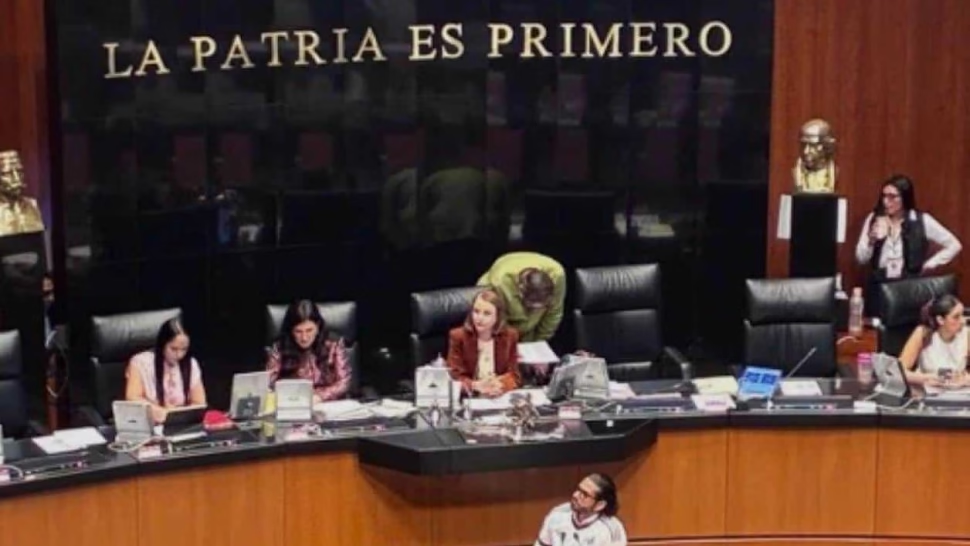
The Permanent Commission of the Congress of the Union dedicated a minute of silence to the four people who lost their lives during the celebrations for the victory of the Mexican men’s soccer team in Mexico City.

Laura Itzel Castillo, president of the Board of Directors, informed the plenary session that the capital’s Health Secretariat confirmed the death of two women, ages 19 and 48, as well as two men, ages 30 and 44. The events occurred in the surroundings of Paseo de la Reforma.

During the session, it was recalled that the Government of Mexico City, headed by Clara Brugada Molina, offered institutional support to the families of the victims and accompaniment in the corresponding processes.

The legislator asked the members to stand up for the posthumous tribute. He expressed condolences to the bereaved and wished them quick resignation in the face of the loss.

At the end, Castillo also congratulated the Mexican team for its performance in the 2026 FIFA World Cup and wished them success in the upcoming matches of the tournament.

Continue reading

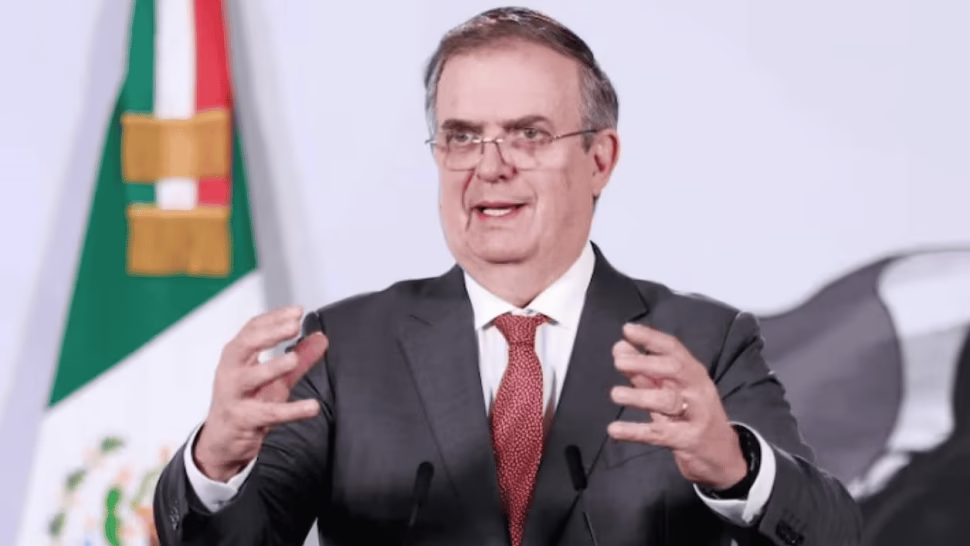
T-MEC remains in place until 2036 with annual reviews, Ebrard announces

The trade agreement will remain in force until 2036 with annual evaluations.

T-MEC: validity and annual reviews

The Secretary of Economy, Marcelo Ebrard, confirmed that the Treaty between Mexico, the United States and Canada (T-MEC) will remain in force until 2036. This was agreed upon by the three countries during a virtual meeting on July 1, as reported in the morning conference of President Claudia Sheinbaum.

Ebrard explained that annual reviews of the agreement will be carried out. The first formal stage will begin on July 20, when a delegation from the United States visits Mexico. The official stressed that the validity of the treaty is not under discussion, only the way to evaluate its operation.

The positions of each country

Mexico and Canada proposed extending the validity until 2042, with reviews every six years. However, the US government rejected that option. He preferred to maintain the current calendar accompanied by annual evaluations, due to his concern about the trade deficit with both nations.

“The treaty remains in force between now and 2036, as scheduled, and we will conduct an annual review,” said Ebrard.

Priority issues and Mexico’s position

During the meeting, Donald Trump’s administration expressed concern about the trade deficit. Therefore, it will seek to review specific issues of the agreement periodically. Ebrard pointed out that the Mexican government’s priority is to preserve current competitive advantages. He highlighted that more than 80% of Mexican exports to the United States do not pay tariffs.

“Mexico’s position with respect to the group of countries that trade with the United States is the best,” he stressed.

Among the issues to be addressed in the reviews are the tariffs imposed by Washington under provisions other than the T-MEC. In addition, regional production will be strengthened in strategic sectors such as the pharmaceutical industry and semiconductors. The objective is to reduce imports from other regions and contribute to reducing North America’s trade deficit.

Ebrard described the meeting as “very cordial” and trusted that the revisions will allow the agreement to be strengthened without modifying its essence or its validity until 2036.

Continue reading

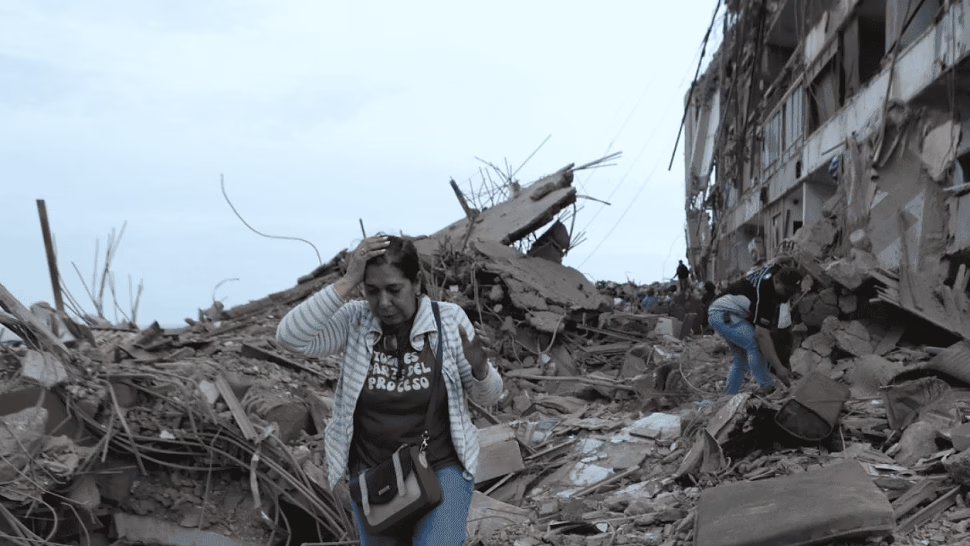
Mexico reinforces humanitarian aid to Venezuela after earthquakes

Mexico adds 71.2 tons of aid to Venezuela after earthquakes.

The Government of Mexico continues to send humanitarian aid to Venezuela after the earthquakes registered in that country. President Claudia Sheinbaum reported that 250 specialized elements have been deployed, along with 71.2 tons of food, medicines and power plants. In addition, the Secretary of the Navy is preparing a ship with more supplies.

Actions in Venezuelan territory

Sheinbaum explained that on July 2, 28 tons of supplies—non-perishable foods and medicines—were transported in response to the request of the Venezuelan government. This brings the total to 71.2 tons. On June 30, five power plants and 80 kilograms of Red Cross material were sent. The following Wednesday, another three plants with lighting systems.

“In total, eight plants with a lighting tower and solar panel have been transported, in addition to 80 kilograms of Red Cross material, in two logistics flights,” said the president.

The Mexican team continues its work in coordination with local authorities. Between June 26 and July 1, two people were rescued alive, 40 dead bodies were recovered, and a dog was rescued. 1,411 medical and first aid consultations were also provided, and 13.1 tons of medicines were delivered.

The head of the Executive announced that the support will continue: “A Navy ship will be sent, probably tomorrow, with the collection that has been made from different places to continue supporting Venezuela.”

Continue reading