They will invest 20 thousand million pesos to clean the most polluted rivers in Mexico

The federal plan seeks to restore the most polluted rivers with long-term works.

President Claudia Sheinbaum announced an investment of 20 billion pesos to clean up and restore the Atoyac, Lerma-Santiago and Tula rivers. The goal is to keep them permanently clean.

“We chose these three rivers because, according to Conagua, historically they are the most polluted,” Sheinbaum said in the morning conference. “We have invested close to 2,500 million pesos between 2025 and 2026, but in total there are 20 billion.”

The plan will benefit 25 million people in 10 states. The actions include marginal drainage, wetland treatment plants, desilting, reforestation and elimination of landfills.

RelatedGovernment announces 20 billion to clean up three key rivers

Details by river

The Secretary of the Environment, Alicia Bárcena, reported that the Lerma-Santiago river covers 1,360 km and benefits 21.4 million inhabitants. Tula has 191 km for 0.8 million, and Atoyac 162 km for 3.7 million.

More than 340 km have been walked, 322 sites have been sampled and 3,202 polluting discharges have been detected. 479 clandestine dumping sites and 460 priority industries were also identified.

Four goals

  1. Improve water quality: 10 new treatment plants, rehabilitation of 23 more, 94 km of collectors and 280 inspections.
  2. Ecosystem restoration: 24 km revegetated, 4,639 hectares reforested and 8,243 hectares intervened in natural areas.
  3. Prevent flooding: 41 km of clearing, slope stabilization and 28 monitoring stations.
  4. Reconnect the population: 9 parks and more than 40 thousand people in cleaning days that collected 4 thousand 667 tons of garbage.

Progress by basin

The director of Conagua, Efraín Morales, specified that on the Atoyac River the first stage of 63 km is 85% complete. In Tula, 74 km with 62% progress. In Lerma-Santiago, 65 km with 90% progress.

Additionally, work is carried out in the Tijuana, Acapulco, Nogales and Sonora rivers.

Intentional injuries against women in Mexico reach historical record

June recorded the second highest number of female victims of intentional injuries: 7,476.

Violence against women: intentional injuries at their highest point

June closed with 7,476 women victims of intentional injuries throughout the country. It is the second highest figure since the National Public Security System began this registry in 2015. In May alone, the entire record was surpassed with 7,940 victims.

On average, every day last month 249 women aged 30 or older suffered this crime. The entities with the highest rate per 100 thousand inhabitants are: State of Mexico (148.9), Guanajuato (135.8), Aguascalientes (128), Baja California Sur (100), Hidalgo (92), Michoacán (86) and Sinaloa (77.9).

42 thousand victims in six months

From January to June of this year there are 42,021 women intentionally attacked. The report is prepared based on the investigation folders initiated by the state prosecutor’s offices. Ministerial authorities and human rights organizations consider that intentional injuries are a preliminary step to homicide or feminicide.

Family violence is also increasing

In June, 25,031 investigation folders for family violence were opened, the second highest number in the same period. Among the cases, that of the former director of Pemex, Víctor Padilla, stands out, who was linked to proceedings for attacking his wife and his minor son. However, he regained his freedom after a few days in the Atlacholoaya prison, Morelos.

The report from the National Public Security System reveals that violence against women does not subside. The figures demand urgent measures from the states with the highest incidence.

Continue reading

They discover a tunnel to extract illegal fuel in Mineral de la Reforma

They find clandestine infrastructure connected to the Pemex pipeline in a state operation.

Tunnel found for hydrocarbon theft

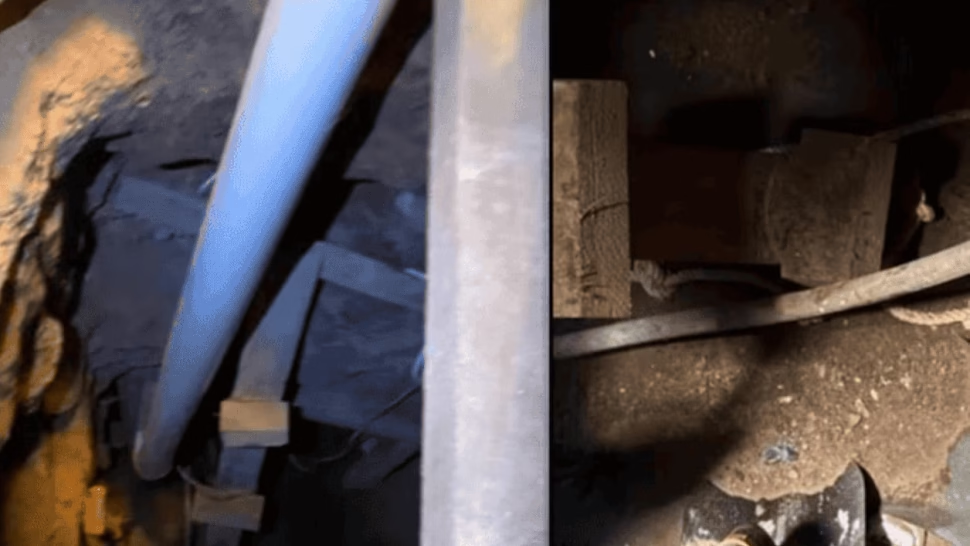
Elements of the Hidalgo Public Security Secretariat (SSPH) located a tunnel used for the illegal extraction of fuel on a property in the El Saucillo neighborhood, in Mineral de la Reforma.

The discovery occurred after a citizen complaint. Agents carried out an operation that led to the arrest of five people and the seizure of three properties. They also seized approximately 500 meters of high-pressure hose and doses of alleged drugs.

The detainees tried to flee when they noticed the police presence, but were captured. As part of the investigations, three searches were carried out. In one of the properties, a tunnel six meters deep and 50 meters long was found, connected to a Petróleos Mexicanos (Pemex) pipeline to illegally extract hydrocarbons.

In another property there was a warehouse that was allegedly used to store the extracted fuel. The secured hose was used for clandestine intakes.

The actions were coordinated by the SSPH, the Attorney General’s Office of the State of Hidalgo (PGJEH), the Secretariat of National Defense and the National Guard. The detainees were placed at the disposal of the Federal Public Ministry, which will integrate the corresponding investigation folders.

With this discovery, during the current state administration there are 19 tunnels located in Hidalgo intended for the theft of hydrocarbons. These have been detected in municipalities such as Cuautepec, Pachuca, Tepeji del Río, Tlanalapa, Tlaxcoapan, Tula, Mineral de la Reforma, Tepeapulco, Tepetitlán, Nopala and Atitalaquia.

Continue reading

SEP rejects militarized education after tragedy in Tamaulipas

The SEP clarifies that militarized education is not authorized after the death of a minor in Tamaulipas.

SEP reiterates ban on military education

The Ministry of Public Education (SEP) stated that education under military or military modalities is not permitted in Mexico. The statement came after the death of a teenager at a summer camp with military characteristics in Ciudad Madero, Tamaulipas.

The head of the SEP, Mario Delgado Carrillo, condemned attempts to justify acts of violence or mistreatment with the argument of a supposed military education. He pointed out that these practices are not training methods and violate the human rights of children and adolescents.

Through a statement, the agency clarified that no basic education institution is authorized to teach teachings labeled as military or military. He explained that military education is exclusive for personnel of the Armed Forces and the National Guard.

Regarding the incident, state educational authorities will take measures to protect the rights of minors. According to family testimonies, the teenager entered the camp on July 13 in good health and days later she was reported fainted after a fall. The minor died inside the facilities.

The SEP reiterated its rejection of any practice of abuse or degrading treatment against minors. The case has generated a call to review supervision mechanisms in extracurricular activities.

Continue reading