


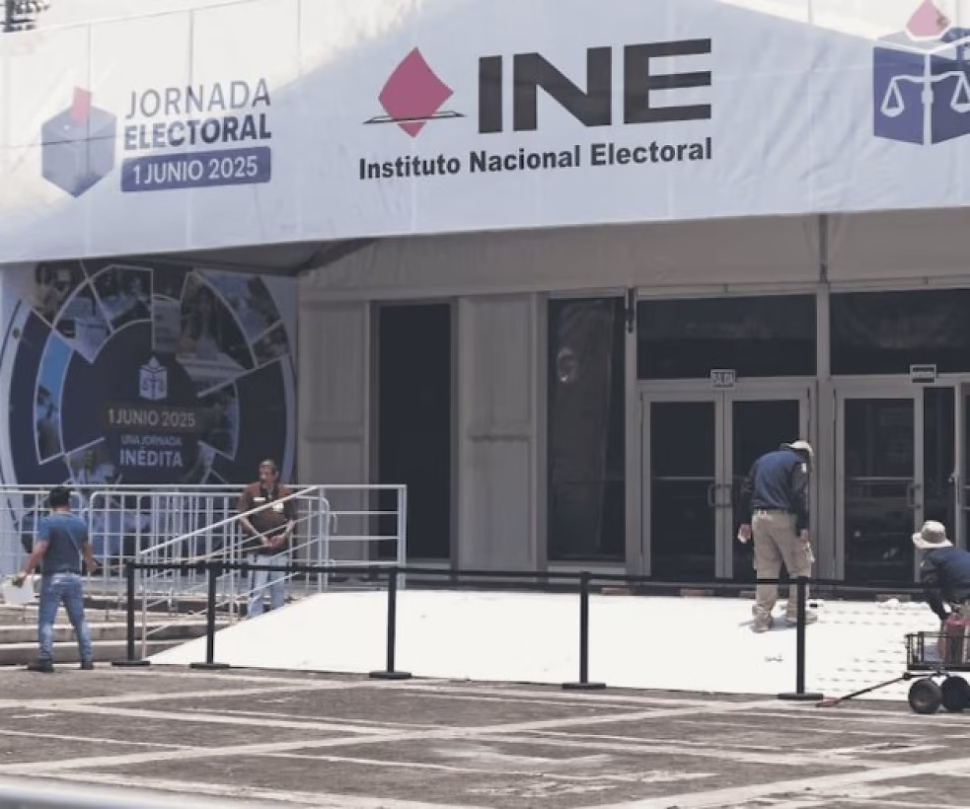
Failures in the accreditation process for electoral observers
The National Electoral Institute (INE) revealed that, during the judicial election, it received a total of 316,430 applications to serve as election observers. However, 45% of these (143,688) were rejected for not meeting the established requirements, among which are not being affiliated with political parties or being officials linked to social programs.
According to the official report presented by the General Council of the INE, only 170,360 applications were approved, which makes this process the most monitored by citizens since 1994. However, counselor Dania Ravel pointed out an obvious contradiction: while thousands sought to be accredited as observers, the participation citizenat the polls barely reached 13%.
Transparency and challenges in electoral supervision
The electoral body implemented measures to guarantee the right to election observation, but also to safeguard the integrity of the process. “The INE took the necessary actions to ensure that only suitable people participated as supervisors, avoiding conflicts of interest,” said Ravel.
For her part, counselor Carla Humphrey highlighted that the critical phase of this mechanism lies in the reports presented by the observers. As of June 4, 4,109 reports had been received, of which 2,375 corresponded to individual evaluations and only 40 came from civil organizations.
This data shows a low commitment on the part of specialized organizations, which raises questions about the effectiveness of collective supervision. Furthermore, the disparity between the number of accreditations and the reports submitted suggests that many observers did not fulfill their role in documenting irregularities.
Implications for confidence in the electoral system
The discrepancy between the high interest in being an observer and the low citizen participation in voting reflects a structural problem: distrust in institutions or lack of clarity in supervisory roles. Although the INE has reinforced its protocols, the low delivery of reports limits the ability to identify areas for improvement.
Experts in electoral law emphasize that this scenario requires a review of the selection criteria and greater training for observers. “The quality of supervision is as important as its quantity. Without detailed reports, there is no useful feedback,” warned one analyst consulted.
The INE thus faces the challenge of balancing openness to participation with the demand for rigor in its processes, a key balance to strengthen participatory democracy.
Are you interested in electoral transparency? Share this analysis and discover more content on accountability on our social networks. #TransparentDemocracy


