Economy and energy: the president’s announcements
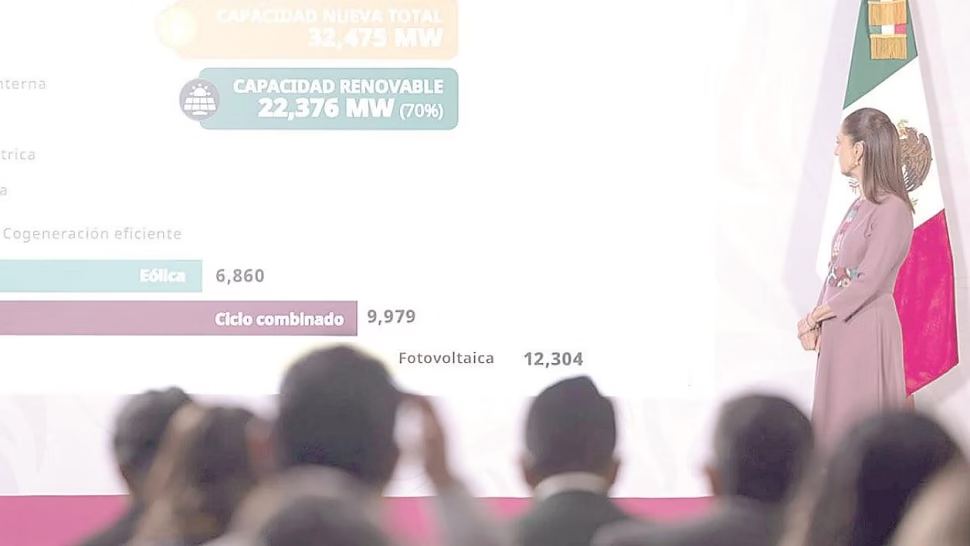
President Claudia Sheinbaum reported that, for the first time, Mexico has projects for 32 thousand megawatts of additional electrical capacity, of which 70% are renewable. “When we leave the government, natural gas consumption will decrease and energy generated by renewable resources will increase,” he stated.
Sheinbaum also highlighted economic growth. According to Inegi, the Global Indicator of Economic Activity (IGAE) rose 1.2% in April compared to March, the best advance since 2021. The annual rate reached 2.2%. The president attributed this to the boost in construction, especially the housing program.
Regarding inflation, the president pointed out that it fell to 3.55% annually in the first half of June, its lowest level since October 2025. This is due, she said, to agreements with gas stations to set maximum fuel prices and the Package Against Inflation and Scarcity (Pacic) to control the basic basket.
Energy transition with 32 thousand megawatts
The Secretary of Energy, Luz Elena González, explained that by 2030 32 thousand megawatts will be added; 22 thousand will be renewable. The goal is for at least 38% of generation to be clean to meet climate commitments. He assured that the CFE will maintain its majority participation, providing 61% of the electricity at the end of the six-year term.
The director of CFE, Emilia Calleja, explained the projects. In Baja California Sur, the Oasis System will combine solar energy, batteries and green hydrogen to supply Mulegé and 40 thousand homes. It includes a 72 megawatt plant, 20 megawatt storage and will produce 120 cubic meters of water per year, avoiding 94 thousand tons of CO2.
In Sonora, the “Rafael Galván” photovoltaic plant in Puerto Peñasco will reach one thousand megawatts of capacity and 246 megawatts of storage. It currently provides 400 megawatts. The investment exceeds 1.4 billion dollars. “They are environmental benefits that strengthen energy sovereignty,” concluded Secretary González.