They find 37 bags with human remains in the Zapopan grave

New findings in the Las Agujas grave reveal the magnitude of a tragedy that has not yet ended.

Progress in the prospecting of the Las Agujas pit

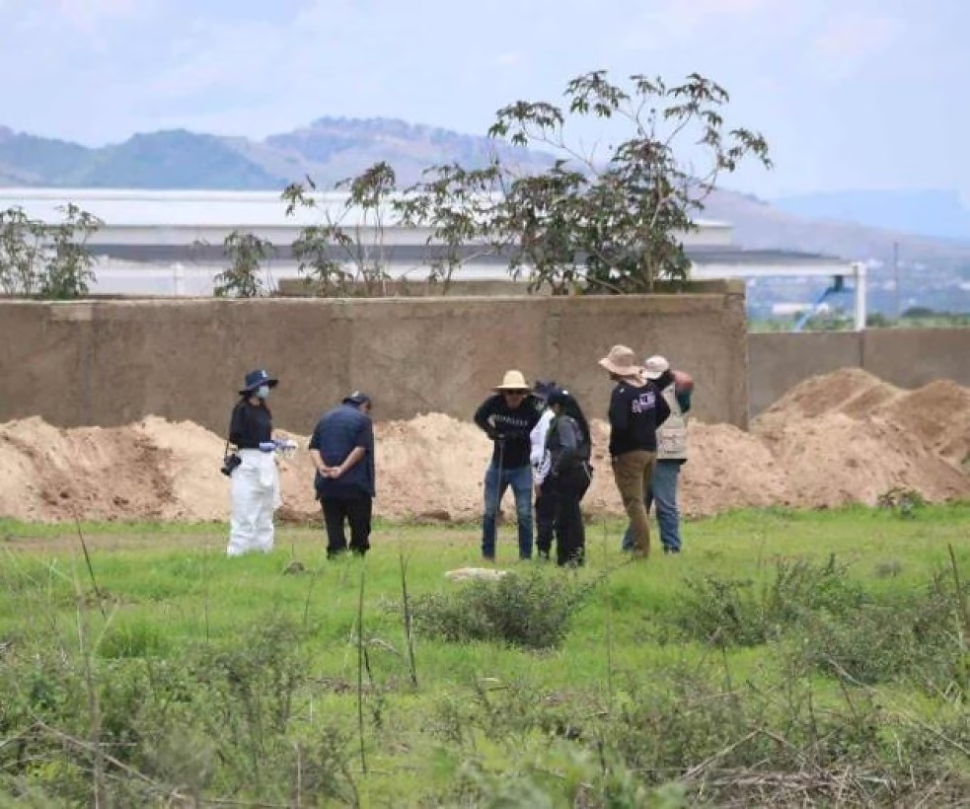
The search efforts at the Las Agujas property, located in the municipality of Zapopan, Jalisco, have yielded a total of 37 bags with human remains as of this Monday. The work, which began on July 1, has involved multiple actors, including the Guerreros Buscadores de Jalisco Collective, the State Person Search Commission, the State Prosecutor’s Office and the Jalisciense Institute of Forensic Sciences.

Details of points of interest

On the first day of operations, teams processed an initial point of interest, extracting three bags of remains. Later, between Thursday and Saturday, they concentrated on a second site, where they recovered 30 additional bags. A third focus was identified on Friday, but its analysis was postponed until this Monday due to the ground conditions, managing to rescue four more bags.

RelatedThey find 12 more bags with human remains in the Las Agujas grave

The three intervened spaces are located in a ditch parallel to a dividing wall of the property. It should be noted that, in the opposite sector of this fence, the Prosecutor’s Office had already carried out work since February, reporting 169 bags with remains corresponding to 34 victims.

Challenges and needs in the search

The groups have indicated that the work on the second and third point has not yet been completed, so the figure could increase. Additionally, during excavations with backhoes, activists used rods to explore other areas, identifying eight new potential sites. “The smells guide us towards possible remains,” explained Marichuy, a member of the search group.

Given the extension of the work, the volunteers have requested government support, including technology such as georadars and canine teams. “We need specialized tools and more personnel to speed up the process,” emphasized the activist.

Context and forensic relevance

This case highlights the forensic crisis in Mexico, where thousands of people remain missing. The methodology used—combining heavy machinery with manual techniques—reflects the challenges of locating and identifying victims in clandestine graves. Collaboration between authorities and groups is key, but the lack of resources limits its effectiveness.

Share this information to make the work of search engines visible and demand justice. Do you want to know more about similar cases? Explore our related content.

Sheinbaum highlights record in clean energy and economic rebound

Sheinbaum reports historic growth in renewables and low inflation at 3.55%.

Economy and energy: the president’s announcements

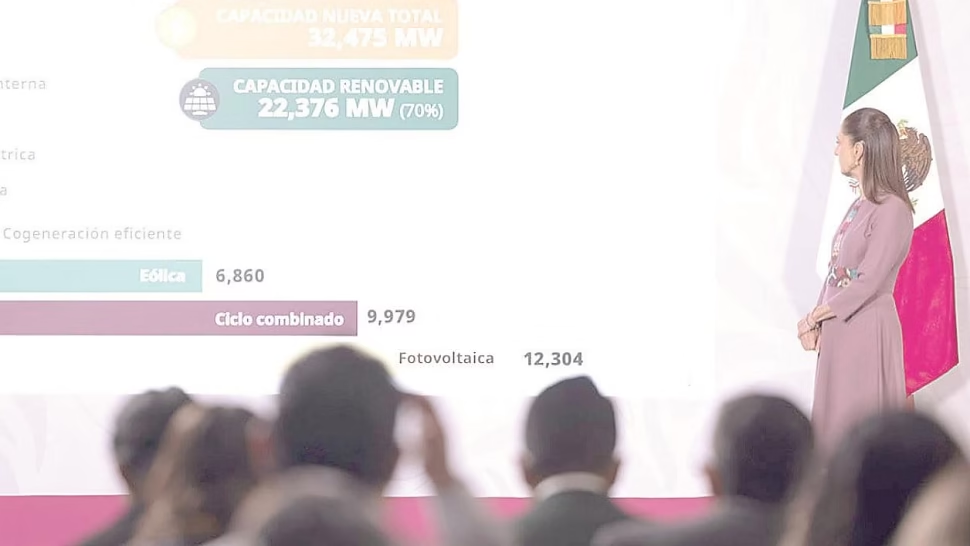
President Claudia Sheinbaum reported that, for the first time, Mexico has projects for 32 thousand megawatts of additional electrical capacity, of which 70% are renewable. “When we leave the government, natural gas consumption will decrease and energy generated by renewable resources will increase,” he stated.

Sheinbaum also highlighted economic growth. According to Inegi, the Global Indicator of Economic Activity (IGAE) rose 1.2% in April compared to March, the best advance since 2021. The annual rate reached 2.2%. The president attributed this to the boost in construction, especially the housing program.

Regarding inflation, the president pointed out that it fell to 3.55% annually in the first half of June, its lowest level since October 2025. This is due, she said, to agreements with gas stations to set maximum fuel prices and the Package Against Inflation and Scarcity (Pacic) to control the basic basket.

Energy transition with 32 thousand megawatts

The Secretary of Energy, Luz Elena González, explained that by 2030 32 thousand megawatts will be added; 22 thousand will be renewable. The goal is for at least 38% of generation to be clean to meet climate commitments. He assured that the CFE will maintain its majority participation, providing 61% of the electricity at the end of the six-year term.

The director of CFE, Emilia Calleja, explained the projects. In Baja California Sur, the Oasis System will combine solar energy, batteries and green hydrogen to supply Mulegé and 40 thousand homes. It includes a 72 megawatt plant, 20 megawatt storage and will produce 120 cubic meters of water per year, avoiding 94 thousand tons of CO2.

In Sonora, the “Rafael Galván” photovoltaic plant in Puerto Peñasco will reach one thousand megawatts of capacity and 246 megawatts of storage. It currently provides 400 megawatts. The investment exceeds 1.4 billion dollars. “They are environmental benefits that strengthen energy sovereignty,” concluded Secretary González.

Continue reading

Controversy over an interview with Monsiváis reaches the Senate and the Palace

The republication of a 1999 interview unleashes accusations between the Executive and legislators.

The republication of an old interview attributed to Carlos Monsiváis climbed to the center of the Mexican political debate this Wednesday. The issue was discussed both in the Senate and in President Claudia Sheinbaum’s morning conference.

The original text was written by journalist Edmundo Cázares in 1999 and recently republished by El Universal. It contains statements about the then head of Government Andrés Manuel López Obrador. Its veracity and context have been questioned, generating conflicting positions.

Sheinbaum describes the content as “grotesque”

During her conference, the president harshly criticized the publication. He described the content as “grotesque” and accused the medium of generating a controversy that distorts the tribute to the Mexican intellectual.

Reactions in the Senate

The issue also reached Congress. Senator Lilly Téllez read fragments of the text on the platform. In response, Gerardo Fernández Noroña rejected its use and maintained that it was a false publication with the intention of political attack.

The exchange reflects the polarization around the figure of López Obrador and the use of historical documents as partisan weapons.

Continue reading

PRI demands urgent action against violence in Guerrero

They denounce an incursion of armed civilians in Coyuca de Catalán; party calls for state intervention.

The national leadership of the PRI demanded that the Mexican State intervene urgently in response to the complaint by inhabitants of the Guajes de Ayala ejido, in Coyuca de Catalán, Guerrero. The residents reported the incursion of armed civilians into their community in the Sierra.

Call for safety

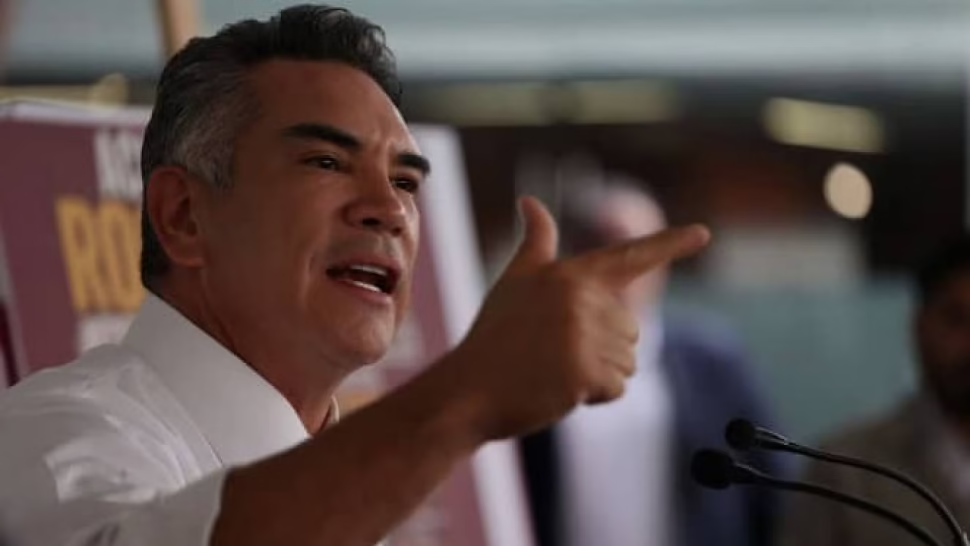
Alejandro Moreno Cárdenas, president of the party, asked the authorities to guarantee the safety of the families. He warned that these events should not be normalized due to the risk they represent for the civilian population.

The leader pointed out that in various communities in Guerrero they live under siege by armed groups. This has caused displacement, confinement of inhabitants and a constant climate of fear and uncertainty. He considered an immediate response from the State necessary.

Moreno Cárdenas also criticized the federal government for minimizing the situation of violence in the country. He affirmed that the population faces conditions of insecurity that require priority attention to restore the rule of law in the region.

Continue reading