Guide to the astronomical events of November 2025

The night sky is adorned with light shows, from fireballs to the most impressive Moon of the year.

A month of intense celestial activity

November 2025 is presented as a period of exceptional astronomical dynamism, offering amateurs and experts a succession of celestial phenomena of notable relevance. The cosmic agenda includes everything from the Super Castor Moon, cataloged as the largest and brightest of the entire year, to the presence of multiple meteor showers that will cross the night sky. This detailed analysis aims to break down each event, providing precise dates, scientific context, and observing recommendations based on astronomical data for an optimal observing experience.

The Super Castor Moon: An Orbital Proximity Event

The high point of the month will take place on November 5 at 07:19 hours, central Mexico time. This phenomenon, known as the Super Beaver Moon, represents the instant in which the full moon coincides with the perigee, the point in the lunar orbit closest to Earth. Although the exact moment of full light is brief, the lunar disk will be seen completely illuminated during the nights of November 4 and 6, offering a prolonged observation window.

RelatedSuper Beaver Moon 2025 will be the largest Moon of the year

According to National Geographic publications, this event is distinguished by presenting our natural satellite with an apparent diameter up to 14% greater and a brightness that can exceed by 30% that of a full Moon at its apogee. This orbital configuration is not an isolated event; It is part of a series of supermoons that included the October event and will culminate with the December one, closing the annual cycle.

Meteor showers and lunar light interference

At the same time, the Southern Taurid Meteor Shower will reach its maximum activity during the night of November 4 to 5. This swarm of particles, caused by debris from Comet Encke, is one of two branches of the complex Taurid system, occasionally known to produce exceptionally bright fireballs. However, astronomical research poses a challenge for observers in 2025: the peak of the Southern Taurids temporally coincides with the Super Castor Moon.

The astronomy portal Star Walk warns that the intense luminosity of the satellite will act as a natural light pollutant, severely hindering the visibility of the faintest meteors. The expert recommendation is to postpone deep observation of this meteor shower until the lunar phase is less prominent, thus prioritizing the quality of the experience.

Other notable phenomena of the month

Meteor activity continues throughout November. The complementary branch, the Northern Taurids, will have its peak of activity during the night of November 11 to 12. Subsequently, the famous Leonids, famous for their historic outbursts, will reach their maximum zenith hourly rate in the early morning of the 17th to 18th of the month. These particles, derived from comet 55P/Tempel-Tuttle, promise a spectacle independent of previous lunar interference.

The lunar cycle will complete with the New Moon on November 20. This phase, characterized by the absence of lunar light, creates ideal conditions for deep astronomical observation, offering a dark sky perfect for the exploration of deep sky objects such as nebulae, star clusters and distant galaxies.

The conjunction of these events makes November 2025 a month of extraordinary interest for the scientific community and space enthusiasts. Meticulous planning and understanding the celestial mechanisms behind each phenomenon are key to making the most of these observing opportunities.

Share this celestial guide with other astronomy lovers on your social networks and explore more content about the mysteries of the universe on our platform.
NASA takes the 2026 World Cup ball into space and plays it on the ISS

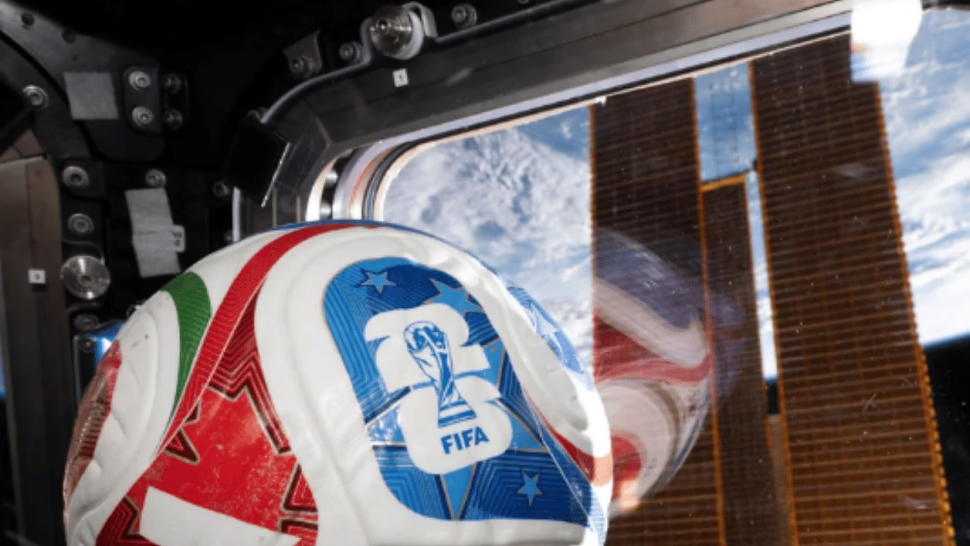
NASA sent an official 2026 World Cup ball into space and opened an exhibition in Houston.

World Cup ball arrives at the International Space Station

The fever of the 2026 World Cup permeated the atmosphere. NASA sent an official World Cup ball to the International Space Station (ISS). In a video shared on social networks, four astronauts are seen playing with the ball in microgravity. The message: “We work to inspire the next generation by showing how space exploration drives innovation in sports science.”

The agency seeks to disseminate how research on the ISS generates advances in science, technology and human health. Benefits that even reach the soccer field.

Exhibition at the FIFA Fan Fest in Houston

NASA set up an exhibit at the FIFA Fan Fest in Houston, Texas. It opened on June 11 at the start of the World Cup and will be available until July 19. Visitors can discover how space research improves life on Earth and learn about the Artemis program missions.

The exhibition explains how more than 25 years of studies on the ISS have helped understand the aerodynamics of the ball. According to a statement from the Johnson Space Center, previous research analyzed how internal mass, sensors and seam texture affect stability and rotation under real-play conditions.

Science applied to sports

As part of the project, NASA and Adidas present the “STEMonstration” demo. They compare how balls spin with different balance in microgravity. The objective: to show that space discoveries benefit athletes and fans of the most popular sport in the world.

Continue reading

Users report massive drop in X this Monday

Users report problems accessing social network X this Monday, June 22.

Cuts in X during Monday

Users of the social network X, formerly Twitter, reported this Monday, June 22, difficulties accessing and browsing the platform. According to data from DownDetector, a site that monitors digital failures, 1,131 people have reported problems with the application, loading the main feed and connecting to servers.

The most common issues include the inability to refresh the home page, errors when displaying posts, and crashes when using basic functions. When trying to log in, some see messages like “Something went wrong. Try loading again,” without the platform recovering.

So far, X has not issued an official statement on the origin of the failures or the estimated time to restore service.

Continue reading

How artificial intelligence transforms global security

Motorola Solutions is committed to hybrid models and agentic AI in the transformation of the sector.

Security industry: cloud migration and artificial intelligence

Security is undergoing a profound transformation. The cloud, generative artificial intelligence and video surveillance systems as decision tools are redefining the sector. This was stated by Pedro Simoes, global vice president of video security and analytics at Motorola Solutions.

“The cloud is a very strong trend, but it is not a solution for all sectors,” he explained. Prison facilities, airports and nuclear plants require hybrid models that combine local infrastructure with cloud services. Motorola Solutions is committed to unified platforms.

One of the key advances is agentic artificial intelligence. The company introduced Operator, a platform that integrates video, access controls and sensors in a single interface. The objective: reduce the time between detection and response. “It’s not just identifying. It’s being collaborative in decisions,” said Simoes.

The role of sensors in smart cities

Cameras no longer just record: they are sensors. “Today a camera produces data that can be used to optimize logistics, mobility or business decisions,” he added. Security information extends to multiple applications.

However, the growth of AI poses privacy challenges. Motorola Solutions developed “AI nutrition labels,” documents that detail capabilities and limitations of its models. “We are the first company in the sector to create and use this type of labels,” said Simoes.

Mexico and the 2026 World Cup

Mexico is experiencing a key moment for the 2026 FIFA World Cup. The arrival of millions of visitors is driving investments in technological infrastructure and security in airports, hotels and stadiums. Simoes confirmed collaboration with governments, without revealing details. “Safety is a priority; our responsibility is to develop technology that protects people and infrastructure.”

He recommended organizations think long term: “The decision should not be based only on current problems, but on the challenges of three or five years.” The combination of cloud, generative AI and unified platforms will define the next stage of the sector.

Continue reading