Government stops possible increase in the price of tortilla

Authorities rule out an increase in the price of tortillas and warn of unjustified increases that affect families.

The drama of the kilo of tortillas: real threat or political theater?

The authorities came to the rescue quickly. Very fast. The Ministry of Agriculture and Profeco released a joint statement to rule out any justification that could lead to an increase in the price of tortillas. The message is clear: there is no increase in the cost of corn or flour that supports raising the basic product par excellence.

“They made a strong call to avoid unjustified increases in the price of tortillas to the detriment of the population”

This is where the plot gets interesting. Why this announcement now? What are they seeing that we aren’t? Like any good political drama, there are always actors behind the scenes.

RelatedGovernment and tortilla makers agree to stop the rise in the price of tortillas

The agreement that few know about

It turns out that there is a National Corn-Tortilla Agreement where the majority of industrialists committed to maintaining stable prices. Canami and UNIMT publicly ratified that commitment. They say there is no technical or economic justification for an increase.

But I wonder: if everything is so controlled, why does the government need to remind everyone?

Profeco has eyes on 603 tortilla shops nationwide as part of the Who’s Who in Prices program. They review compliance monthly. It’s like having an inspector on every corner.

My wife, a teacher, tells me that at her school the mothers already comment on the prices. My teenage daughters notice when the pantry gets tighter. This is not economic theory—it is everyday life.

The government is working to organize the entire chain, from the producer to the tortilla factory. They talk about food sovereignty and protection of purchasing power. Nice words, but what matters is what you pay tomorrow for your kilo.

The next time you hear rumors about raises, remember this move. Someone tried to raise the curtain on a new inflationary act, and the authorities lowered the curtain before it began. The political theater continues, but for now, the tables remain in place.

Sheinbaum orders to review FBI donation of small plane used in capture

Sheinbaum asks to review the FBI's donation of the aircraft used in the transfer of Zambada and Guzmán López.

Official review after FBI donation

President Claudia Sheinbaum instructed the Ministry of Foreign Affairs (SRE) and the Security Cabinet to analyze the case of the small plane that the FBI donated to a museum in New Mexico. The aircraft transported Ismael “El Mayo” Zambada and Joaquín Guzmán López from Mexico to the United States in July, where they were detained.

During his morning conference in Morelia, Michoacán, Sheinbaum indicated that he will speak on the issue next week. “I asked the SRE and the Security Cabinet to carry out this review and, if they agree, we will comment next week,” he said.

Questions about FBI involvement

Given the insistence of the press on whether the donation confirms the FBI’s participation in the operation, the president avoided advancing conclusions. “Let’s review. Yesterday we saw the Pie de Nota report,” he added.

The plane was delivered by the US agency to a cultural venue, which has generated debate about the role of US authorities in the capture of the kingpins. Sheinbaum did not provide more details until the requested analysis was available.

Continue reading

Sheinbaum details Plan Michoacán: 54 billion and 850 thousand services

Sheinbaum presents progress of the Michoacán Plan with 54 billion in investments and more than 850 thousand services.

Sheinbaum heads the evaluation of the Michoacán Plan

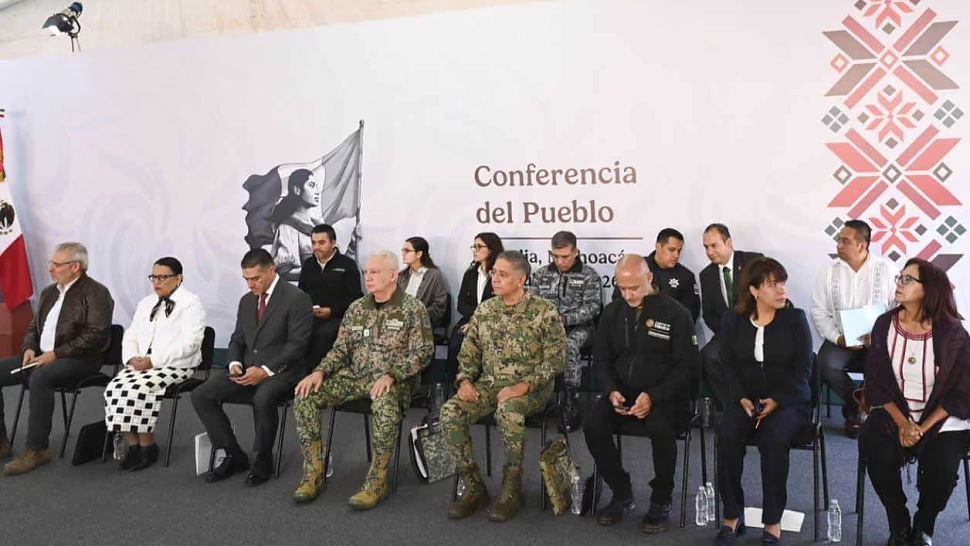
President Claudia Sheinbaum led the presentation of progress of the Michoacán Plan for Peace and Justice in Morelia. The federal deployment seeks to consolidate the development of the state hand in hand with the Justice Plan of the P’urhépecha People.

“We are going to continue looking at Michoacán with the objective of advancing peace and justice for the people of Michoacán,” he stressed.

More than 850 thousand services at Wellness Fairs

The Secretary of the Interior, Rosa Icela Rodríguez, reported that from November 19, 2025 to July 2, 2026, 850,679 services and procedures were granted in 68 municipalities, with 77 federal and state agencies.

He also detailed that the Welfare Markets delivered more than 2 million basic necessities to 27,050 families.

Million dollar investment in infrastructure

The global investment is around 54 billion pesos, of which 16 billion correspond to 2026. They are allocated to the conservation and modernization of 411 kilometers of highways, artisanal roads and the “MegaBachetón” program.

In education, the “Rita Cetina”, “Benito Juárez” and “Gertrudis Bocanegra” scholarship programs provide 5.7 billion pesos for 842 thousand students.

In addition, 1,627 million pesos were dispersed in favor of 166,000 agricultural and fishing producers through Production for Wellbeing and Free Fertilizers.

Indigenous development in the P’urhépecha region

The construction of the National Guard barracks in Cherán, the construction of hospitals, credits for artisans and the publication in the Official Gazette of the geographical indication of the avocado to protect its value stand out.

Continue reading

Sheinbaum: eradicating extortion in Michoacán is a priority of the Federal Government

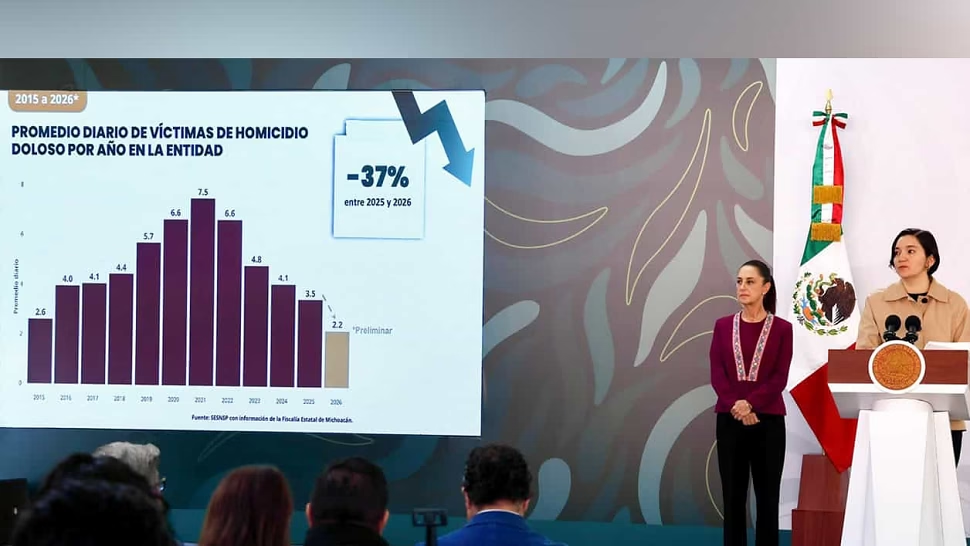
Federal government reports 46% drop in homicides in Michoacán; prioritizes combat over extortion.

Security strategy in Michoacán

President Claudia Sheinbaum affirmed that the priority objective of the Federal Government in Michoacán is to build peace and completely eradicate extortion. This crime directly affects producers and merchants from various regions of the state.

During the morning conference in the 21st Military Zone of Morelia, Sheinbaum highlighted that the National Security Strategy has achieved a 46% reduction in intentional homicides. The daily average of victims went from 4.32 in January 2025 to 2.33 at the end of June 2026.

Marcela Figueroa Franco, executive secretary of the National Public Security System, explained that June 2026 was positioned as the period with the fewest homicides since 2015. The year-on-year reduction was 43%. In addition, the daily average of high-impact crimes fell from 18.1 cases in 2025 to 17.5 in the sixth month of 2026.

For his part, Omar García Harfuch, Secretary of Security and Citizen Protection, explained that the actions are based on four axes: greater territorial deployment, intelligence work to dismantle criminal networks, comprehensive coordination with Michoacan authorities and direct protection of productive chains such as packers and producers of avocado and lemon.

Thanks to this scheme, the arrest of 1,300 people was reported, the seizure of 1,400 firearms and the disabling of 30 clandestine methamphetamine laboratories.

Continue reading