Government of Aguascalientes boasts figures in the fight against cancer

State authorities report figures for chemotherapy and radiotherapy, highlighting new technology at the main hospital.

The happy accounts of health

Rubén Galaviz Tristán, Secretary of Health of Aguascalientes, presented numbers that sound like victory. In three years, he said, 24,284 chemotherapies were performed. Of them, 17 thousand for adults and more than 7 thousand for pediatric patients.

The official put the Centenario Hospital Miguel Hidalgo as the banner of this battle. He described it as having specialized staff, modern infrastructure and high-quality treatments.

“With cutting-edge technology and specialized care, Aguascalientes strengthens the fight against cancer,” said Galaviz Tristán.

And of course, he did not forget to mention the commitment of Governor Tere Jiménez Esquivel. Promises of more prevention, timely detection and access to treatments. The usual.

RelatedAguascalientes receives international award for neurology and kidney health

The jewel in the crown: a linear accelerator

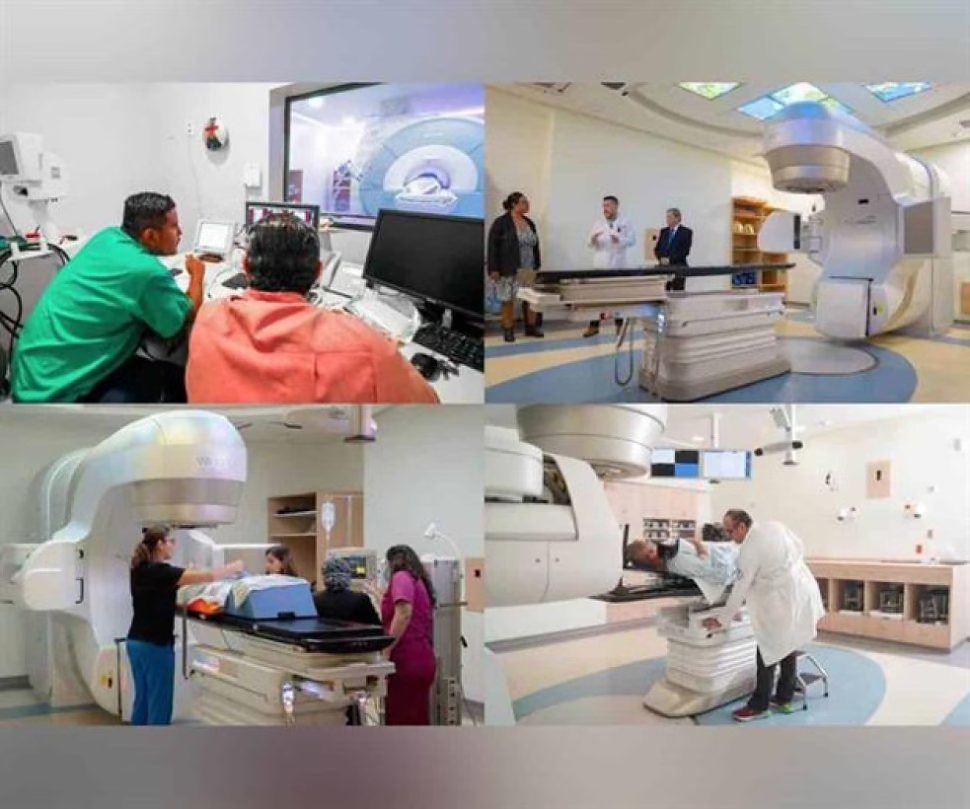
The big news seems to be a linear accelerator. They describe it as the most complete and modern in the country. According to the figures, from July 2023 to November 2025 it treated 855 patients.

In that same period, 25,183 sessions of radiotherapy were granted. The number of patients treated with this machine, they say, increased by 150 percent.

They argue that sessions now last between seven and ten minutes. Less time, more chances of recovery and fewer sequelae. It sounds good on paper.

To top it all off, Galaviz Tristán highlighted that the Secretariat operates three high-tech mammography machines. They are in Rincón de Romos, the Women’s Hospital and Hidalgo. There is even a mobile one that travels through municipalities.

The figures are on the table. The official story is clear: capacity, continuity and cutting-edge technology. It remains for patients and their families to say whether the numbers translate into real relief.

Sheinbaum highlights record in clean energy and economic rebound

Sheinbaum reports historic growth in renewables and low inflation at 3.55%.

Economy and energy: the president’s announcements

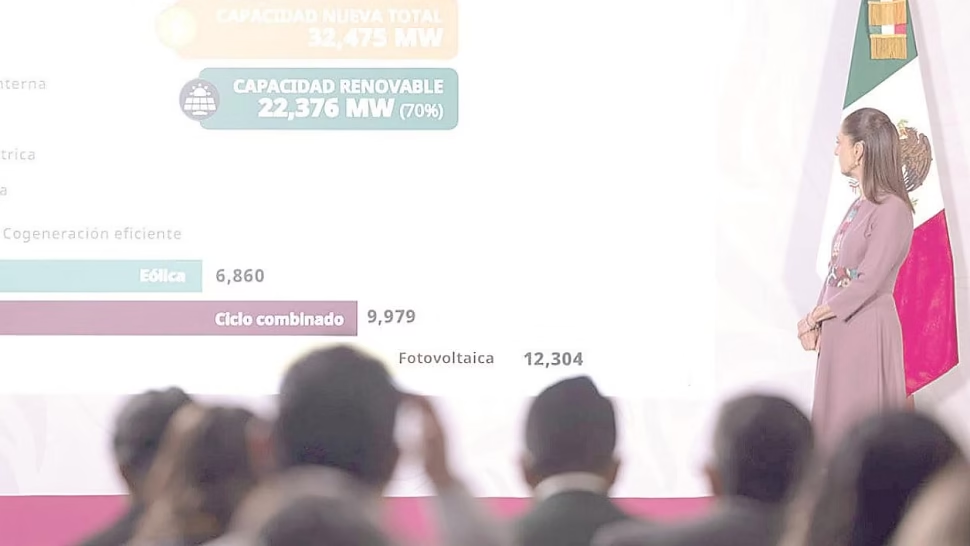
President Claudia Sheinbaum reported that, for the first time, Mexico has projects for 32 thousand megawatts of additional electrical capacity, of which 70% are renewable. “When we leave the government, natural gas consumption will decrease and energy generated by renewable resources will increase,” he stated.

Sheinbaum also highlighted economic growth. According to Inegi, the Global Indicator of Economic Activity (IGAE) rose 1.2% in April compared to March, the best advance since 2021. The annual rate reached 2.2%. The president attributed this to the boost in construction, especially the housing program.

Regarding inflation, the president pointed out that it fell to 3.55% annually in the first half of June, its lowest level since October 2025. This is due, she said, to agreements with gas stations to set maximum fuel prices and the Package Against Inflation and Scarcity (Pacic) to control the basic basket.

Energy transition with 32 thousand megawatts

The Secretary of Energy, Luz Elena González, explained that by 2030 32 thousand megawatts will be added; 22 thousand will be renewable. The goal is for at least 38% of generation to be clean to meet climate commitments. He assured that the CFE will maintain its majority participation, providing 61% of the electricity at the end of the six-year term.

The director of CFE, Emilia Calleja, explained the projects. In Baja California Sur, the Oasis System will combine solar energy, batteries and green hydrogen to supply Mulegé and 40 thousand homes. It includes a 72 megawatt plant, 20 megawatt storage and will produce 120 cubic meters of water per year, avoiding 94 thousand tons of CO2.

In Sonora, the “Rafael Galván” photovoltaic plant in Puerto Peñasco will reach one thousand megawatts of capacity and 246 megawatts of storage. It currently provides 400 megawatts. The investment exceeds 1.4 billion dollars. “They are environmental benefits that strengthen energy sovereignty,” concluded Secretary González.

Continue reading

Controversy over an interview with Monsiváis reaches the Senate and the Palace

The republication of a 1999 interview unleashes accusations between the Executive and legislators.

The republication of an old interview attributed to Carlos Monsiváis climbed to the center of the Mexican political debate this Wednesday. The issue was discussed both in the Senate and in President Claudia Sheinbaum’s morning conference.

The original text was written by journalist Edmundo Cázares in 1999 and recently republished by El Universal. It contains statements about the then head of Government Andrés Manuel López Obrador. Its veracity and context have been questioned, generating conflicting positions.

Sheinbaum describes the content as “grotesque”

During her conference, the president harshly criticized the publication. He described the content as “grotesque” and accused the medium of generating a controversy that distorts the tribute to the Mexican intellectual.

Reactions in the Senate

The issue also reached Congress. Senator Lilly Téllez read fragments of the text on the platform. In response, Gerardo Fernández Noroña rejected its use and maintained that it was a false publication with the intention of political attack.

The exchange reflects the polarization around the figure of López Obrador and the use of historical documents as partisan weapons.

Continue reading

PRI demands urgent action against violence in Guerrero

They denounce an incursion of armed civilians in Coyuca de Catalán; party calls for state intervention.

The national leadership of the PRI demanded that the Mexican State intervene urgently in response to the complaint by inhabitants of the Guajes de Ayala ejido, in Coyuca de Catalán, Guerrero. The residents reported the incursion of armed civilians into their community in the Sierra.

Call for safety

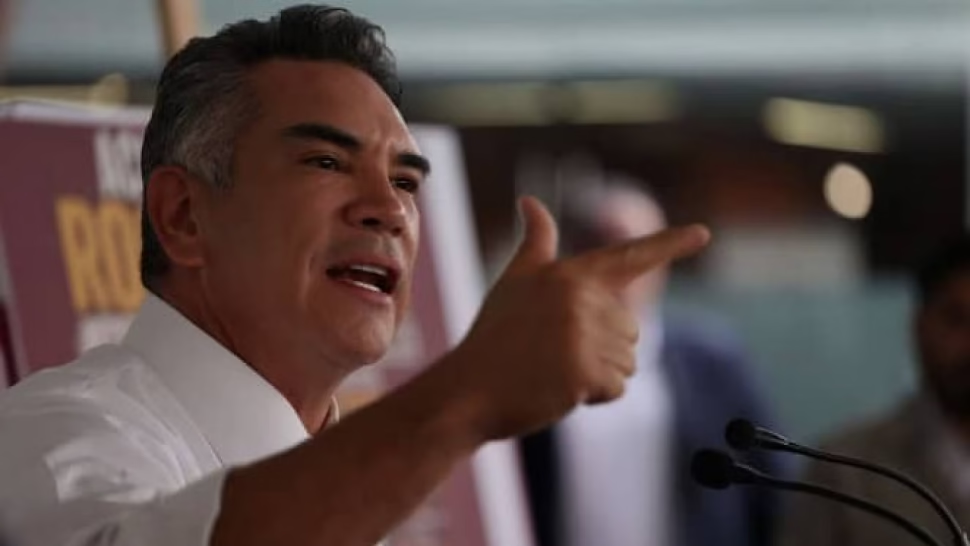
Alejandro Moreno Cárdenas, president of the party, asked the authorities to guarantee the safety of the families. He warned that these events should not be normalized due to the risk they represent for the civilian population.

The leader pointed out that in various communities in Guerrero they live under siege by armed groups. This has caused displacement, confinement of inhabitants and a constant climate of fear and uncertainty. He considered an immediate response from the State necessary.

Moreno Cárdenas also criticized the federal government for minimizing the situation of violence in the country. He affirmed that the population faces conditions of insecurity that require priority attention to restore the rule of law in the region.

Continue reading