Government announces date for second support for victims

The federal government announces the details and amounts of upcoming financial aid for those affected by the floods.

Finally the (economic) reinforcements arrive

In a turn of events that no one saw coming (well, actually everyone expected it after the disaster), the Government of Mexico has decided to remind the citizens of five states, who are still splashing through memories and mud, that it exists. Yes, it has announced the long-awaited – and for some, mythological – date for the delivery of the second financial support. Aimed at families who lost almost everything in Veracruz, Puebla, Hidalgo, San Luis Potosí and Querétaro, this aid comes after the October rains decided to remodel the urban and rural landscape without permission.

The news, communicated with the immediacy of the 21st century through a publication on social networks (because the municipal sides are no longer cool), reveals that the amounts will range between 20 thousand and 70 thousand pesos. The final figure, of course, depends on a complex algorithm that evaluates your home’s level of affinity with a pool. Or, in more serious terms, the seriousness of the effects on the assets of each family, as long as they have been counted. A shame for those who were too busy swimming to get on the list.

RelatedGovernment announces millionaire support for rain victims

Reconstruction: An act of faith or a promise?

As if it were a trailer for a movie that we may never see, the government added, almost in passing, that the fascinating stage of reconstruction and relocation is also being prepared. Sounds good, right? It is that magical moment in which rubble becomes hope (hope, for those who don’t buy anglicisms). And let’s not forget the agricultural sector in these five states, because what would we be without our farmers, whose fields are now better suited to growing seaweed than corn? There will also be distribution of resources for them. Promised.

The big question, the one that all those affected ask themselves while drying their photo albums: When will the money arrive?. Put the date on your calendars, preferably a waterproof one: the delivery will begin on November 10. A strategically chosen date so that the victims can, with a little luck, begin to put their lives back together just before the end of the year. All of this, they tell us, with the laudable intention of helping Mexicans return to their “normality.” A normality that, for 82 people, is unfortunately no longer an option.

To round out the action plan (or the wish list, who knows), president Claudia Sheinbaum announced last Friday, October 31 – a date associated with scares, which is not a coincidence – that they will continue to distribute pantries and household goods. Because nothing says “starting over” like a can of tuna and a new pot in the middle of what used to be your living room. A gesture that, without a doubt, is better than a blow to the head, but that makes it clear that the path to full recovery is longer than the line for government support.

Do you know anyone in these affected areas? Share this information on your social networks so that help, or at least the news that it is on the way, reaches everyone. Or, explore more content related to natural disaster management to understand the real challenge these communities face.
Sheinbaum announces 42 CT scanners and telemedicine to strengthen health

The president detailed investments in medical equipment, telemedicine and improvement of clinics.

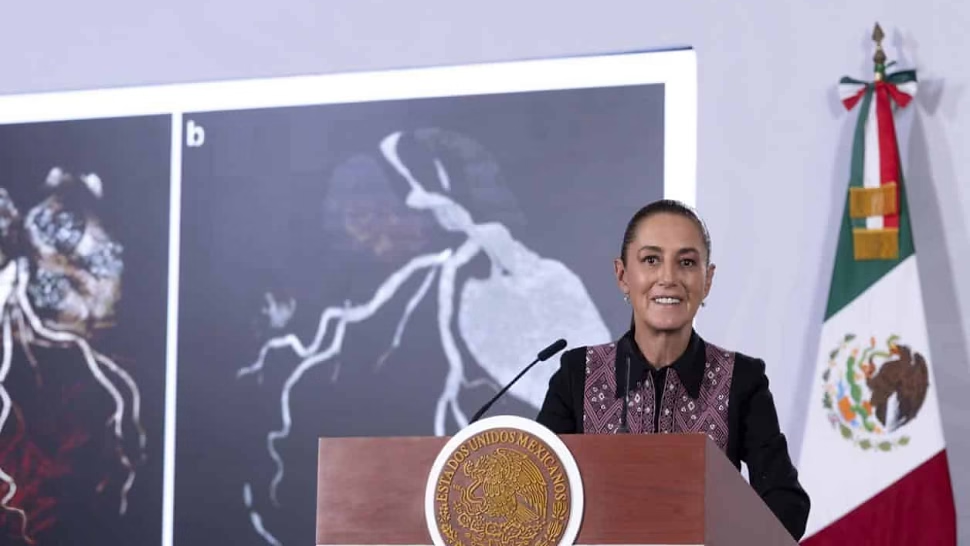
President Claudia Sheinbaum reported on advances in the public health system, with investments in equipment, telemedicine and improvement of clinics. He affirmed that the State must guarantee access to health from prevention to care for complex diseases.

“We are compensating for the profound damage that neoliberalism caused in the health system,” he said at the morning conference.

Equipment and telemedicine

The IMSS installed 42 state-of-the-art CT scanners in 40 hospitals in 19 states. Of these, 41 are from 256 cuts. They allow early detection of tumors and bleeding, perform up to 50 studies per day and reduce waiting times. They were acquired for 29 million pesos each, below the 40 million in the past.

The ISSSTE expanded telemedicine from 239 to 859 units. It offers consultations in 15 specialties, such as cardiology and dermatology, from 118 second and third level units to 741 first level.

The Clinic is Ours

The La Clínica es Nuestra program delivered 4,608 million pesos in 2025 to 8,483 medical units, with the participation of 67,864 people. 42 thousand improvement actions were carried out in infrastructure and equipment. The 2026 call will begin in July, including for the first time 153 units from Yucatán with 80 million pesos.

Sheinbaum added that progress is being made in the House to House Health program, with more than 20 million consultations with older adults and people with disabilities. Starting in August-September, you will be able to collect medications at Farmacias del Bienestar, health centers and a network of pharmacies. Next year the Universal Health Service will begin with a single credential.

Continue reading

Massive security reinforcement and alcohol ban at the Azteca

56,000 police officers and alcohol restriction for the game at the Azteca.

Measures for the Mexico-Czech Republic match

The government of Mexico City announced an unprecedented security operation for this Wednesday’s game at the Azteca stadium. 56,000 personnel will be deployed, five times more than the 11,219 employed last week.

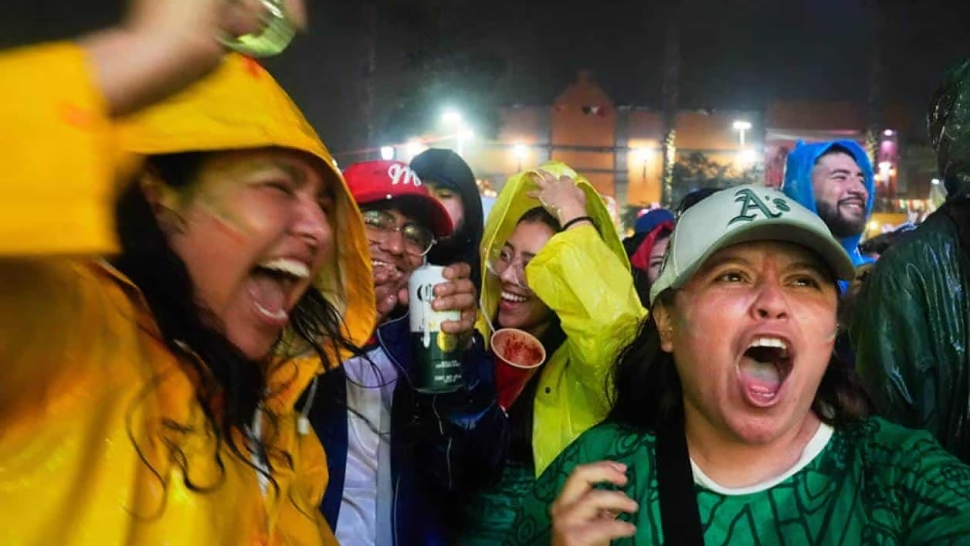
The decision responds to the celebrations of the previous Thursday, when some 700,000 people gathered in the capital after Mexico’s victory over South Korea. Although there were no injuries, nearly 40 tons of garbage were collected in the Ángel de la Independencia and the Zócalo.

The Secretary of Security, Pablo Vázquez, detailed that 7,500 police officers will guard the Azteca stadium. Another 3,275 will be in the Zócalo and 4,200 on Reforma Avenue. The objective is to protect players, referees, authorities and fans.

In addition, the Secretary of Government, César Cravioto, reported that starting at 3 p.m. on June 24, a ban on the sale of alcohol will take effect for sixteen hours. Applies to the Historic Center and five neighborhoods of Cuauhtémoc.

Sales will only be allowed in restaurants, hotels and private clubs, accompanied by food. Convenience stores and supermarkets are excluded. The fines for non-compliance amount to up to 293,275 pesos (about $17,251).

The Mexican Alliance of Transporters Organization (AMOTAC) called for mobilizations on highways in the 32 states and blockades in the capital to protest against the violence. The operation also considers these protests.

Continue reading

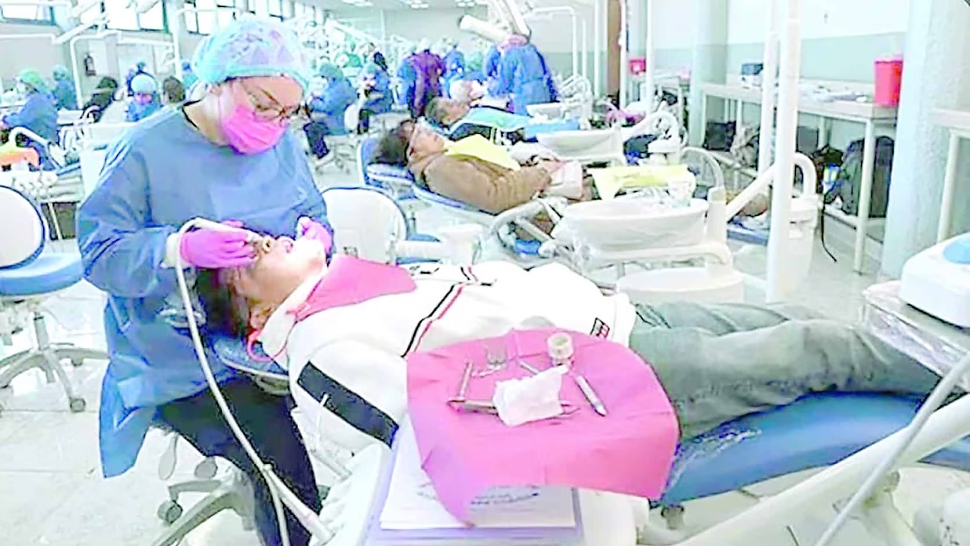
UNAM, new WHO collaborating center in oral health

The WHO recognizes UNAM as a reference in oral health and aging.

International recognition for UNAM

The World Health Organization (WHO) designated the Department of Oral Public Health of the UNAM Faculty of Dentistry as a Collaborating Center in Oral Health and Aging. The distinction is valid for four years.

With this appointment, the highest educational institution consolidates itself as a regional reference in the comprehensive care of older adults.

Implications of the appointment

The recognition will allow university specialists to participate in the development of public policies focused on improving the quality of life of the elderly.

In addition, they will promote strategies to promote among older adults and caregivers the importance of maintaining adequate oral health as an essential part of general well-being.

The designation places UNAM on a level of technical cooperation with the WHO, which opens opportunities to influence global guidelines on aging and oral health.

Continue reading