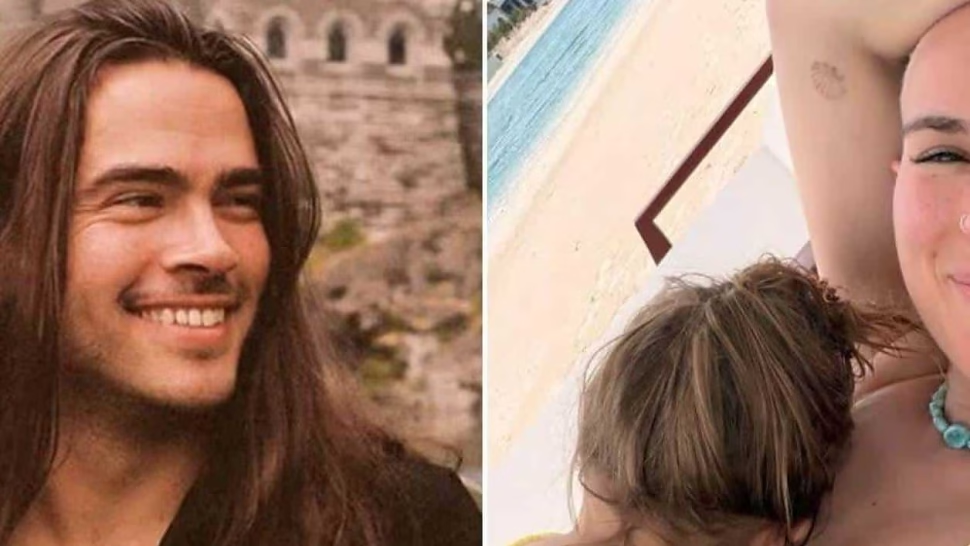
The actress Ginny Hoffman has made a deep and public reflection on one of the most painful chapters of her family life: the complaint of sexual abuse that her daughter, Alexa, filed against her father, the actor Héctor Parra. In an interview for his brother’s YouTube channel, Ryan “Rayito” Hoffman, Hoffman candidly addressed not only the trauma he experienced, but also the decisions made during the process, among which he identified a crucial error: the media coverage of the case in an entertainment magazine.
A fatal error in crisis management
With a tone of sincere regret, Ginny Hoffman analyzed the sequence of events that led to the case being aired in the media. The situation erupted publicly after, during a press conference, Hoffman was questioned about the reasons why her daughter did not see her father. His response, “This man knows perfectly well why he doesn’t see her, a dad doesn’t do the crap he did”, acted as a trigger. This statement, according to what he says, caused Héctor Parra, accompanied by his other daughter, Daniela, to go to the media to demand explanations, which generated a spiral of public speculation.
It was in this context of media pressure that Alexa, who initially wanted to keep the complaint secret, decided to break her silence. Hoffman was categorical in clarifying an essential point: “We never received a cent from that magazine, neither was it offered to us nor did we ask for it.” He explained that the choice of a written medium, specifically the magazine “TVNotas”, responded to Alexa’s desire not to expose herself to the cameras, looking for a channel that would allow her to control her narrative to a certain extent, although with the benefit of hindsight, her mother now sees that decision as a mistake.
Family fracture and support for the aggressor
One of the aspects that generates the greatest pain for Ginny Hoffman is the position adopted by Daniela, Alexa’s half-sister. Hoffman argues that the unconditional support that Daniela has given to Héctor Parra transcends filial loyalty to become support for a person convicted of serious crimes. With a direct analysis, Hoffman expresses: “How sad to support and raise your voice to defend an abuser… you are covering for a pedophile, sorry, but things are what they are.” He points out that, in his perspective, Parra exercises significant control over Daniela, using her as a spokesperson for messages aimed at public opinion, which deepens the wound and isolation of the main victim.
The legal process has concluded with the deprivation of liberty of Héctor Parra, after being found guilty of the crimes of sexual abuse and corruption of minors. However, the emotional process for Hoffman and his daughter is far from closed. The actress confesses to carrying a constant feeling of guilt, despite having ignored the events while they were happening. She insists that she was unaware of the abuse until Alexa, years later, made the brave decision to confess to her. However, this fact does not mitigate his self-reproach, and he maintains a permanent dialogue of apologies with his daughter, recognizing the failure in his protective role.
This case transcends the scope of entertainment to become a study on the mechanisms of power, manipulation and the complex dynamics that arise in families when abuse is revealed. Hoffman’s reflection brings to the table the risks of judicializing a case of this nature in the public arena, where the search for justice can be intertwined with the logic of the media scandal, re-victimizing those who have already suffered profound damage. Their testimony underlines the importance of handling these processes with extreme caution, prioritizing the psychological well-being of the victim and the rigor of formal legal channels over exposure in the sensational press.
If this analysis on the consequences of media exposure in cases of violence seems relevant to you, share it on your social networks to expand the conversation. Explore more content related to victims’ rights and justice in our special reports section.