García Harfuch rules out presidential candidacy for 2030

The Secretary of Security rules out aspiring to the Presidency in 2030 and recognizes the work of the cabinet.

Omar García Harfuch, Secretary of Security and Citizen Protection (SSPC), distanced himself from any presidential aspiration towards 2030. In an interview with Azucena Uresti for Grupo Formula, he described it as “irresponsible” and “a lack of respect” to think about a political position while heading the agency.

No parallel agenda

“I rule it out because I am Secretary of Security. There is no way I can think about anything other than being Secretary of Security until the President decides,” he stated.

RelatedOmar García Harfuch consolidates himself as the axis of security in Mexico

The official, who enjoys high popularity, attributed his public recognition to being the visible face of the National Security Strategy. However, he clarified that the achievements “are not those of Omar García or the SSPC itself,” but of the Security Cabinet as a whole.

“They are results from the entire cabinet: Secretary of Defense, National Guard, Secretary of the Navy. That helps them identify us more with good results, but they are from the entire cabinet,” he stressed.

Recognition of the operatives

García Harfuch highlighted that every month President Claudia Sheinbaum awards, in a private ceremony, elements of the Army, Navy, National Guard and SSPC. They are, he said, the ones who “truly execute the National Security Strategy in the territory.”

Regarding Sheinbaum’s leadership, he noted that his high approval strengthens the coordination of the cabinet, whose work “is not political.”

“Such close coordination is facilitated when there is very strong leadership, like that of the president herself. Having the president directing makes a difference. It is noticeable when a ruler gets involved in matters of security,” he concluded.

Sheinbaum inaugurates power plant that will contribute 653 MW to the national grid

The new plant in Mexicali reinforces energy sovereignty with historic investment.

President Claudia Sheinbaum launched the González Ortega Combined Cycle Power Plant, operated by the CFE in Mexicali, Baja California. The plant will contribute 653 megawatts to the National Electric System as part of a six-year goal of 32 thousand new MW.

“This vision that energy production in Mexico has to have at least three characteristics: the first is to guarantee national sovereignty; the second is to reduce its environmental impacts, sustainability; and the third is social justice,” said the president.

Benefits for Baja California

Sheinbaum also announced the renovation of 4,000 electrical poles in the region to reduce service interruptions. The director of CFE, Emilia Calleja, explained that the plant will generate more than 5 thousand gigawatt-hours per year, with direct benefit for the months of greatest demand for heat.

Of the 32 thousand MW planned, 22 thousand will come from renewable sources. The CFE will increase its participation in generation from 54 to 60 percent, supported by constitutional changes that guarantee priority to its plants over private ones.

Governor Marina del Pilar Ávila highlighted an investment of more than 73,900 million pesos in transmission, distribution and generation, in addition to a subsidy of 1,485 million for electricity rates in Mexicali and San Felipe, which will benefit more than 1.37 million people.

Since 2018, power supply continuity has improved 30 percent. Sheinbaum recognized the CFE workers and the women who lead the country’s energy strategy.

Continue reading

Update your INE credential: requirements for change of address

Documents and steps to modify your address in the INE without setbacks.

If you moved this year, updating the address on your voter registration card is a key step. The INE recommends doing so to participate in decisions in your new area and maintain an official document with true data.

What do you need?

Go to an INE module with these documents:

  • Legable birth certificate or Naturalization Letter (if you were not born in Mexico).
  • Recent proof of address: electricity, property or water bill.
  • Identification with valid photo: passport, professional ID card, driver’s license, military card, previous credential or school ID with photo.

Schedule your appointment

To speed up the process, the institution suggests scheduling an appointment on its official site. Go to www.ine.mx/credencial/, complete the required information with your CURP and full name. If you do not know your CURP, you can access it with name, date of birth and place of origin. There you will also locate the nearest module.

Continue reading

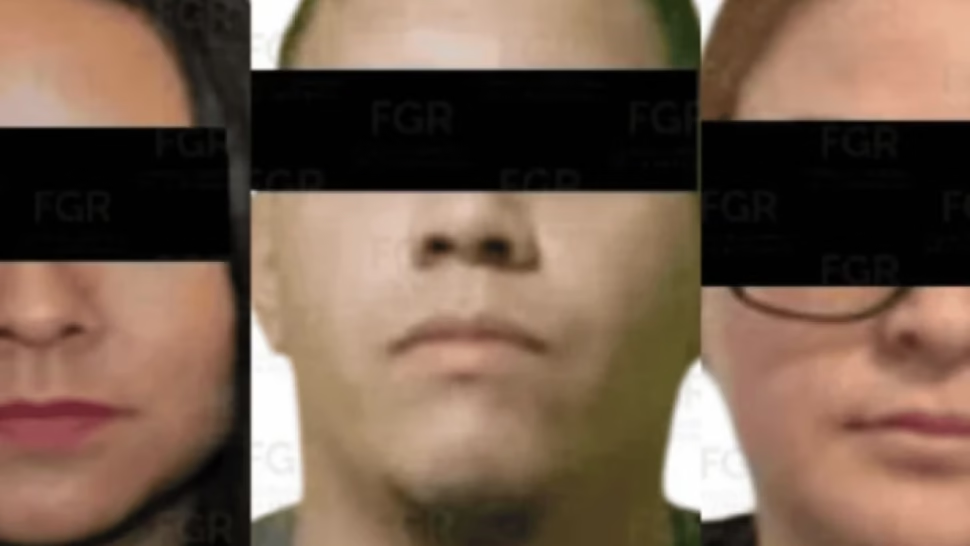
Three are linked to trial for kidnapping Indians in Juárez

Three alleged members of the Northeast Cartel, arrested for the kidnapping of five Indians in Juárez.

A Control judge linked Tomás “N”, Diana “N” and Jaqueline “N” to the trial for their probable responsibility in organized crime crimes for the purposes of kidnapping and aggravated kidnapping. The victims were five citizens of India, kidnapped in June 2025 in Ciudad Juárez, Chihuahua.

As a precautionary measure, the three defendants were placed in informal preventive detention in State Prisons 2 and 3 of the entity. The judge granted four months for the complementary investigation.

Investigation and capture

The case began when the Consul of the Indian Embassy in Mexico reported via email that five compatriots were deprived of their liberty. Based on that notice, the Special Prosecutor’s Office for Organized Crime (FEMDO) began the investigations.

Days later, agents of the Federal Ministerial Police, experts from the Federal Forensic Expert Center and elements of the National Guard executed a search warrant in five homes in Ciudad Juárez. Before these operations, the victims had already been released. During the investigations, they located the three men identified, who had current arrest warrants; They were secured and placed at the disposal of the judge.

Regional context

The connection to the process of these individuals—presumably linked to the Northeast Cartel—evidences the challenge that organized crime represents in the border area. The authorities have indicated that this type of crime affects both Mexican citizens and foreigners, and they maintain operations to dismantle kidnapping networks.

Continue reading