Federal deployment in Washington divides opinions regarding crime figures

The US capital intensifies its security with an unprecedented operation, while official data reveals contradictions in the government narrative.

Unprecedented context and deployment

In a move that has generated intense political debate, the federal administration announced the permanent deployment of National Guard agents and federal forces in Washington D.C., marking a milestone in the recent history of the American capital. This operation, active 24 hours a day since Wednesday, is based on Article 32 of the D.C. Code, which grants the president exceptional powers to assume police control for 30 days without requiring congressional approval.

Discrepancies in the fundamentals

While the White House justifies the measure by citing “emergency levels” in violent crime, data from the Metropolitan Police Department reveals an 18% reduction in homicides and a 23% reduction in robberies compared to the pandemic peak of 2022. Experts from the Council of Criminal Justice point out that, although Washington exceeds the national average, the trend follows the same downward line observed in 40 cities analyzed.

RelatedFederal intervention deploys agents in Washington DC

The operation already shows quantifiable results: 43 arrests in 48 hours, including arrests for illegal possession of weapons (7 seized) and driving under the influence. However, incidents such as the search of a motorist who was eating food in his vehicle have raised questions about the intervention criteria.

Strategic components and controversies

The plan covers three axes:

  • Police reinforcement: 1,450 federal and local agents coordinated
  • Logistics support: Up to 800 National Guard soldiers in non-combatant roles
  • Social intervention: Dismantling of camps for homeless people with provision of shelters

This last point has raised particular concern among human rights organizations. According to Park Police records, 34 camps have been removed since March, with alternatives including addiction treatment, although under threat of fines or arrest for refusal.

Institutional impact and legal loopholes

Police Chief Pamela Smith acknowledged that the department operates with 800 officers less than its optimal staffing. While local authorities see the operation as a temporary palliative, legal analysts warn of risks of prolongation: extending the 30 days would require legislative approval, unlikely given Democratic control of the Senate.

The District Council of Government issued a joint statement noting that “federalization contradicts principles of local autonomy,” especially when statistics show that current violent crime rates are the lowest in three decades.

Are you interested in understanding how security policies impact cities? Share this analysis on your social networks and explore more content on urban governance in our specialized section.
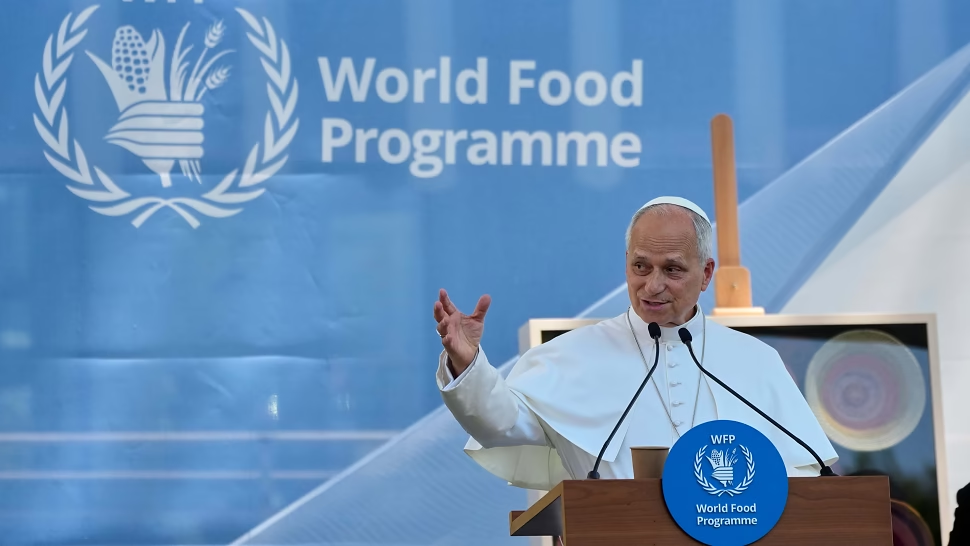
Leo XIV criticizes the ease of financing wars and not hunger

The pontiff warned about the drop in financing for food assistance from 2022.

Call from the pontiff in the face of the food crisis

Pope Leo XIV urged governments to allocate more resources to combat hunger. During a meeting in Rome with the UN World Food Program (WFP), he pointed out that it is easier to finance armed conflicts than to guarantee food for millions of people in vulnerable situations.

The pontiff warned that political and administrative obstacles delay humanitarian aid. In contrast, military spending is advancing with fewer obstacles. This paradox reflects a serious inequality in global priorities.

Leo XIV indicated that funding for food assistance has decreased considerably since 2022. Although needs increased due to conflicts, climate crises and economic problems, funds did not grow at the same pace.

He highlighted that recent international contributions, such as the one announced by the United States for the WFP, will benefit millions of people. However, he stressed that there is still a significant gap to cover the necessary resources.

Before the UN body, the pope called on world leaders to place human dignity at the center of their decisions. Strengthening international cooperation is key to confronting hunger and inequality.

Continue reading

Explosion at gas plant in Qatar leaves 13 dead

Explosion at gas terminal in Qatar leaves 13 dead and dozens injured.

Explosion in Ras Laffan: 13 dead and dozens injured

An explosion rocked the gas export terminal in Ras Laffan, one of Qatar’s most important energy facilities. The preliminary balance is 13 people dead and dozens injured.

The incident occurred while workers were trying to resume operations in the area. Work had stopped after previous clashes related to the conflict between Qatar and Iran.

Details of the accident

State-owned Qatar Energy confirmed that the explosion originated at the Barzan gas supply facility. The full extent of the damage caused by the fire is still unknown.

Ras Laffan is home to one of the world’s leading gas liquefaction plants. Disrupting its operations could lead to tensions in global energy markets, given that Qatar is a key exporter of natural gas.

Local authorities are investigating the causes of the explosion. It is not ruled out that technical problems or human failures may have contributed to the incident.

The accident adds to a context of instability in the region. The war with Iran had already affected the Qatari energy infrastructure, and this new fact complicates the recovery of the sector.

Continue reading

Ebola in Congo: 1,003 cases and 254 deaths from rare virus

Ebola outbreak reaches 1,003 confirmed cases in Congo. Difficulties in containing the virus.

Ebola outbreak in eastern Congo

The Ebola outbreak in eastern Democratic Republic of the Congo now has 1,003 confirmed cases. This is reported by the health authorities. Of that total, 254 people have died.

The Congo Ministry of Health indicated that since the outbreak was declared on May 15 in Ituri province, 100 people have recovered. However, 365 patients remain hospitalized or in isolation due to the seriousness of the situation.

A virus without specific treatment

Authorities warn that this outbreak is caused by the Bundibugyo virus, a rare strain. There is no vaccine or specific treatment for this variety. Therefore, they fear that the outbreak will be more extensive than what has been recorded so far. They recognize that the peak of infections has not yet arrived.

Tracing contacts of infected patients remains a challenge. This complicates the containment of the virus and the protection of the population.

Continue reading