Conalep students expelled for prank with isopropyl alcohol

A student 70% intoxicated after a prank that crossed the line of crime. Authorities are investigating possible criminal charges.

When the “joke” stops being funny and becomes a crime

Imagine the scene: any given Friday at the Conalep in San Luis Río Colorado. An electronics student, innocent and ignorant of his destiny, eats his cake peacefully. What he thought would be a normal day turned into a nightmare straight out of a teen horror movie, but without the Netflix budget. Two of his “colleagues”, in a burst of creativity worthy of a better cause, decided that offering isopropyl alcohol disguised as water was the new viral challenge. Spoiler alert: it wasn’t.

Our protagonist, confident as someone who believes that the last episode of his favorite series is going to have a satisfactory ending, had two good drinks. For the third, his body did what any organism with a survival instinct would do: it activated “this is not water” mode and spat it out. But the damage was already done. The sensation, according to reports, was as if a torch had been placed in his throat, esophagus and stomach. Come on, the detox plan that no one asked for.

RelatedDeputies seek to eliminate alcohol advertising in public spaces

From school to the emergency room in record time

The call to the mother was not the typical “ma’am, your son didn’t do his homework.” It was one of those calls that freezes your blood and makes you drop whatever you’re holding. Upon arriving at the campus, the scene was worthy of an episode of Grey’s Anatomy: ambulance and patrol, because apparently a medical tragedy is not complete without the police touch. They explained to him that his son had ingested a “substance.” A euphemism as big as saying that the Titanic had a little problem with an ice cube.

At the hospital, the doctors released the information that no one wants to hear: 70% poisoning and severe damage to internal organs. Seventy. By. Hundred. That figure is staggering. It’s not “he’s going to feel bad for a while”; It’s a “your body is literally at war with a poison.” The joke, in case anyone had doubts, had crossed the criminal line faster than a meme goes viral.

Faced with this nonsense, Conalep did not mess around. The following Wednesday, director Elsa Oralia Cruz issued a statement more formal than a suit for a wedding, announcing the immediate expulsion of the two geniuses of black humor. The institution, in an attempt to control the story, assured that it acted quickly by applying the corresponding protocol and that this saved the young man’s life. They also promised that they have reinforced surveillance, as if putting more eyes were the solution to someone giving poison to a colleague to drink.

But here comes the plot twist: the family of the affected student did not sit idly by. With the support of the Domestic Violence Attention Group, they filed a formal complaint with the Public Ministry. Now the ministerial authorities have an open investigation folder to determine the exact nature of the substance and, the juiciest thing, the possible criminal responsibilities of our frustrated comedians. Because what started as a “joke” between colleagues could end with someone facing the law, a much less funny ending.

The institution, in its statement, “strongly rejected any manifestation of harassment, harassment or bullying.” A statement as obvious as saying that water is wet, but necessary in a world where sometimes it seems that you have to remember the basics. They also urged parents to “contribute from home,” which is a fancy way of saying, “please educate your children not to poison anyone.”

This incident goes beyond the typical case of bullying. It’s a chilling reminder of how peer pressure, approval-seeking, or simple teenage stupidity can have irreversible consequences. Isopropyl alcohol, for those who don’t know, is that substance that you use to clean electronic components or disinfect, not to hydrate. You don’t need a master’s degree in chemistry to know that ingesting it is a bad idea.

The expulsion was the least that could happen. But the real drama is just beginning, with a criminal investigation underway that could redefine the future of these two students beyond any academic suspension. Meanwhile, the affected student recovers from massive poisoning that, we hope, does not leave long-term consequences. And all for a joke that, clearly, was not funny at all.

Do you think you know perfectly the limits between mischief and crime? Share this story to raise awareness and help prevent a similar “prank” from ruining more lives. Explore more content related to safety in educational environments on our social networks.
Sheinbaum announces 42 CT scanners and telemedicine to strengthen health

The president detailed investments in medical equipment, telemedicine and improvement of clinics.

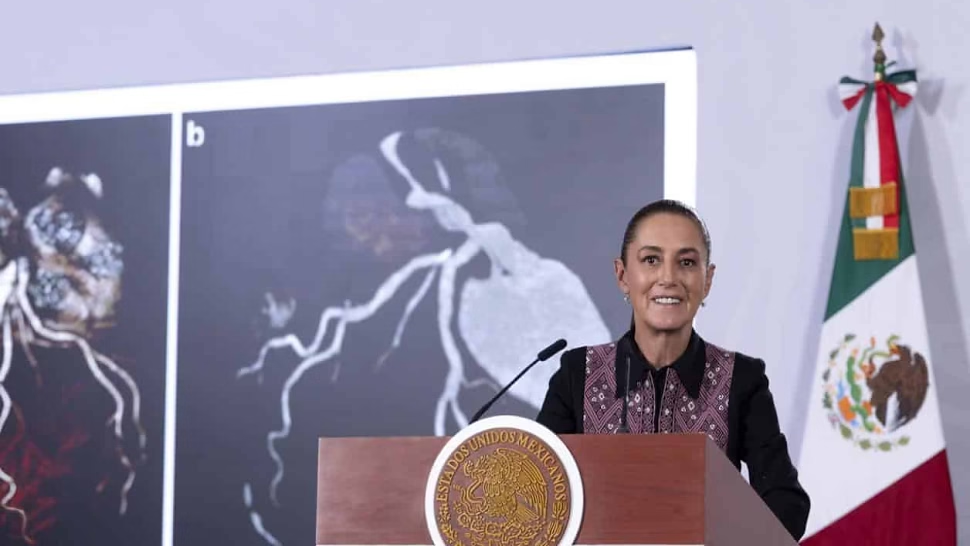
President Claudia Sheinbaum reported on advances in the public health system, with investments in equipment, telemedicine and improvement of clinics. He affirmed that the State must guarantee access to health from prevention to care for complex diseases.

“We are compensating for the profound damage that neoliberalism caused in the health system,” he said at the morning conference.

Equipment and telemedicine

The IMSS installed 42 state-of-the-art CT scanners in 40 hospitals in 19 states. Of these, 41 are from 256 cuts. They allow early detection of tumors and bleeding, perform up to 50 studies per day and reduce waiting times. They were acquired for 29 million pesos each, below the 40 million in the past.

The ISSSTE expanded telemedicine from 239 to 859 units. It offers consultations in 15 specialties, such as cardiology and dermatology, from 118 second and third level units to 741 first level.

The Clinic is Ours

The La Clínica es Nuestra program delivered 4,608 million pesos in 2025 to 8,483 medical units, with the participation of 67,864 people. 42 thousand improvement actions were carried out in infrastructure and equipment. The 2026 call will begin in July, including for the first time 153 units from Yucatán with 80 million pesos.

Sheinbaum added that progress is being made in the House to House Health program, with more than 20 million consultations with older adults and people with disabilities. Starting in August-September, you will be able to collect medications at Farmacias del Bienestar, health centers and a network of pharmacies. Next year the Universal Health Service will begin with a single credential.

Continue reading

Massive security reinforcement and alcohol ban at the Azteca

56,000 police officers and alcohol restriction for the game at the Azteca.

Measures for the Mexico-Czech Republic match

The government of Mexico City announced an unprecedented security operation for this Wednesday’s game at the Azteca stadium. 56,000 personnel will be deployed, five times more than the 11,219 employed last week.

The decision responds to the celebrations of the previous Thursday, when some 700,000 people gathered in the capital after Mexico’s victory over South Korea. Although there were no injuries, nearly 40 tons of garbage were collected in the Ángel de la Independencia and the Zócalo.

The Secretary of Security, Pablo Vázquez, detailed that 7,500 police officers will guard the Azteca stadium. Another 3,275 will be in the Zócalo and 4,200 on Reforma Avenue. The objective is to protect players, referees, authorities and fans.

In addition, the Secretary of Government, César Cravioto, reported that starting at 3 p.m. on June 24, a ban on the sale of alcohol will take effect for sixteen hours. Applies to the Historic Center and five neighborhoods of Cuauhtémoc.

Sales will only be allowed in restaurants, hotels and private clubs, accompanied by food. Convenience stores and supermarkets are excluded. The fines for non-compliance amount to up to 293,275 pesos (about $17,251).

The Mexican Alliance of Transporters Organization (AMOTAC) called for mobilizations on highways in the 32 states and blockades in the capital to protest against the violence. The operation also considers these protests.

Continue reading

UNAM, new WHO collaborating center in oral health

The WHO recognizes UNAM as a reference in oral health and aging.

International recognition for UNAM

The World Health Organization (WHO) designated the Department of Oral Public Health of the UNAM Faculty of Dentistry as a Collaborating Center in Oral Health and Aging. The distinction is valid for four years.

With this appointment, the highest educational institution consolidates itself as a regional reference in the comprehensive care of older adults.

Implications of the appointment

The recognition will allow university specialists to participate in the development of public policies focused on improving the quality of life of the elderly.

In addition, they will promote strategies to promote among older adults and caregivers the importance of maintaining adequate oral health as an essential part of general well-being.

The designation places UNAM on a level of technical cooperation with the WHO, which opens opportunities to influence global guidelines on aging and oral health.

Continue reading