Explosion on Lima bus leaves three injured due to extortion

An artifact detonated on a capital bus, revealing the alarming increase in violent extortion.

Explosive attack on public transport shows security crisis in Lima

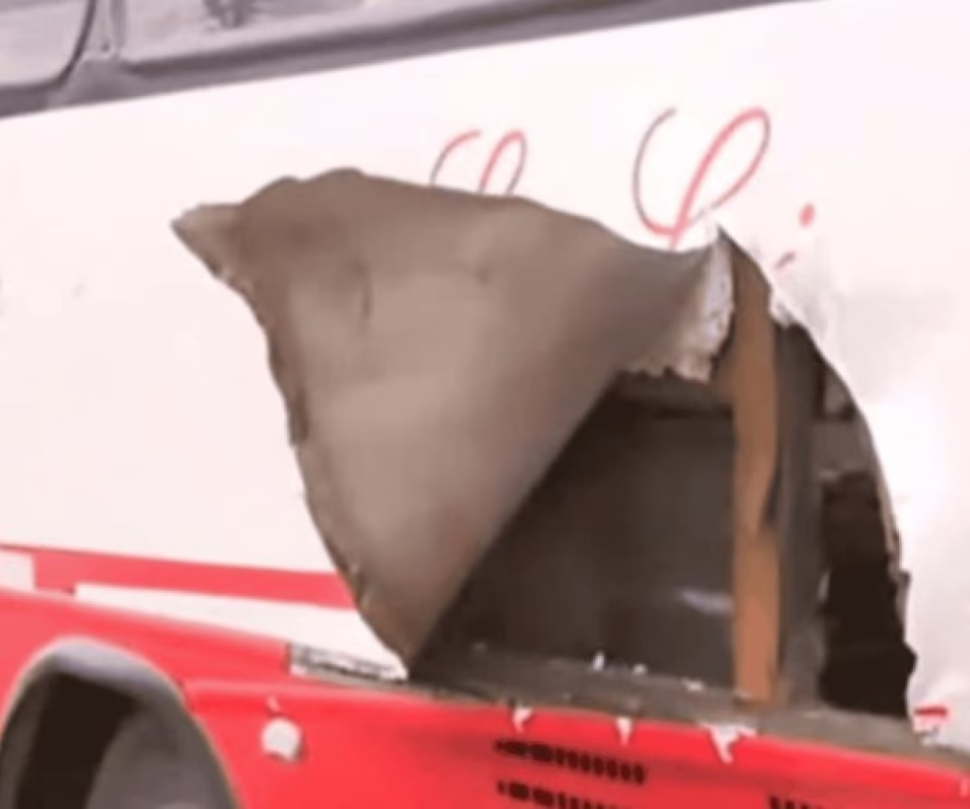
Three people suffered injuries this Tuesday after the detonation of an explosive device placed by unknown individuals inside a public transportation unit in Lima, Peru. The incident occurred in a vehicle belonging to the company “Once de Noviembre”, which covers routes between the northern and eastern areas of the capital, as confirmed by Colonel Roger Cano, police spokesperson.

Technical details of the attack

The explosive charge, whose exact type is still being investigated, was strategically installed inside the bus to cause material damage and intimidation. The authorities of the Explosives Deactivation Unit determined that the device severely affected the structure of the vehicle, destroying seats and windows. The injured, taken to a nearby medical center, suffered trauma from shrapnel and blast waves.

RelatedTransporters and young people protest in Lima due to insecurity and corruption

This event adds to a pattern of growing violence: a month ago, two employees of the same company were executed with 14 bullet wounds. Security experts point out that these events respond to organized crime tactics to force illegal payments.

National context of extortion

According to statistics from the Public Ministry, Peru registered 15,989 complaints of extortion in the first seven months of 2025, an increase of 28% compared to the same period of the previous year. The gangs operate with increasingly violent methods:

  • Placement of explosives in businesses and homes
  • Public executions of transporters as a warning
  • Systematic threats through calls and messages

Despite citizen protests, the authorities have not managed to significantly reduce these crimes. Analysts attribute the phenomenon to the expansion of criminal cells that operate with impunity in key economic corridors.

Key fact: 73% of extortions are concentrated in Metropolitan Lima and Callao, according to the National Institute of Statistics and Informatics (INEI).

Social and economic impact

The violence has generated million-dollar losses in the transportation sector, where many drivers abandon their routes out of fear. Small business owners face dilemmas between paying “quotas” or risking retaliation. Psychologists report an increase in anxiety symptoms in areas with a high incidence of crime.

International organizations such as the OAS have offered technical assistance to strengthen investigation protocols, although local specialists criticize the lack of comprehensive strategies that combine police intelligence, financial control and witness protection.

What’s next? The authorities announced a special operation in bus terminals, while neighbors demand a greater military presence. However, without profound judicial reforms, experts predict that the crime wave will persist.

Share this analysis on your networks to make the security crisis visible or explore more content on strategies against organized crime in Latin America.

China sanctions 10 US companies in the military sector

Beijing replicates Washington's restrictions on Chinese technology firms.

The Chinese government announced sanctions against 10 United States companies linked to the military sector. The measure responds to the restrictions imposed by Washington on Chinese technology companies accused of maintaining ties with the armed forces of the Asian country.

Companies affected and scope of sanctions

According to China’s Ministry of Commerce, American companies will be prohibited from receiving exports of dual-use products. That is, goods with both civil and military applications. The decision seeks to protect national security.

Among the sanctioned firms are manufacturers of military drones, defense technology companies and companies dedicated to the extraction of rare earths. These materials are considered strategic for the technological and military industries.

The Chinese action comes after the United States included companies such as Alibaba and Baidu on a list of companies with alleged ties to the Chinese military. That list prevents them from accessing US defense contracts.

Analysts pointed out that Chinese sanctions have a mainly political and symbolic character. They reflect the growing commercial and technological tension between both powers. However, they warn that they could intensify restrictions in strategic sectors.

Continue reading

Diplomacy in Switzerland: progress in negotiations between the US and Iran

Progress in dialogue between the US and Iran in Switzerland opens the way to a possible agreement.

The vice president of the United States, JD Vance, assured that talks with Iranian representatives in Switzerland achieved significant progress. According to Vance, a basis was established to reach a definitive agreement to reduce tensions in the Middle East.

Key issues at the dialogue table

During the negotiations, both sides discussed the reopening of the Strait of Hormuz, a strategic route for global oil transportation. They also discussed the conflict between Israel and Hezbollah in southern Lebanon.

Iran had closed the sea passage after attacks by the United States and Israel, causing an increase in international fuel prices. Although some vessels resumed transit, the main route remains affected by security risks.

As part of the diplomatic process, the US Treasury Department issued a temporary license allowing exceptions to sanctions related to Iranian oil. Technical talks will continue over the next 60 days.

In parallel, mediators noted progress in maintaining a ceasefire in Lebanon. However, differences persist over the Iranian nuclear program and other key points of the agreement that Washington and Tehran seek to finalize.

Continue reading

Kenya: Health minister found in contempt by court

Minister ignored court order suspending work destined for the US.

Kenya’s Health Minister Aden Duale was found in contempt by the country’s High Court. The reason: he did not stop the construction of an Ebola quarantine center for US citizens, despite a court order suspending the project.

The ruling and the lawsuit

The court ordered Duale to appear this Tuesday for the reading of the sentence. The ruling followed a lawsuit filed by the Law Society of Kenya and the Katiba Institute. Both organizations questioned the installation given the limited capacity of the Kenyan health system.

The details of the center

The Kenyan government had defended the construction of the center, located at the Laikipia air base. He argued that it is part of a preparedness strategy for possible Ebola outbreaks and that it would benefit both Kenya and its international partners.

Continue reading