The United States returns to Mexico a manuscript signed by Hernán Cortés

A document from the 16th century, key to understanding the conquest, returns after decades of absence.

Recovery of a historical treasure

The United States Embassy in Mexico confirmed this August 13 the return of an original manuscript signed by Hernán Cortés in 1527, after a coordinated investigation between the FBI, the New York Police Department and Mexican authorities. This document, stolen from the General Archive of the Nation between the 1980s and 1990s, represents a milestone in the repatriation of cultural property thanks to bilateral cooperation.

Context and value of the document

The text, dated February 20, 1527, details financial transactions related to the exploration of unexplored territories, specifically payment in gold pesos for expeditions in search of spices. According to experts, it offers a unique vision of the logistics and economic strategies during the Spanish colonization. Its rediscovery allows us to reevaluate aspects of early colonial administration that had been poorly documented.

RelatedMexico recovers manuscript of Hernán Cortés stolen decades ago

This is not the first fragment recovered: in July 2023, another section of the same manuscript was repatriated in what then-ambassador Ken Salazar called “one of the most agile processes in the history of heritage recovery.” The piece is part of a documentary corpus critical to understanding the conquest of Mexico and the bureaucracy implemented by Cortés.

Recovery methodology

The FBI, through its art crimes division, tracked down the manuscript on the black market for antiques, where it had been circulating for years. The investigation combined forensic analysis—such as verification of inks and watermarks—with international intelligence. The participation of the US Department of Justice stands out, which applied laws such as the UNESCO Convention of 1970 against the illicit trafficking of cultural property.

Mexican authorities emphasized that this case sets a precedent for future collaborations in the recovery of more than 5,000 historical artifacts still missing, according to records from the National Institute of Anthropology and History (INAH).

Historical and cultural implications

The return reinforces global efforts against the looting of assets, a crime that according to Interpol generates close to 10 billion dollars annually. For Mexico, this act symbolizes the vindication of its historical memory, especially in a context where 30% of colonial documents remain outside the country.

The manuscript will undergo conservation processes in the General Archive of the Nation before its possible public exhibition. Experts emphasize its value not only as a relic, but as a primary source for studies on economics and territorial expansion in the 16th century.

Are you interested in the preservation of historical heritage? Share this news to make visible the importance of protecting our cultural legacy and continue exploring more content about archaeological finds on our social networks.
Sheinbaum praises humanitarian work of soldiers in Venezuela

Sheinbaum recognizes the military group that he supported after the earthquakes in Venezuela.

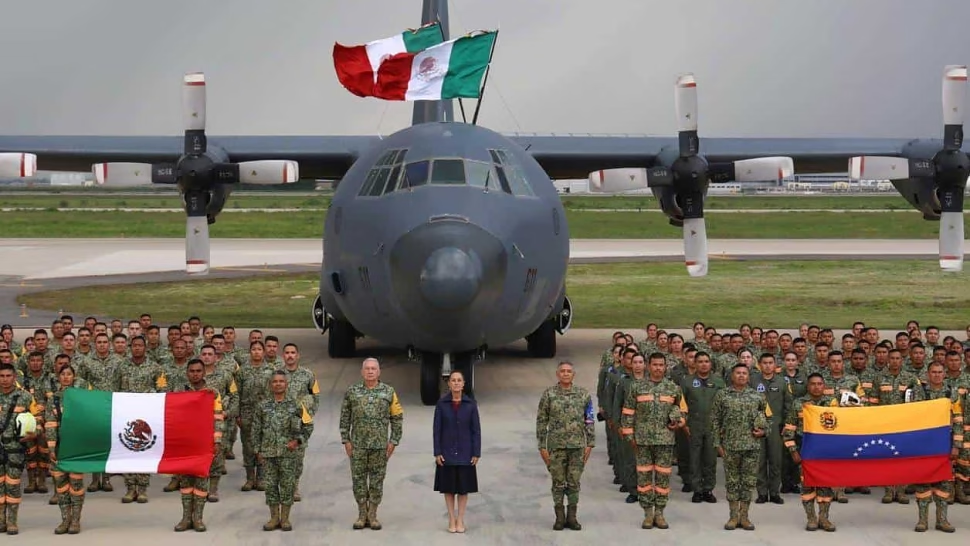
President Claudia Sheinbaum received and recognized the “Yumare” group of the Secretariat of National Defense for its assistance to the people of Venezuela after the earthquakes of June 24. He highlighted that the mission showed a supportive, fraternal and humanistic Mexico.

“You showed the true face of Mexico, a supportive, fraternal and deeply humanistic Mexico,” expressed Sheinbaum from the Military Strategic Collection Center in Zumpango, State of Mexico.

The group was made up of 264 elements and 18 canophilous binomials. During the work, 2 people were rescued, 92 bodies were recovered and 2,059 medical consultations were carried out, according to the Secretary of Defense, Ricardo Trevilla.

Humanitarian aid to Venezuela

Mexico sent more than 70 tons of groceries, supplies and tools through an airlift of 8 flights and 2 Semar ships. 13 tons of medicines were also distributed and emergency surgery was performed on a Venezuelan soldier in a mobile operating room of the Mexican Army. In addition, 8 industrial light plants were delivered with coverage of 5 thousand m² each.

The Venezuelan ambassador to Mexico, Stella Marina Lugo, thanked the support from the first hours of the incident. As a gesture of reciprocity, Venezuela donated to Mexico “Laika”, a 6-month-old Belgian shepherd who will join the Mexican Army. In addition, two members of the Venezuelan civil protection will arrive with the dogs “Sol” and “Sara” to be trained in search and rescue.

Sheinbaum received a letter from the president in charge of Venezuela, Delcy Rodríguez, and the “First Class Hero of Venezuela” award, the highest recognition for humanitarian assistance. The president stressed: “Her mission was a message that cooperation between nations is still possible.”

Continue reading

Man arrested for illegal logging of strawberry tree in Querétaro

Joint operation thwarts felling of protected tree in San Juan del Río.

Operational in San Juan del Río

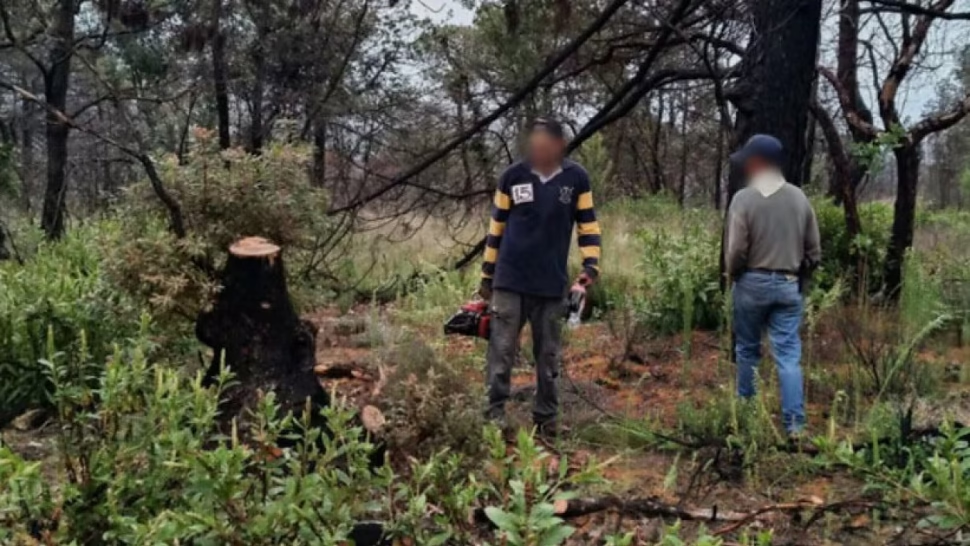
The Federal Environmental Protection Agency (Profepa) reported the arrest of a man accused of illegally felling a strawberry tree in the municipality of San Juan del Río, Querétaro. The subject was placed at the disposal of the Attorney General’s Office (FGR), along with the chainsaw used and the forestry material obtained.

The events occurred on July 2 in the Dolores de Enmedio ejido. Profepa personnel carried out surveillance tasks in coordination with the “Forest Assets” Participatory Environmental Surveillance Committee. Upon hearing the operation of a chainsaw, the inspectors deployed an operation with the support of a drone and ground tours.

Investigation in progress

Upon arriving at the site, officials found the person cutting down an arbutus tree that had survived a forest fire. Profepa pointed out that the action occurred in flagrante delicto and could constitute a crime against biodiversity for affecting protected forest resources.

The agency indicated that the case will be investigated by the Federal Public Ministry to determine responsibilities. The identity of the detainee was not revealed, although images were released of the moment he was located next to the affected tree and with the tool used for felling.

Continue reading

Fire destroys 25 homes in San José de Comondú

An accident destroyed 25 houses and damaged another 50 in Baja California Sur. Dozens of families evacuated.

A rapidly spreading disaster

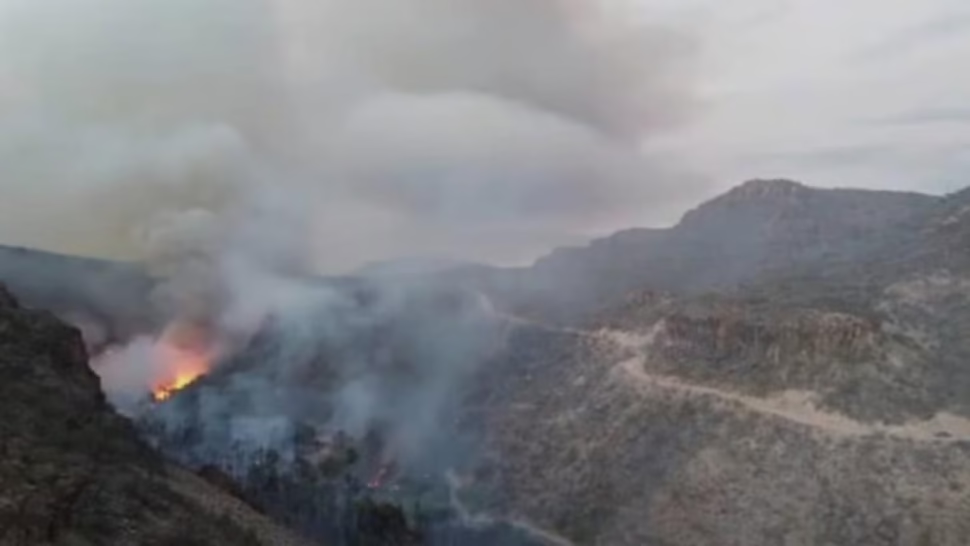
A large fire consumed part of the town of San José de Comondú, in Baja California Sur. The preliminary balance is 25 homes destroyed and damage to at least another 50. The material losses are considerable.

The incident forced dozens of families to evacuate. For more than 12 hours, firefighters, brigade members, military elements and emergency bodies worked to avoid a greater misfortune.

According to municipal authorities, the fire was allegedly caused by negligence during the burning of palm tree waste, a common practice among residents. The mayor of Comondú, Roberto Pantoja Castro, pointed out that the windy conditions, high temperatures and abundant vegetation favored the rapid spread of the flames, which in a few minutes got out of control.

Response from the authorities

Local authorities activated emergency protocols to care for the victims and assess the damage. It is expected that inspections of affected homes will be carried out and support will be provided to evacuated families.

The community of San José de Comondú faces a difficult panorama. Many families lost their homes and require urgent assistance. The authorities have called for the solidarity of the population to help those affected.

Continue reading