
Epstein survivors demand transparency in Congress

The victims demand justice and truth in Washington in the face of the political dismissal of their fight.

Epstein survivors demand transparency in Congress

In an act of remarkable courage and determination, a group of survivors of sexual abuse perpetrated by financier Jeffrey Epstein showed up this Wednesday in the vicinity of the Capitol of the United States. Its main objective was to exert direct pressure on legislators to force the full disclosure of all documents linked to the exhaustive federal investigation into the sex trafficking network led by the now deceased criminal. Simultaneously, they emphatically rejected former President Donald Trump’s attempts to classify the matter as a simple “farce,” underlining the seriousness of the crimes and the urgent need for justice.

A Public Call for Legislative Action

During a moving press conference held on the grounds of the Capitol, surrounded by hundreds of supporters chanting slogans such as “free the archives,” these women shared their traumatic experiences. For several of them, this was the first time they recounted their testimony publicly, detailing the methods of manipulation and coercion used by Epstein’s former partner and romantic partner, Ghislaine Maxwell, to attract them into the financier’s circle. Their central demand focused on a demand for absolute transparency and accountability on the part of the federal government for the suffering suffered during their adolescence.

RelatedCourt documents detail Trump’s travels on Epstein’s plane

This event represented a striking stance in the current political context, where the push to declassify the investigation’s court records has reached a crucial moment in Washington. While legislators debate the scope and methodology that Congress should adopt to thoroughly investigate the Epstein saga, the position of former President Trump—who in his campaigning beginnings spoke out in favor of government transparency—has turned towards dismissal and discredit, calling the process a “Democratic farce.” lacking foundation.

The Political Response and the Rejection of Victims

The statements of the former president, who stated “No matter what they do, this will continue. Really, I think it is enough“, contrast diametrically with the reality experienced by the survivors. However, within the Capitol itself, these women found echo, even among some of Trump’s closest allies in Congress. Several of those affected made a direct call to the president, urging him to reconsider his position and support their cause in search of truth and reparation.

The testimony of Haley Robson, one of the survivors who identified herself as registered under the Republican party, encapsulates the frustration and urgency of the moment: “It feels like you want to explode inside because no one, again, is understanding that this is a real situation. These women are real. We are here in person.” This statement not only emphasizes the authenticity of their struggle, but also challenges the narrative of denial and minimization that attempts to impose itself from certain sectors of power.

The case of Jeffrey Epstein transcends the mere figure of an individual criminal; It stands as a symbol of impunity, power and the deep systemic failures that allow networks of sexual exploitation to operate. The request to declassify documents is not a mere bureaucratic procedure, but a fundamental step to understand the magnitude of the network of complicities, identify all those involved and, above all, to grant the victims the recognition and justice that they have been denied for years. Transparency in this case sets a crucial precedent for elite accountability and strengthens the integrity of American judicial and legislative institutions.

Share this story on your social networks to help amplify the voices demanding justice and transparency. Explore our site for more in-depth analysis of high-impact court cases.

Egypt detains hundreds for illegal gold mining on border with Sudan

More than 200 people arrested, including 136 foreigners, in an operation against illegal mining and gold trafficking.

Egyptian security forces detained hundreds of people, including foreigners, on the border with Sudan on accusations of illegal gold mining and smuggling. This was reported by the army on Monday.

Operational in the south

The southern region of Egypt is home to rich gold mines. The government has promoted large projects, such as the Sukari megaproject. The military statement indicated that the detainees total 87 Egyptians and 136 foreigners, without specifying nationalities. Additionally, “large quantities of equipment used in illegal mining operations” were seized.

The area borders Sudan, also rich in gold. The three-year armed conflict in that country has left much of mining unregulated. According to a 2024 report by a UN panel of experts, more than 50% of the gold mined in Sudan was smuggled out. Gold represents 70% of Sudanese income.

Videos on the internet showed hundreds of Sudanese at a border crossing. Sudanese media reported that they were miners detained and expelled by Egypt. Gold has been central to the Sudanese conflict: the paramilitary group Rapid Support Forces has trafficked tons from Darfur and Kordofan to finance itself.

The Egyptian military claimed that several suspected miners surrendered to authorities and were sent back to their country. He did not give further details about the nationalities. He also warned that he “reserves all available options to address all threats.”

Continue reading

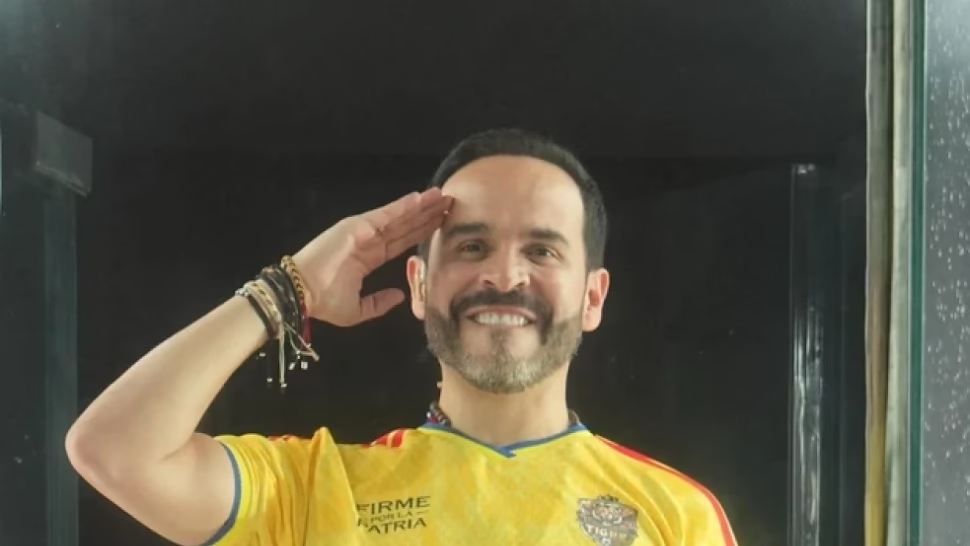
Abelardo de la Espriella is proclaimed president-elect of Colombia

The conservative narrowly leads Cepeda amid allegations of fraud.

Post-election tension in Colombia

The conservative Abelardo de la Espriella declared himself the winner of the second presidential round in Colombia. With 99.98% of the tables counted, he obtained 49.66% of the votes, compared to 48.70% for Senator Iván Cepeda. The difference exceeds 250,000 votes.

“The Colombian people have entrusted me with the supreme honor of serving as their next president,” De la Espriella said before thousands of supporters in Barranquilla. He promised to protect the freedoms and rights of everyone, even those who did not vote for him.

Cepeda asked to wait for the final scrutiny. “The pre-count is neither official nor binding,” he said, and anticipated that his party will challenge 33,000 tables throughout the country. The outgoing president Gustavo Petro wrote in X: “No one can be proclaimed president. It is the scrutiny that determines who is the president.”

De la Espriella responded: “To Mr. Petro and his heir I say: respect the will of the people of Colombia. Refrain from unleashing a social fire… pack your bags and prepare to exercise opposition.”

The 47-year-old candidate, nicknamed “El Tigre,” is a lawyer and businessman who made his fortune in wine, rum and clothing. Without political experience, he promises to take a tough line against armed groups and build mega prisons in the style of El Salvador. He was born in Bogotá but grew up on the Caribbean coast; He lived in Italy until before the campaign.

US Secretary of State Marco Rubio congratulated him as “president-elect” and said he hoped to work on regional security and reduce irregular migration.

Election day passed with high participation of more than 41 million eligible voters. Violence remains the main concern: last year 14,780 homicides were recorded, the highest number since 2015, and extortion doubled in a decade.

The saleswoman Yolanda Hernández, who voted for Petro in 2022, now opted for De la Espriella: “We want there to be a change in Colombia because it is always the same violence, always everything the same.”

The electoral judges will carry out the final count in the coming days. The country awaits the official result in the midst of a polarized environment.

Continue reading

Ramiro Valdés, key figure of the Cuban Revolution, dies at 94

Ramiro Valdés, historic Cuban leader and companion of Fidel Castro, dies.

Ramiro Valdés, the last commander of the Cuban Revolution, dies

Ramiro Valdés Menéndez, commander of the Cuban Revolution and figure close to Fidel and Raúl Castro, died this Sunday at the age of 94. This was confirmed by the Communist Party of Cuba (PCC) and the island’s government in an official statement. No details were offered about the causes of death nor was it reported how the funeral will be.

“Ramiro Valdés Menéndez is deserving of the respect and admiration of the people of Cuba for his dedication and proven loyalty to the revolutionary cause,” said the note published in Cubadebate.

Valdés was part of the group that assaulted the Moncada Barracks in 1953, the act that began the armed struggle against Fulgencio Batista. He then fought under the command of Che Guevara and received the honorary title of Commander of the Revolution. He was also declared “Hero of the Republic of Cuba.”

He held senior positions in the government, including the Ministry of the Interior, but in 1986 he stepped down from power after an argument with Fidel Castro. He remained away from public life for 17 years. In 2003 he returned to the Council of State. In 2006, Raúl Castro appointed him Minister of Information Technology and Communications, despite being over 70 years old. In 2011 he became number three in the PCC, only behind Raúl and José Ramón Machado Ventura. In 2019 he became Deputy Prime Minister, a position created by the new Constitution.

Known for his critical stance towards the Internet, in 2007 he stated: “The wild horse can and must be dominated, and infocommunications, put to work for peace and development.” He rarely appeared in public and never spoke to the press.

President Miguel Díaz-Canel reacted on social networks: “The physical departure of the commander of the Revolution, Ramiro Valdés Menéndez, hurts deeply, like that of a father. That is how I always loved and respected him. This is how I will remember his support and advice, his discreet collaboration and exemplary dedication to the service of the Homeland.”

Continue reading