Getting sick in Mexico now costs half more

Getting sick in Mexico is no longer just a health problem, but an economic risk that has grown 50% in three years.

The health bill skyrockets

The numbers are clear and they hurt. Treating an illness in a private hospital in Mexico costs almost 50% more than three years ago. Grupo Interesse says it, and the culprit has a name: a medical inflation that does not drop below double digits.

Getting sick is no longer just a health issue. Now it’s a cheap roulette wheel that can empty bank accounts. The pressure falls on families and insurers alike.

“It is not enough to transfer it to a policy; it is essential to design schemes that anticipate it, contain it and make it sustainable over time,” warned the specialized firm.

The pocket bleeds

Insurers paid out more than 145 billion pesos in claims alone last year. But the revealing data is another: close to 40% of health spending comes directly from family money.

RelatedProtect your health and your pocket from fraudulent managers

It is one of the highest levels among countries similar to ours. Translation: millions of households are one serious illness away from bankruptcy.

The big villains are known: cancer, heart problems and diabetes. Long, specialized and very expensive treatments, especially if they are detected late.

This forces families to make drastic decisions. Rearrange income, touch savings, even sell assets. Health became the number one financial risk.

The final recommendation is crude but necessary. Health must be managed for what it is: an economic risk that requires prevention, early diagnosis and real cost control.

Because we are already seeing the alternative: a system where healing can cost you everything.

AICM taxi drivers refuse to apply discounts agreed for the World Cup

Three AICM taxi drivers groups refuse to apply discounts of up to 18% during the World Cup.

Three groups of taxi drivers that operate at the Mexico City International Airport (AICM) refused to apply discounts of up to 18% on their rates during the World Cup. The measure contradicts previous agreements announced by airport authorities and part of the union.

The companies Nueva Imagen, Porto Taxi and Sitio 300 issued a statement to clarify their position. They argued that they have no contractual relationship with the Grupo Aeroportuario Marina (GAM), the entity that promoted the benefits for airport users.

According to permit holders, the announced discounts do not represent a direct reduction in rates. They are, they say, adjustments derived from compensation for improper charges and administrative processes for maintenance work at the AICM.

They demand transparency

The taxi drivers asked the AICM authorities to make public the documents that support these measures. They also called on the GAM to make transparent the minutes and contracts where the application of discounts had been agreed upon. They questioned the legal validity of the obligations attributed to them.

The refusal could affect users who expected more affordable rates during the sporting event. Until now, there is no certainty about the real cost of service at the AICM during the World Cup.

Continue reading

Morena opens the door to a coalition with the PVEM in San Luis Potosí

Morena conditions alliance on PVEM ruling out Ruth González for the governorship.

Morena-PVEM Coalition for 2027?

The state leadership of Morena in San Luis Potosí left open the possibility of an alliance with the Green Ecologist Party (PVEM) for the local elections of 2027. The condition: that the PVEM present a different profile from that of Senator Ruth González.

Rita Ozalia Rodríguez Velázquez, state president of Morena, explained that if the PVEM discards Ruth González—wife of Governor Ricardo Gallardo—the green party could lead the coalition, which would also integrate the Labor Party (PT).

The leader clarified that the relationship with the PVEM at the local level does not face a conflict, although she admitted that there is no direct communication between both state leaders. Decisions about alliances, he said, are made by national leaders.

The possible agreement arises in the midst of the debate about nepotism, after Ruth González’s intention to succeed her husband in the state government was questioned. Morena looks for profiles that avoid that controversy.

Rodríguez Velázquez stressed that there is coordination between the party leadership to define the electoral strategy. For now, the panorama in San Luis Potosí remains open.

Continue reading

Morena accuses INE advisors of being ‘ill-wishers’

The Morena leader accuses INE advisors of being 'ill-wishers' and defends her affiliation system.

Morena questions the impartiality of the INE

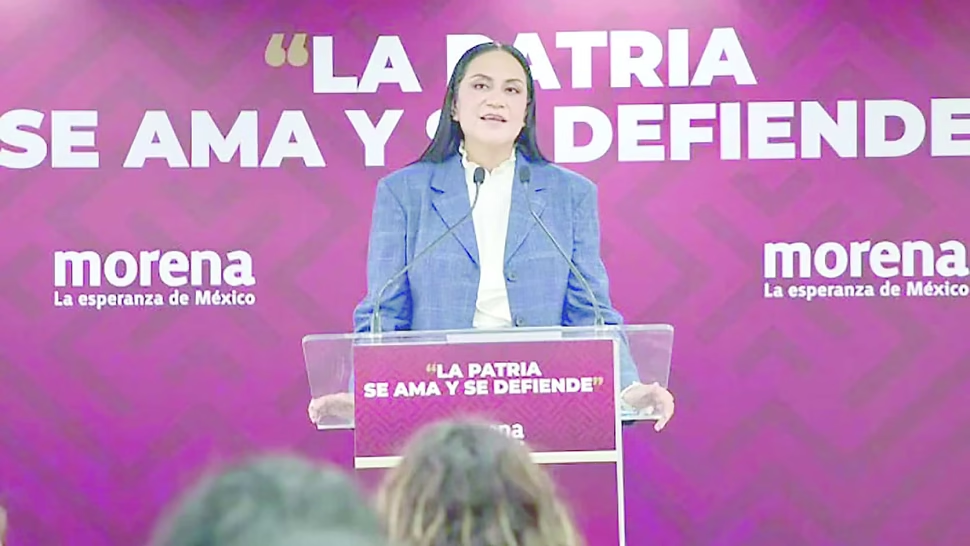
The national leader of Morena, Ariadna Montiel Reyes, pointed out that within the INE there are advisors with critical positions towards her party. He described them as “Morena haters” during a press conference where he addressed recent resolutions on duplicate affiliations.

Montiel affirmed that his party abides by the determinations of the Electoral Court. The authority ordered the elimination of more than 93 thousand affiliate records and leave under review about 19 thousand cases that the INE must verify.

The leader demanded that the institute adhere to the resolutions of the General Council and not to individual opinions. He accused that there are figures close to past electoral administrations who maintain a critical stance towards the movement.

Regarding the affiliation system, Montiel defended that Morena’s application is efficient. He assured that it surpasses that of the INE in functionality, since it allows duplications in the records to be detected.

He also proposed that the INE should have real-time verification mechanisms to cross-check affiliation data. However, he acknowledged that there are different processes between parties and the electoral authority.

Continue reading