Analysis of the LUX album and its artistic context
The recent release of the album LUX by the Spanish singer and songwriter Rosalía has generated a wide spectrum of reactions within her community of followers. The audience has enthusiastically received this new creative stage of the artist, a project that constitutes a comprehensive and conceptually dense sound experience. Throughout fifteen musical pieces that incorporate multilingual fragments, Rosalía delves into the feminine mystique through a narrative that fuses spirituality, soul purification, prayers, poetry and intimate metaphors. The symphonic instrumentation, combined with choruses performed in unison, has achieved a deep connection with the public, projecting an atmosphere charged with an ethereal and transcendent feminine essence.
Thematic and lyrical deconstruction of La Perla
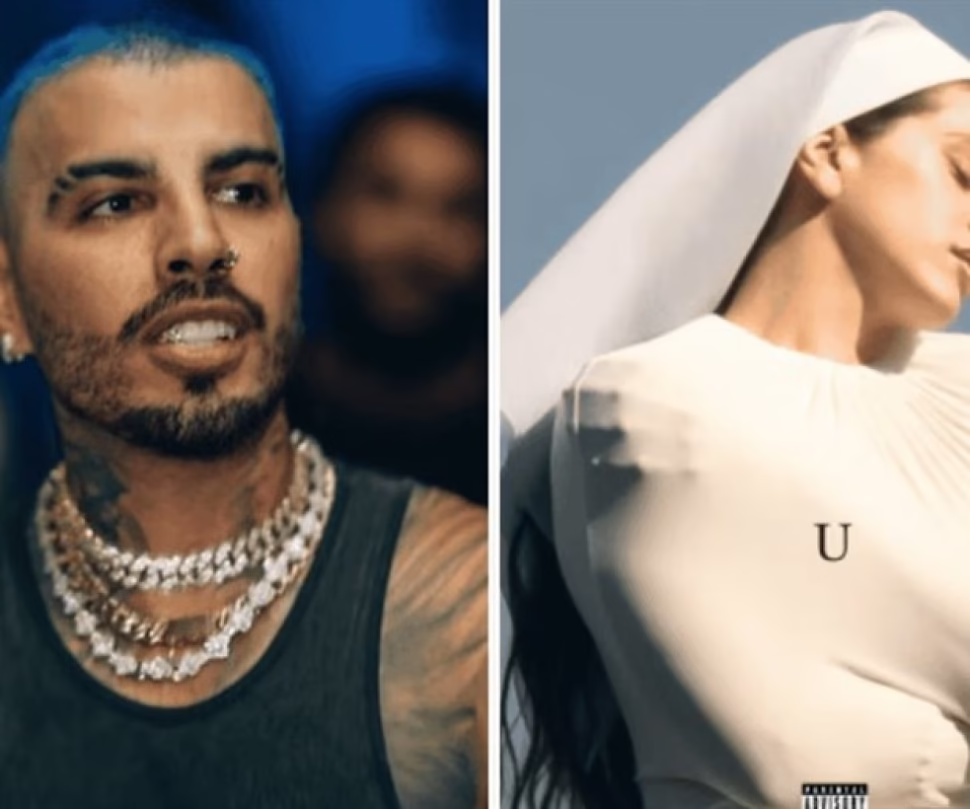
Among the album’s repertoire, the song La Perla, a collaboration with the Mexican regional group Yahritza y su Esencia, has captured the attention of analysts and fans for its lyrical content. The general interpretation suggests that this is a direct allusion to the reggaeton artist Rauw Alejandro. Although the creator refrains from mentioning names explicitly, collective speculation and contextual clues embedded in the lyrics indicate that the composition is directed at her ex-partner. The title La Perla has been identified as an ironic reference, given that it also designates a well-known sector of San Juan, in Puerto Rico, with which Rauw Alejandro is usually associated, adding consistency to the hypothesis that the song revolves around his figure.
The Puerto Rican artist has not officially commented on these interpretations. However, a part of his fan base has begun a process of conjecture on digital platforms, particularly after the singer posted on his X account (formerly Twitter): “Don’t confuse the protagonists, that movie happened a while ago.” This replica of the interpreter of Todo de ti generated a change of perspective in numerous internet users, who redirected their suspicions towards a new possible recipient: the Spanish rapper and composer Antón Álvarez, recognized by his artistic alias C. Tangana, and whose romantic relationship with Rosalía ended in May 2018.
Exploration of the narrative nuclei and their social impact
La Perla is configured as a piece of despite and heartbreak that deploys an incisive criticism towards an ex-partner characterized by dishonesty and infidelity. The lyrics describe the subject as an “emotional terrorist” and “the world’s greatest disaster“, lamenting the narrator’s participation in an emotional story of a cruel nature. The composition addresses universal themes such as infidelity and betrayal. The phrase “loyalty and fidelity is a language that will never be understood” is introduced almost at the end of the song, catalyzing endless speculation on the part of listeners, who have revitalized the possibility that the Puerto Rican artist has incurred disloyalty during the romantic relationship. Verses like “They will make you a monument to dishonesty. I don’t feel sorry for you, whoever stays with you will be drained” reinforce this reading.
The song also addresses the concept of affective responsibility, where the artist exposes the psychological damage suffered in a relationship, outlining the profile of a superficial, egocentric individual, with an aversion to commitment, financial complications and meanness, a simple “playboy” that “no one trusts”. Through this narrative, Rosalía seems to channel her personal experience into a message of female empowerment, in line with other breakup songs that have achieved significant media impact, transforming pain into an artistic product of high cultural value. The forceful and sharp phrases on the subject have circulated massively on social networks, generating a wave of analysis, viral reactions and persistent rumors.
Both personalities ended their relationship in July 2023, shortly after announcing their engagement. To date, the Catalan artist has not officially confirmed the identity of the recipient of the song, keeping millions of followers in suspense with unresolved questions. In the most notable comments of Rauw Alejandro‘s publication, which already exceeds 21 thousand reactions and almost 4 million views, you can read statements such as: “It’s what an emotional terrorist would say“, “no, the song is for you, and denying it is a bit not intelligent“, and “People get very intense, as if it were their story“, evidencing the intense debate generated.
Does this analysis resonate with you? Share this perspective on your social networks and discover more content about the intersection between music, culture and contemporary relationships on our platform.