The US military cannot attack cartels even if Trump calls them terrorists

Because, of course, a “terrorist” title does not come with an attack button included. Imagine the scene: a senior Pentagon commander, probably with a face like…

Because, of course, a “terrorist” title does not come with an attack button included

Imagine the scene: a senior Pentagon commander, probably with a “you already knew this, right?” face, explains to the Senate that, surprise, the US military cannot launch drone attacks against Mexican cartels just because President Donald Trump labeled them “terrorist organizations.” What a disappointment, right? As if classifying someone as a “public enemy” automatically triggers a missile. Too bad bureaucracy doesn’t work like that!

The show of contradictions

Colby Jenkins, undersecretary of Defense for special operations, had to clarify — with the patience of someone who explains that water is wet — that Trump’s appointment is not a free pass to bomb drug traffickers. Meanwhile, Elon Musk, that multitasking genius who also advises on government reform (because why not?), tweeted in February that, oh yeah, theU.S. could use dronesagainst cartels. Fountain? His imagination, apparently. Jenkins, with the elegance of a diplomat, responded: “No, gentlemen, but now we can offer options… just in case.” Translation: “Prepare the planes, but don’t take them off… yet.”

RelatedNATO intercepts Russian drones in Polish airspace

Meanwhile, the Northern Command is already doing its part: more surveillance flights, more intelligence sharing with Mexico (which, by the way, already has US drones flying over its territory, according to President Claudia Sheinbaum). All very cooperative, until someone remembers that Trump wants “maximum pressure.” The result? A strategic limbo worthy of a soap opera: “I hate you, but I need your help.”

And just in case there was no drama, General Gregory Guillot asked Congress for more authorization to work with the Mexican special forces. Because, of course, what better way to combat drug trafficking than with endless meetings and triplicate permits?

Moral: In the war on drugs, even missiles need to sign a form before taking off. Want more geopolitical irony? Share this article and explore our content on the absurdities of global security. Because reality always surpasses fiction (and sarcasm)!
Israel-Lebanon peace framework faces resistance from Hezbollah

Agreement seeks to disarm Hezbollah and restore Lebanese sovereignty, but the group rejects it and warns of civil war.

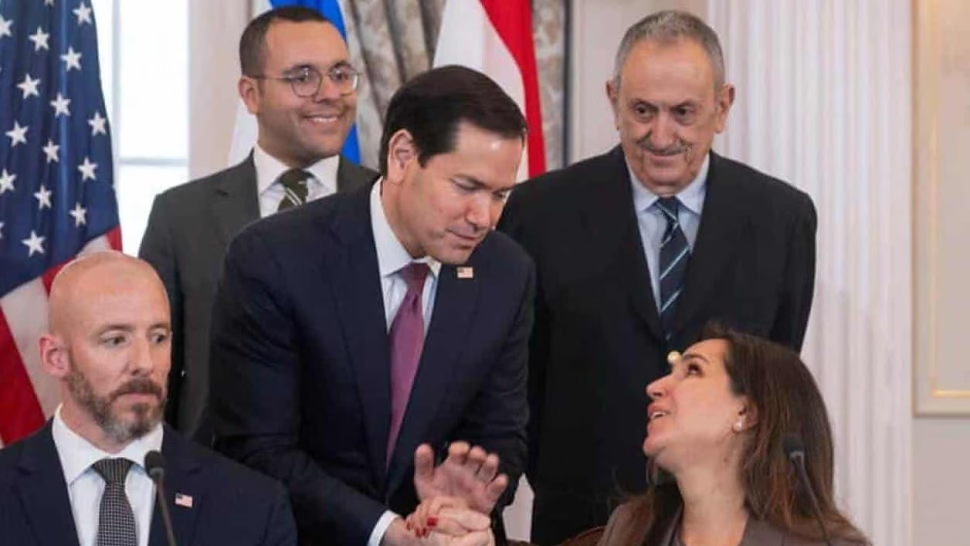
The US Secretary of State, Marco Rubio, announced together with the ambassadors of Israel and Lebanon a framework agreement that he described as a first step towards peace. The pact seeks to dismantle Hezbollah and return to Lebanon the territories occupied by Israel during the fighting.

The agreement excludes Hezbollah, which does not support it. Hassan Fadlallah, a member of the group’s parliamentary bloc, warned on Al-Mayadin TV that if the pact is imposed “it could spark a civil war.” He also called the deal an attempt to derail negotiations between the United States and Iran.

A framework with American backing

The State Department detailed that the framework creates a process to eliminate the threat of Hezbollah. Washington will facilitate a new “Military Coordination Group for Lebanon” and committed $100 million in humanitarian assistance.

“For Lebanon, this framework provides a genuine path out of a long-standing crisis,” the State Department said. “For Israel, it creates a verifiable path to eliminating the persistent threat on its northern border.”

Ambassadors Yechiel Leiter (Israel) and Nada Hamadeh Moawad (Lebanon) signed the document before Rubio. Leiter stated that the final destination is peace: “We want to get in our car in Tel Aviv and drive to Beirut.” However, he conditioned that advance on the disarmament of Hezbollah.

Hezbollah refuses to lay down its arms

The group maintains that it should only disarm south of the Litani River, near the border with Israel, in accordance with previous agreements and UN resolutions. Fadlallah reiterated that they reject Lebanon’s direct negotiations with Israel.

The most recent conflict erupted on February 28, when Hezbollah launched rockets into Israel days after the start of the war between Israel and Iran. Since then, more than 4,000 people have died in Lebanese territory and at least 37 Israeli soldiers have fallen in combat.

Position of Israel and Lebanon

Israeli Prime Minister Benjamin Netanyahu called the pact a “great achievement.” In a video, he assured: “Israel will remain in the security zone in southern Lebanon as long as Hezbollah has not been disarmed.”

For his part, Lebanese Prime Minister Nawaf Salam stated that the agreement aims to achieve the Israeli withdrawal from all Lebanese territory and restore the sovereignty of the State. President Joseph Aoun mentioned that the proposal for “pilot zones” controlled by the Lebanese army is under discussion.

Direct talks between Israel and Lebanon are moving forward separately from the interim US-Iran deal signed last week. The Lebanese government sought to negotiate directly with Israel so as not to be tied to Iranian interests.

Continue reading

Double earthquake shakes Venezuela: more than 900 dead

Hundreds of dead and thousands of injured after two consecutive earthquakes on the northern coast of Venezuela.

Devastating double earthquake

An unusual double earthquake hit Venezuela on Wednesday, with magnitudes of 7.2 and 7.5 just 39 seconds apart. According to the United States Geological Survey (USGS), the earthquakes occurred along the San Sebastián fault, on the north coast of the country. The first earthquake was located near Morón, about 170 kilometers west of Caracas, while the second, the most intense, had an epicenter 16 kilometers southwest of that town.

Authorities reported at least 920 deaths and more than 3,360 injuries, although it is feared that the number will increase. The most affected region is La Guaira, north of Caracas, where dozens of buildings collapsed. The president in charge, Delcy Rodríguez, declared the area a disaster and deployed rescue teams. Thousands of families spent the night in parks, highways and open spaces. Caracas’ main airport closed due to damage, the subway suspended service and gas and electricity supplies were cut off in some areas.

International aid

The international community responded quickly. The International Red Cross launched an emergency appeal for 50 million Swiss francs and sent 17 tons of supplies from Panama. The United States contributed 150 million dollars, two urban search and rescue teams, specialized dogs and logistical support. The European Union sent 520 troops from eight countries, activated its Copernicus satellite service and offered geospatial images.

The United Kingdom allocated 2 million pounds, a rescue team with 68 members and drones. China promised emergency humanitarian aid. Brazil dispatched a plane with firefighters, water purifiers and medical equipment. India sent two C-17 aircraft with a field hospital and 30 tons of supplies. Italy and Türkiye also mobilized rescue personnel and equipment.

Humanitarian situation

Classes were suspended and schools became shelters. In La Guaira, families settled on baseball fields with sheets and plastic bags. Rodríguez announced a reconstruction fund of 200 million dollars for hospitals and housing. The seismic crisis adds to the complex political situation facing the government, amid internal and external tensions.

Continue reading

Earthquakes in Venezuela: citizens search for missing people in rubble

More than 920 dead and 51 thousand missing after two earthquakes in Venezuela.

The devastation caused by two consecutive earthquakes of magnitude 7.2 and 7.5 left at least 920 dead and more than 51,000 missing in Venezuela, according to official reports on Friday. The number of injured exceeds 3,300, while 243 people have been rescued alive.

Citizens take the search into their own hands

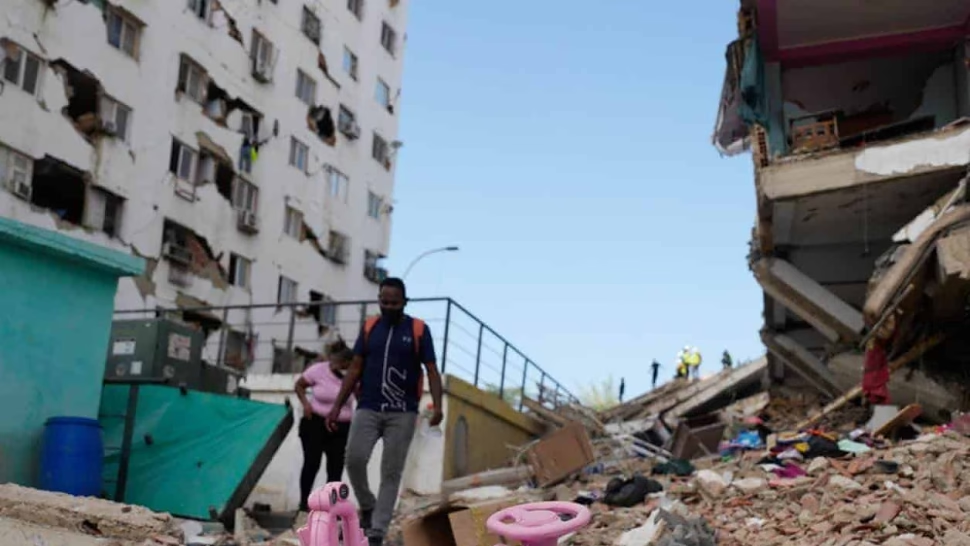
Inhabitants of areas such as La Guaira and Catia La Mar denounce the scarce presence of government rescue teams. With hammers and power tools, neighbors try to remove concrete slabs from collapsed buildings.

“My God, how do we get all the people out of there?” muttered Nazareth Jiménez, who is waiting for news of her brothers and nephews.

Omar Reyes walked among the rubble where two of his children are buried: “I was practically alone in this life.” He stated that about 20 relatives died.

Official response and international aid

The acting president Delcy Rodríguez assured that her government is deploying a total response in these “critical hours for the rescue.” He announced the militarization of La Guaira and the arrival of humanitarian aid. As of Friday, 861 international volunteers from Mexico, the United States, El Salvador, Switzerland and Colombia were working in the country. The UN reported that 25 search and rescue teams with 1,000 personnel are on the way.

However, residents consider the assistance insufficient. In Catia La Mar, looting of basic goods was recorded and the population improvised shelters in parking lots.

Stories among the rubble

Yuleidy Cadenas, 28, looks for her son, her mother and her brother in a collapsed tower in La Guaira. Friday was her son’s 12th birthday.

“I went up to the rubble and told them to yell at me, and no, no one. I just hope they get them out,” he said through tears.

The state press reported moments of hope: the rescue of a young man in Caracas and a girl covered in dust who emerged from a 10-story building. “We want to highlight this girl’s strength and desire to live,” said José Luis Núñez, head of the metropolitan rescue group.

Impact on the region

The International Organization for Migration estimates that up to 6.76 million people could be affected, about 2 million in Caracas alone. Loyce Pace of the Red Cross said: “People are still terrified to go back into their homes.”

The epicenter of the earthquakes was located near Morón, on the Caribbean coast, 170 kilometers west of Caracas. The superficiality of the movements amplified the destruction, explained geophysicist Marcos Ferreira of the Geological Survey of Brazil.

Continue reading