Eala makes history for the Philippines with controversy at the US Open

A controversial decision with video replay and an epic comeback write the first page of the history of Philippine tennis.

The historical feat that almost no one saw coming (and that some question)

It seems that to make history sometimes it takes a little more than talent and determination; Sometimes, a good dose of refereeing controversy is needed. Alexandra Eala, barely 20 years old and with the seal of the Rafa Nadal Academy on her game, decided that this Sunday at the US Open was the perfect time to become the first Filipino woman to win a Grand Slam match. How did he achieve it? Ah, that’s the fun part. Defeating the fourteenth seed, Clara Tauson, with a score that is an emotional journey in three acts: 6-3, 2-6, 7-6 (13-11). But the third set was not just any set; It was a dramatic novel with a chair umpire, a video review and a comeback that left more than one with their mouths open and others, well, quite indignant.

Imagine the scene: Eala, with the score against them 5-1 in the decisive set. Any bettor would have closed the bet. But tennis, like life, is gloriously unpredictable. The Filipino, with a calm that could well have been the envy of a Zen master, began to rise. The key moment arrived, 5-4 for Tauson, who served for the match. Eala hits a shot near the net. Did your racket cross the sacred line of the tape? The regulations are clear: you cannot. The chair umpire, Kader Nouni, in a burst of modernity, decided that technology had the answer. He activated video review, that system that the US Open introduced in 2023 and that this year is already in full force on 17 courts. Because, what could go wrong when putting up a little screen to decide the fate of an athlete?

RelatedRenata Zarazúa makes history at the US Open with epic victory

The controversy that will fuel conversations for days

Nouni ruled that everything was in order. Point for Eala. And this is where the Danish film became a tragedy. Tauson, understandably, was astonished. “Look at the ball. What is your opinion on this? What is your opinion?” he snapped at the referee, in a dialogue that he surely practiced mentally a thousand times later. The stadium, clearly on the side of the underdog, booed. Because nothing unites the public more than a possible referee error against the favorite.

The Dane, in a statement that mixes frustration with a touch of acid humor perfect for this narrative, dropped pearls to the Associated Press: “I was playing really badly, anyway. But it definitely didn’t help… That’s life.” But wait, there’s more. In a later interview, she added: “I don’t need to see it again. (It was a) wrong decision. My coach said the same thing. The physiotherapist said the same thing. And especially if my coach says that, I know I’m not wrong, because he often tells me I’m wrong.” Heck, even the coach jumped on the validation bandwagon. He even asked, with devastating logic, whether this use of video replay was even regulatory. The doubt, dear readers, is served.

The game, as expected, fell apart for Tauson from that precise moment. A double fault from him shortly after tied the score at 5-5, causing ecstasy in the stands. Eala, fueled by this energy and perhaps by Filipino karma, collected 16 of 21 points and stood with victory within reach of the racket. But like any good story, it needed its dose of suspense: five match points and more than two and a half hours of fighting before a last long forehand from Tauson sealed the deal.

Eala dropped to the hard surface of the Grandstand, her chest heaving as if she had just run a marathon, and covered her face with both hands. The moment of glory, tainted by controversy, but undoubtedly historic. After the formal handshake at the net, the winner jumped around the court as the crowd roared. An idyllic image, if it weren’t for the shadow of doubt that was already spreading through social networks.

Beyond the drama, the fact is that Alexandra Eala, world number 75, achieved her fourth victory against a Top-20 this year. Do you remember? She beat Iga Swiatek herself in Miami. Clearly, the girl is not afraid of big dates. And now, he has given his country a source of monumental pride. “I am so blessed to be the first to do this. I am very proud to represent my country. It makes what I do bigger than myself,” she declared. A beautiful phrase, almost too perfect for such a… complicated ending.

So there you have it: story, drama, technology and a touch of chaos. Tennis in its purest form. Was it fair? Was the decision correct? That debate is already on the street. The only thing that is unquestionable is that Alexandra Eala’s name is already written in the record books. How it got there, well, that’s a matter for purists and polemicists.

Do you love tennis drama and open-ended stories? Share this article on your social networks and tell us what you think of video reviews in tennis! Don’t miss more coverage packed with scathing analysis and keep exploring our content to stay up to date with all the sports controversies.

Atlanta: connectivity and sports experience for the 2026 World Cup

The city relies on its airport and stadiums as pillars to receive tournament fans.

Connectivity and mobility

Atlanta arrives at the 2026 World Cup with two clear operational advantages: its airport and its experience in major events. Hartsfield-Jackson International Airport, seven miles from downtown, is the main entry point to the city. For internal mobility, the MARTA system (subway and bus) connects key areas. In addition, the Beltline project seeks to add a 35-kilometer tram around Downtown and Midtown, reusing old railroad tracks.

Sports infrastructure

The city has Mercedes-Benz Stadium, home of the Atlanta Falcons (NFL), and State Farm Arena, home of the Hawks (NBA). It has already hosted two Super Bowls and the NCAA Final Four in 2007. A precedent that weighs: the 1996 Olympic Games, which demonstrated its ability to manage massive flows of visitors.

Urban and demographic profile

According to the 2020 census, Atlanta has 498,715 residents. It is a business city, with a strong corporate hub in Midtown and more than 30 institutions of higher education, including the Georgia Institute of Technology and the Atlanta University Center, the largest consortium of historically black colleges in the country.

These elements – air connectivity, transportation, world-class venues and a solid urban base – outline the framework with which Atlanta integrates into the 2026 World Cup scenario.

Continue reading

Messi becomes the all-time top scorer in the World Cup

Messi scores a double, reaches 18 goals in World Cups and surpasses Klose as the all-time leading scorer.

Messi’s historic double in the 2026 World Cup

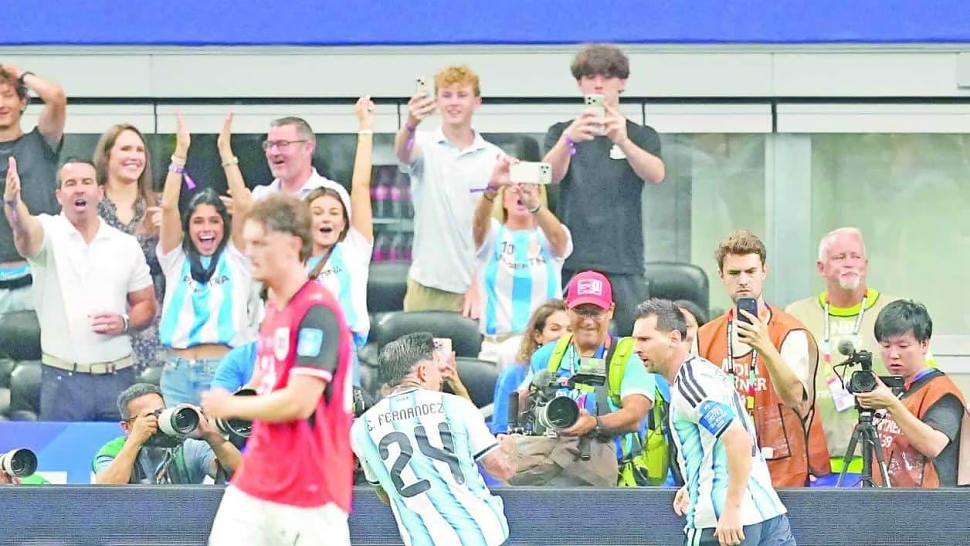
Lionel Messi continues to make history. In the match against Austria, corresponding to the group stage of the 2026 World Cup, the Argentine star scored two goals that allowed him to reach 18 goals in six World Cups, surpassing the German Miroslav Klose (16) as the tournament’s all-time top scorer.

Argentina won 2-0 and secured their place in the round of 32. The team leads Group J with perfect pace.

However, the afternoon did not start out easy. At minute 8, Messi missed a penalty against Lautaro Martínez. The ball went to the side. But thirty minutes later, he appeared in the area to receive a pass from Facundo Medina and define with precision, in a play similar to the one he made against Real Madrid in 2017.

Already in added time, he took the ball inside the area, shot twice and on the second attempt he achieved the double. With these five goals so far in the competition, he is also emerging as a candidate for the Golden Boot.

The figures of the moment

With his double, Messi has 18 goals in World Cups. In Qatar 2022 he scored seven; Now he has five and aspires to surpass that personal best. On June 24 he will turn 39, but he assured not to think about age.

“A lot of happiness for the victory mainly, it was very hard. We had to put a lot of intensity. I am happy for the result and the classification,” declared the MVP of the match.

Meanwhile, FIFA announced that it will distribute 871 million dollars among the 48 participating teams, 15% more than in Qatar 2022. Each team receives a minimum of 12.5 million dollars: 2.5 for preparation and 10 for qualifying.

Continue reading

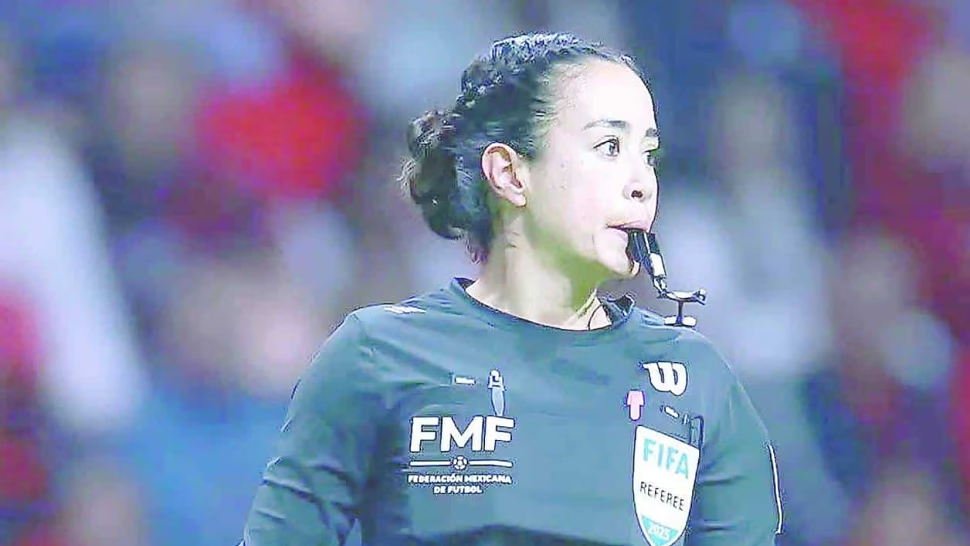
Katia Itzel García: first Mexican referee in a men’s World Cup

The Mexican will be the first woman to direct a men's World Cup match.

Milestone for Mexican arbitration

The wait is over for Katia Itzel García. After the first two days of the 2026 North America World Cup, she will finally debut as a central referee. It will be in the match between Tunisia and the Netherlands, which will be played the day after tomorrow in Kansas City.

This is a historical fact. García will become the first Mexican referee to officiate a men’s World Cup match. In addition, she will be the third woman in the entire history of the World Cups to referee a match, after the French Stephanie Frappart (Qatar 2022) and the American Tori Penso, who already has two appointments in this edition.

A key duel in Group F

The match between Tunisians and the Dutch will be decisive in defining first place in Group F. The African team is already eliminated, but the European team needs to win to stay at the top of the table. García will thus have an attractive and highly demanding match.

The tricolor whistler will be accompanied by her compatriot Sandra Ramírez as assistant number one, and the Spanish José Enrique Naranjo as number two. The fourth referee will be the Paraguayan Juan Gabriel Benítez, while the reserve assistant is the also Guaraní Milcíades Saldívar.

The advancement of women’s refereeing

Katia Itzel will be the second central judge participating in North America 2026. Penso already directed the game between the Czech Republic and South Africa, and yesterday she was appointed for the duel between Ecuador and Germany, also the day after tomorrow.

García had already worked as the fourth referee in three matches of this World Cup. Her appointment as principal confirms the growing presence of women in high-level refereeing.

Continue reading