Legal context of the dispute between Drake and Kendrick Lamar
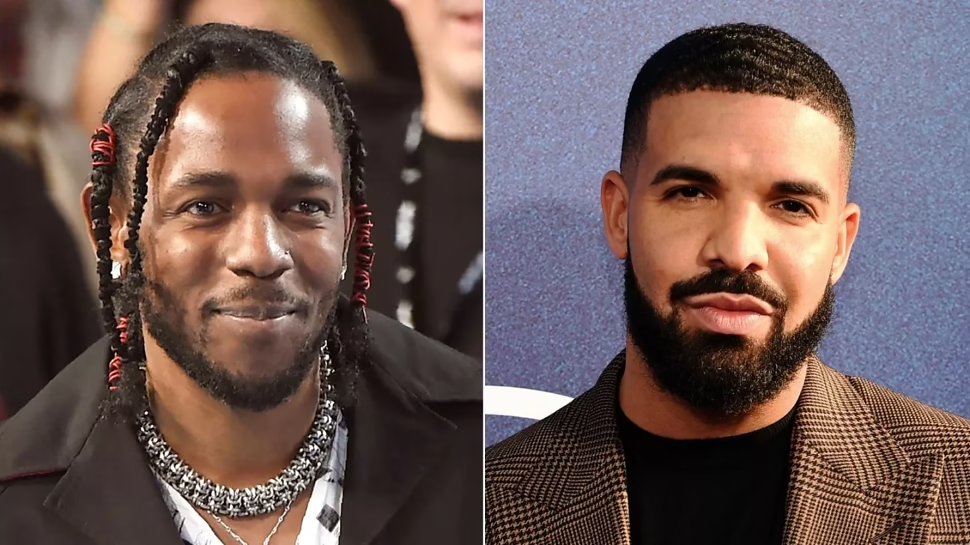
Federal Judge Jeannette Vargas is analyzing an unprecedented case that questions the limits between artistic freedom and defamation in the music industry. The center of the conflict is the song “Not Like Us” by Kendrick Lamar, whose lyrics have been interpreted by Drake as a slanderous personal attack. This litigation could establish a legal precedent for how courts interpret the metaphors and hyperbolic language characteristic of rap battles.
The legal arguments at stake
Drake, whose real name is Aubrey Graham, filed a lawsuit against Universal Music Group (UMG), a label that distributes both artists’ music. Their claim is based on the company knowingly promoting defamatory content when marketing the song. For its part, UMG defended that the lyrics are part of a cultural tradition rooted in hip-hop, where “tiraderas” are an accepted rhetorical device. Legal experts consulted point out that the case will depend on whether malicious intent or quantifiable reputational damage is demonstrated.
During the hearing, historical examples were cited such as the rivalry between Tupac Shakur and The Notorious B.I.G., where accusations in songs never escalated to formal lawsuits. However, Drake’s lawyers argue that the current context, with social media amplifying the impact of words, requires a legal reassessment.
Implications for the music industry
This case could redefine how record labels handle disputes between artists. Analysts point out that a decision in favor of Drake would generate an inhibitory effect on the creativity of musicians, while a ruling in favor of UMG would reinforce artistic autonomy. Data from the Copyright Association shows that 78% of rap battles contain language that, out of context, could be considered defamatory.
The absence of both rappers in the audience suggests that they prefer to maintain strategic distance. Sources close to Lamar indicate that the artist considers this lawsuit as an extension of the artistic rivalry, not a legal one. On the other hand, Drake’s team insists on protecting his image, especially after losing 12% of followers on Instagram after the release of the controversial song.
Perspectives and possible resolutions
Experts anticipate three likely scenarios: 1) Dismissal of the case because the lyrics are considered protected artistic opinion, 2) A confidential agreement between the parties, or 3) A trial that would establish jurisprudence for similar cases. Judge Vargas has up to 30 days to issue her preliminary ruling.
Meanwhile, “Not Like Us” has accumulated 420 million views on digital platforms, demonstrating that the controversy has increased its popularity. This phenomenon raises another question: do entertainment lawsuits end up being an unconventional marketing strategy?
Are you interested in the legal impact of music on modern culture? Share this analysis and explore more content on artistic rights on our social networks.