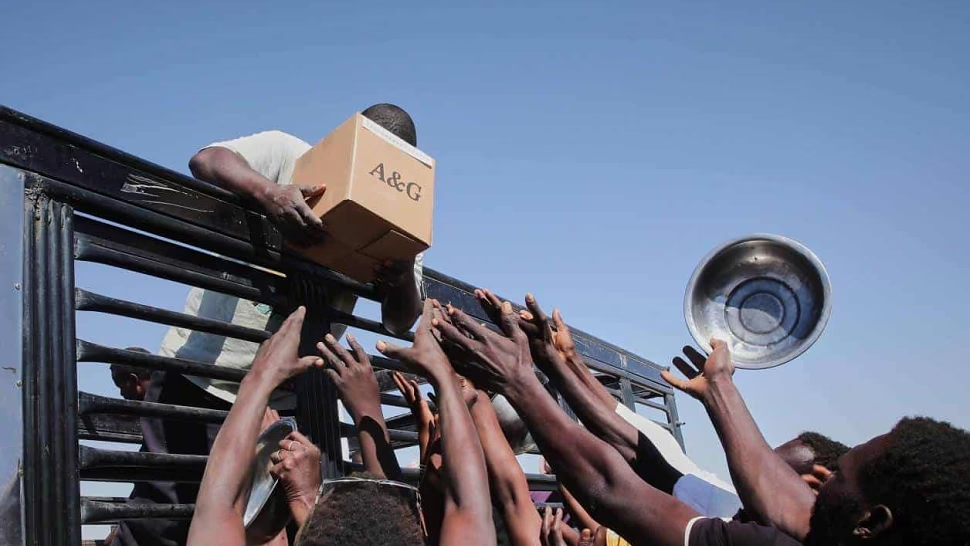
Double earthquake in Venezuela: 7.2 and 7.5 in 39 seconds

Two earthquakes of magnitude greater than 7 shake Venezuela 39 seconds apart and only 3 kilometers deep.

Two earthquakes in half a minute

Movement between the Caribbean plate and the South American plate activated a complex fault system. The result: two earthquakes of magnitude 7.2 and 7.5, separated by only 39 seconds and 13 kilometers away. The depth was barely 3 kilometers, which multiplied the impact.

“The two main earthquakes occurred in rapid succession and at very shallow depths, a combination that can easily cause significant damage to buildings and infrastructure,” explained Salvatore Stramondo, director of the Department of Seismology at the National Institute of Geophysics and Volcanology of Italy.

Possible comparison with Türkiye and Syria

The dynamics are reminiscent of the violent tremors that affected Syria and Türkiye in February 2023. There two shocks of magnitude 8.0 and 7.5 occurred hours apart. In Venezuela the interval was seconds, but the double event pattern is similar.

RelatedThe United States carries out a military operation and captures Maduro in Venezuela

Stramondo added: “In this case there was an interval of 39 seconds and a distance of 13 kilometers, although we know that there is a certain margin of error because the local network does not have a high density of monitoring stations.”

The Venezuelan seismic network has limitations. Therefore, the current data will be complemented with readings from other stations to accurately reconstruct the mechanism of the failure.

Venezuela, seismic country

The country has already experienced high intensity earthquakes in the past. An example of this is the 7.7 magnitude earthquake that shook Caracas on October 29, 1900.

Finally, the expert ruled out any relationship with the 7.0 magnitude earthquake recorded 25 minutes later in Japan, east of Honshu. “These are completely different events without any connection. We tend to perceive connections, perhaps influenced by temporal coincidence. However, this is a misconception,” concluded Stramondo.
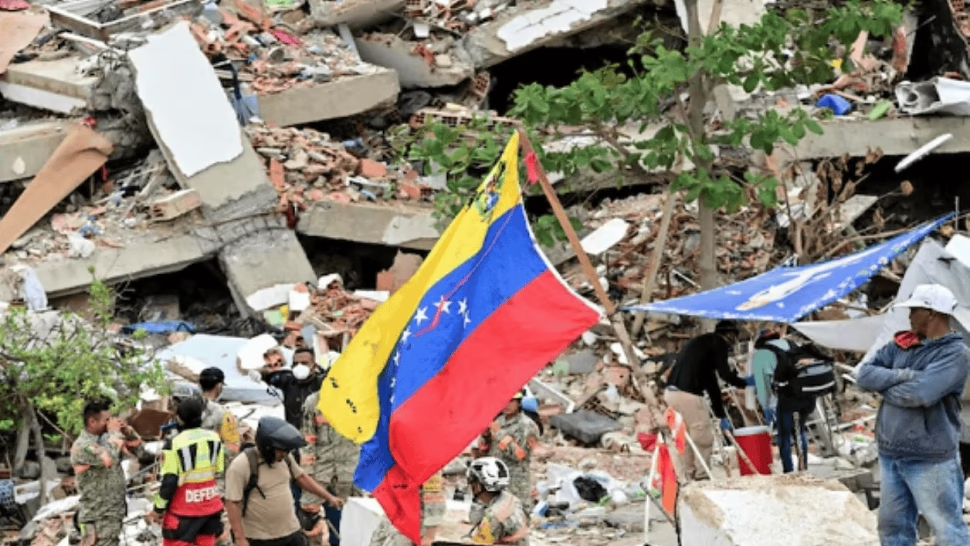

Venezuela reports 2,645 deaths from earthquakes

More than 2,600 dead and 12,000 injured after the earthquakes on June 24 in Venezuela.

Updated figures after the earthquakes in Venezuela

The official number of deaths from the June 24 earthquakes in Venezuela amounts to 2,645, while the injured total 12,666, according to the latest report from the Ministry of Popular Power for Communications and Information. The information was released today by the president of Parliament, Jorge Rodríguez.

The authorities have rescued 6,462 people. In addition, there are 15,050 displaced people, 885 buildings damaged and 189 collapsed. To date, 890 aftershocks have been recorded.

In terms of humanitarian aid, the government has distributed 78,478 food packages, 453,326 liters of water and 9,486 liters of liquid food. The patients treated total 20,909. A total of 29,567 workers and 3,305 international rescuers participate in emergency operations.

Rodríguez reported that 59 temporary camps have been set up to house the displaced and that 25,846 volunteers have joined the assistance tasks. More than 86 thousand families receive support.

Continue reading

Heat wave in France leaves 2,000 additional deaths

At least 2,000 additional deaths in a week due to record temperatures in France.

The heat wave that hit France at the end of June left a tragic toll. According to Public Health France, deaths increased by almost a third during the hottest week, with at least 2,000 more deaths than the previous week.

Preliminary and revised figures

The agency reported 8,973 deaths between June 22 and 28, 29% more than the 6,948 recorded between June 15 and 21. The difference of 2,025 deaths is attributed to extreme heat. This figure doubles the initial estimate of 1,000 additional deaths.

Public Health France warned that the numbers are partial and that the real mortality will be higher.

Impact on hospitals and communities

Dr. Nicolás Gonzales, head of emergencies at Paris-Saclay Hospital, told The Associated Press:

“Patients with heat exposure began arriving on June 20. We treated cases of heart attacks, dehydration and kidney failure, from children to elderly people who lived alone.”

Deaths in private homes shot up 91% compared to the previous week. In nursing homes they increased by 37%, and in hospitals by almost 20%. The Paris region was the most affected, with an increase of 63%.

Overload in funeral services

In Paris, funeral directors reported difficulties storing bodies before burial or cremation. Several morgues were at their limit and rejected bodies.

France recorded its hottest days in history between June 22 and 28, with day and night records in multiple locations. The wave also affected other European countries.

Health authorities continue to monitor the situation while awaiting definitive data.

Continue reading

UN red alert for possible catastrophe in Sudan

Volker Türk warns of atrocity crimes in El-Obeid and calls for urgent action.

The UN warning

The UN High Commissioner for Human Rights, Volker Türk, launched an alert this Friday before the Human Rights Council in Geneva. The signs from the city of El-Obeid, in central Sudan, are clear: a new humanitarian catastrophe is approaching.

“This is not a drill. It is a red alert that must reach the desks of heads of state and government around the world,” declared Türk.

Civilians have been under siege conditions for 18 months, with constant drone attacks. The Sudanese army and the paramilitary Rapid Support Forces (FAR) are fighting for control of the area. Half a million people live in El-Obeid, North Kordofan, and face shortages of food, water, fuel and health services.

The context of the conflict

The war broke out in April 2023. So far, at least 59,000 people have died, nearly 13 million have been displaced, and large regions of the country are suffering from famine. More than 30 million need humanitarian assistance.

The army broke a siege on El-Obeid in February 2025, but the FAR has launched offensives to reestablish it. The United Nations and several countries expressed concern about FAR reinforcements around the city.

The Human Rights Council is considering a draft resolution presented by the United Kingdom, Germany, Ireland, the Netherlands and Norway. The text condemns the escalation of violence by the FAR, encourages support for countries hosting Sudanese refugees and rejects all external interference in the conflict.

Türk urged world leaders to take concrete action: “Your phones should be abuzz with ideas to prevent atrocity crimes in El-Obeid and other areas of Kordofan.”

Continue reading