Democrats defy Trump’s government shutdown threats

The Democratic opposition is strengthening in the face of presidential warnings, intensifying the political pulse in the capital.

The Great Theater of the Absurd in Washington: A Closing That Nobody Wanted (But Everyone Enjoys Performing)

It seems that Washington D.C. has decided that the best way to govern is, precisely, not governing. What a revolutionary concept, right? As the shutdown of the United States federal government enters its third week of glory, a spectacle worthy of the best tragicomedy unfolds in the halls of power. And on center stage, Democrats, with a serenity that would make a Zen master pale, assure that President Donald Trump’s threats to fire thousands of public employees do not intimidate them in the least. Of course, why would they feel intimidated? After all, what is the livelihood of thousands of families compared to a battle of political egos?

Far from being cowed, our heroes in Congress seem more emboldened than ever. They returned to the capital from their districts, probably after hearing the complaints of their constituents, and with the determination of a child refusing to eat broccoli, they rejected it for the eighth time – eight! we’ve already lost count – the Republican bill to reopen the government. Because in the upside-down world of politics, stubbornness is synonymous with principles.

RelatedTrump turns government shutdown into a power battle

The Pearls of Political Wisdom: Phrases for Posterity

Senator Tim Kaine of Virginia, speaking as if he had just come down from Mount Sinai with the tablets of the law, declared: “What people are saying is that we have to stop the mass layoffs.” An impressive revelation, without a doubt. Who would have imagined that federal workers, those mythological beings with mortgages to pay, would be against losing their jobs. Kaine, with the impeccable logic of a Hollywood screenwriter, concluded: “And we’re not going to achieve that if we give in.” Translation: To save your jobs, we must first make sure the chaos continues. It makes sense, in an alternate reality.

Meanwhile, from the paradisiacal islands of Hawaii, Senator Brian Schatz enlightens us with his diagnosis: the layoffs are “a lot of grandstanding.” Fantastic! It is comforting to know that the possible economic ruin of thousands of people is, at its core, just a spectacle of bravado. He predicts, with the certainty of an astrologer, that the courts will eventually overturn this measure. In the meantime, those affected can pay their bills with judicial predictions and optimism.

But the prize for most exquisite cynicism goes to Senator Richard Blumenthal of Connecticut. With insight that cuts like a knife, he noted that the shutdown is just “an excuse for (Republicans) to do what they were already planning to do.” Oh! Who would have thought? A manufactured crisis that serves as a screen for pre-existing agendas. It’s almost as if politics were… politics.

To close with a flourish, Chuck Schumer of New York, the Democratic minority leader in the Senate, called the firings a “misguided attempt” to change votes. “Unwise” is a wonderful word. It suggests a touch of quaint madness, like a cartoon villain who has a ridiculously complicated plan to rob a bank. Perhaps he expected the terrified Democrats to immediately capitulate. What a lovely mistake to underestimate the ability of politicians to hold their own while the country burns around them.

In this three-ring circus – the White House, the Senate and the House of Representatives – everyone plays their role to perfection. The president threatens, Democrats shrug, and Republicans present the same proposal over and over again, hoping for a different ending. Albert Einstein had a name for it. Meanwhile, the federal workers, those anonymous extras in this play, wonder how they are going to pay the rent. But hey, at least we are witnessing a master class in political theater. The farce must continue.

What does the future hold for us? Will someone figure out the light switch to put an end to this feature? Or will we continue applauding through tears as paralysis becomes the new normal? Only time, and perhaps a few more motions, will tell. The only thing certain is that in Washington, the show never ends.

Are you intrigued by this pulse of power? Share this scathing analysis on your social networks and make your audience also reflect on this political absurdity. Explore more content about government crises and their curious dynamics on our site.

Tourism in Cuba plummets: arrivals fall 41.6% in May

Cuba registered only 30,800 tourists in May, a drop of 41.6% year-on-year.

May confirms the downward trend

Cuba received only 30,800 foreign tourists in May, according to the National Office of Statistics and Information (ONEI). The figure represents a year-on-year drop of 41.6% and a slight rebound compared to April.

In the first five months of the year, 359,491 international visitors arrived, 505,706 less than in the same period in 2025. Canada continues to be the main issuing market, with 126,239 tourists. They are followed by Cuban emigrants (60,874) and travelers from the United States (25,572).

Russia, Mexico, Argentina and China also show sharp declines. European countries such as Italy, Portugal and Germany left the top 10. Spain and France only contributed 8,106 and 7,525 visitors, respectively.

The drop has been constant: from 184,833 tourists in January, it fell to 77,663 in February and 35,561 in March.

Factors that aggravate the crisis

Starting in June, the situation will worsen with the departure of foreign hotel companies that operated alongside Gaviota, from the GAESA conglomerate. Dozens of facilities will be out of service. The hotel occupancy rate in the first quarter of 2026 fell to 12.9%, well below the 23.7% of the previous year.

In addition, most international airlines canceled flights due to critical fuel shortages, following the end of shipments from Venezuela and Mexico, and in the face of threats of sanctions from Washington.

In 2025, Cuba received just over 1.8 million foreign visitors, far from the projected 2.6 million. In 2024, 2.2 million arrived and in 2023, 2.4 million. The figures reflect a sustained deterioration in the sector, hit by the lack of fuel, the departure of international companies and lower global demand.

Continue reading

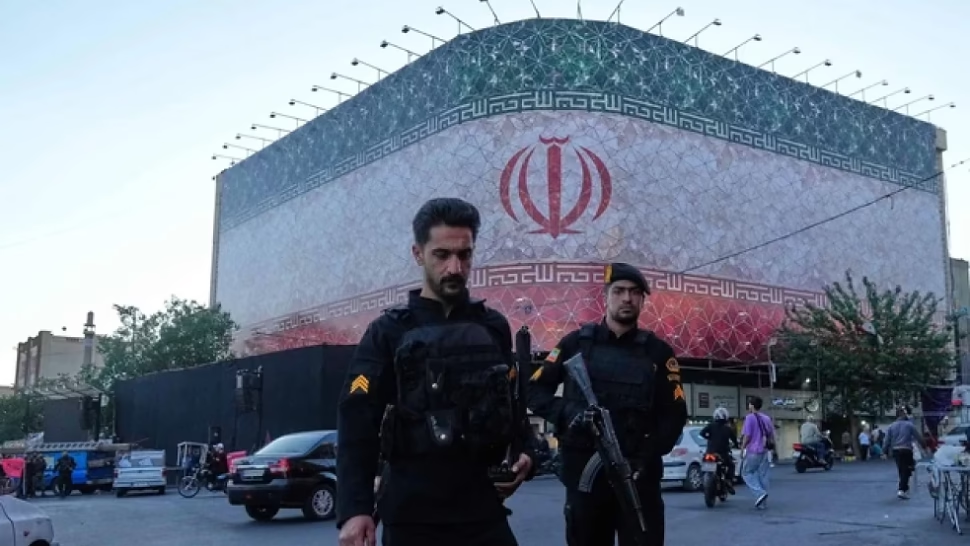
US and Iran reach provisional agreement to reopen Hormuz

The US and Iran agree to reopen the Strait of Hormuz and extend the truce.

The United States and Iran closed a provisional agreement that seeks to end the armed conflict and reopen the Strait of Hormuz, one of the most strategic maritime routes on the planet. The understanding also contemplates extending the fragile ceasefire in force in the region, amid years of military and political tension.

What does the pact contemplate?

The announcement opens the door to a formal signing next Friday in Switzerland, although authorities acknowledge that previous similar attempts have failed. As of Monday, the final content remained in dispute, especially on issues of regional security, nuclear verification and conditions for the lifting of sanctions.

The crisis between both nations has deep roots, from the Iranian nuclear program initiated with international cooperation to the Islamic Revolution of 1979. Since then, relations have been marked by diplomatic ruptures, economic sanctions and indirect clashes in the Middle East. The new agreement could mark a turning point, but doubts remain over its implementation.

Continue reading

Israel criticizes Netanyahu over US-Iran deal

The provisional pact between the US and Iran sparks internal criticism against Netanyahu for possible loss of influence.

Reactions in Israel

Israel is experiencing an intense internal debate after the provisional agreement between the United States and Iran. The pact has generated widespread criticism across the political spectrum, who consider it a strategic setback.

Prime Minister Benjamin Netanyahu has not yet issued an official position. Meanwhile, opposition figures, former officials and analysts react harshly. They point out that the Israeli government overestimated its ability to influence Washington’s strategy during the conflict with Tehran.

Another point of complaint is that the agreement could limit Israel’s freedom of military action, especially on the Lebanon front, where tensions with Hezbollah persist. Government sectors warn that resuming attacks could complicate the relationship with the United States.

International analysts point out that the pact alters the power dynamics in the Middle East. Israel would come under greater strategic pressure. Furthermore, the eventual partial lifting of sanctions on Iran would strengthen its economic and military capacity in the medium term.

Continue reading