Current panorama of artificial intelligence in the Mexican business ecosystem
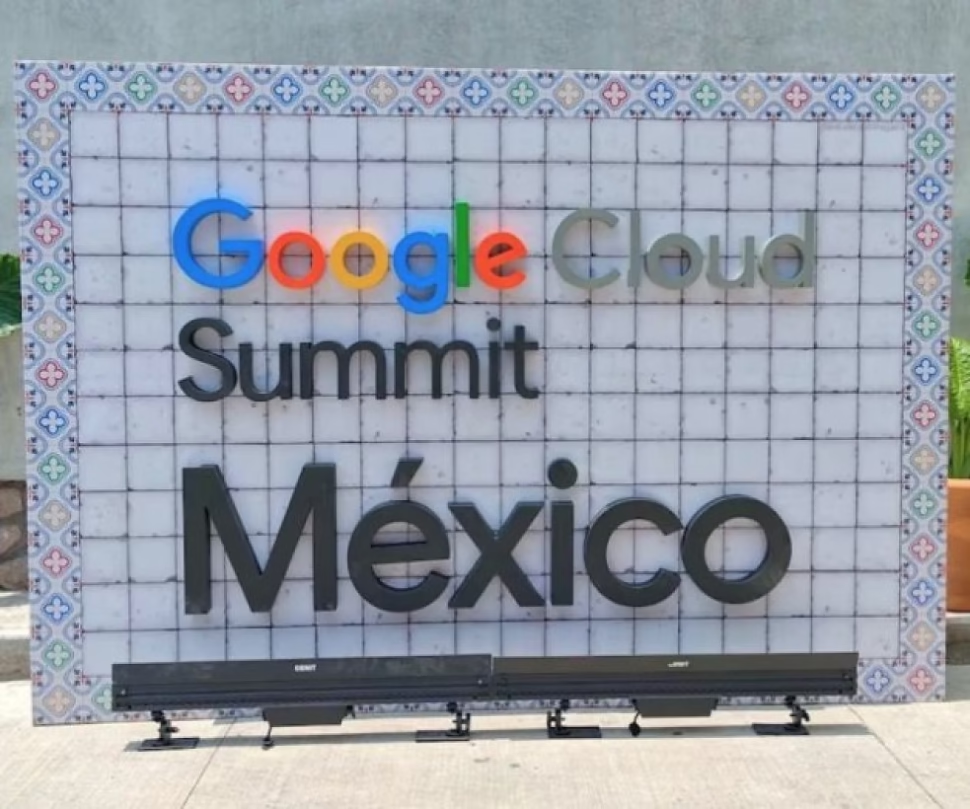
The Google Cloud Summit Mexico, held on September 3 and 4 in Mexico City, served as a platform to disseminate an exhaustive analysis of the penetration of artificial intelligence in the country. The event not only presented revealing metrics but also showcased successful implementations in national corporations and unveiled a strategic training initiative to counteract the lack of specialized human capital in this technological discipline.
According to research prepared by IDC and commissioned by Google, an overwhelming majority of 83% of companies operating in Mexico have a AI strategy formally defined or are in advanced stages of construction. More significantly, 95% of these organizations report having obtained positive and measurable results from their first forays. However, this optimistic outlook is clouded by a persistent obstacle: the shortage of specialized talent continues to represent the main impediment to the acceleration and scaling of projects.
Return on investment and the rise of agentic AI
A second study, focused specifically on the Return on Investment (ROI) of AI initiatives, provided conclusive data: 79% of companies already achieve a positive ROI in at least one use case implemented. Oliver Parker, Global Vice President of Generative AI at Google Cloud, specified these findings: “Three in four organizations are seeing returns on investment in at least one generative AI use case, and most reach this financial milestone within the first year of operation.”
Parker delved into the evolution towards the so-called “agent AI”, which consists of language models connected to tools that execute actions autonomously. This technology has passed the experimental phase; More than 56% of organizations surveyed already leverage intelligent agents in their daily operations, and early adopters are substantially accelerating their return on investment thanks to gains in efficiency and automation of complex processes.
Fundamental pillars and an initiative to close the skills gap
Eduardo López, President of Google Cloud Latin America, identified the three fundamental pillars for the robust development of AI in the region: “The continuous search for the use of innovation technologies, the infrastructure that the country must have and, critically, education.” It is in this last point where the immediate response to the talent challenge is framed.
To address this urgent need, Google Cloud announced the “Train+ AI in Practice with Google Cloud” program. This is a free training day, hybrid modality, scheduled for next December 6. The primary objective of this initiative is to train more than 200 thousand students and professionals in the practical use of the Gemini platform, equipping them with the skills demanded by the labor market.
Success stories: tangible applications in the Mexican industry
The event served as a showcase for successful AI implementations in the local industry. Grupo Herdez, for example, undertook a profound process of modernizing its technological infrastructure in order to transform its vast data repositories into a decisive strategic advantage. This effort culminated in the development of analytical models that reach 95% accuracy in the predictive analysis of market behavior, thus optimizing its supply chain and commercial strategies.
On the other hand, the firm DEACERO developed an “Industrial Intelligence” solution through the use of advanced agents built on the “AgentSpace” platform. This system is designed to autonomously analyze complex architectural plans and generate detailed economic proposals automatically, drastically reducing response times that traditionally required intensive human intervention.
Governance, security and shared responsibility for data
During a roundtable discussion, Eduardo López addressed growing concerns about the privacy of corporate information head-on. He stressed the absolute emphasis on data governance and security, clarifying that contracts with Google Cloud establish that all customer information resides in private and segregated spaces. However, he emphasized that the ultimate responsibility for security is shared: it is up to each company to generate robust internal policies to prevent leaks, especially in the face of unregulated use of open and public AI models by employees.
“The security and data breach risk materially emerges when an employee extracts confidential corporate information for use in an external open model. Therefore, privacy management does not fall solely on the structural solution provider, but requires a comprehensive commitment from the organization,” concluded López, thus outlining a model of bilateral responsibility in cybersecurity.
Was this analysis about the state of AI in Mexico revealing to you? Share this article on your social networks to expand the conversation and explore more content related to digital transformation on our site.