Claudia Valle and Gilberto Bátiz could define the future of the Electoral Tribunal

Two profiles with decades of experience arrive at a fractured organ. Balance or polarization?

A deep analysis of the new judges of the Superior Court

The appointment of Claudia Valle Aguilasocho and Gilberto Bátiz García as magistrates of the Superior Chamber of the Electoral Tribunal of the Judicial Branch of the Federation (TEPJF) marks a turning point in the internal dynamics of this body. With a judiciary divided into two ideological blocks, its incorporation could reconfigure the balance of power or, on the contrary, deepen the existing polarization.

Professional careers and political ties

Both candidates have more than a decade of experience in the electoral field, although their journeys present significant nuances. Valle, current magistrate of the Monterrey Regional Chamber since 2016, developed a large part of her career within the TEPJF, occupying key roles as General Secretary of Agreements. Her technical profile and her unanimous support from the three branches of government distinguish her among the 15 evaluated candidates.

RelatedGilberto Bátiz assumes the presidency of the TEPJF for the period 2025-2027

For his part, Bátiz—president of the Electoral Court of Chiapas since 2022—has a career more linked to political spheres. His time coordinating advisors to the Chiapas Congress during the hegemony of the PRI and the PVEM has generated speculation about his partisan affinities, despite his insistence on maintaining judicial independence.

The context of institutional fracture

The arrival of both magistrates occurs in a scenario where the Superior Chamber faces tensions between factions: one aligned with progressive positions and another with more traditional approaches. Data collected by election observers indicate that 68% of recent resolutions have reflected this division, with close votes (5-4 in 12 emblematic cases during 2024).

A controversial element is the so-called “accordions” distributed by Morena, where both names appeared recurrently. Although there is no evidence of direct negotiations, internal sources suggest that they sought support through government intermediaries. This information becomes relevant when considering that the designation requires the approval of the Senate, currently controlled by the government coalition.

Implications for electoral justice

Experts consulted agree that the composition of the Superior Chamber will define criteria on sensitive issues:

  • Impartiality in electoral processes: Chiapas and Nuevo León—states linked to the new magistrates—will be key scenarios in the 2025 elections.
  • Interpretation of gender parity: Valle has issued progressive rulings on political violence against women, while Bátiz lacks a clear record.
  • Relationship with the federal Executive: The TEPJF will face pressure due to possible electoral reforms.

A report from the Senate’s Belisario Domínguez Institute warns that the court’s credibility depends on avoiding perceptions of bias. Historically, 43% of magistrate appointments have generated controversy due to alleged partisan influences, according to records from 2000 to 2023.

Immediate perspectives and challenges

The deadline to join expires next month, and your first exam will be the resolution of challenges in Guerrero and Coahuila. Analysts such as Dr. Ignacio Rivas (Colegio Mexiquense) emphasize that “your vote could tip the balance in cases where a technical tie prevails”. Transparency in your deliberations will be crucial to legitimize your management.

Are you interested in understanding how these designations will impact the 2025 elections? Share this analysis and explore our specialized coverage on electoral reforms. #ElectoralJustice #Transparency
INEHRM becomes a research and teaching center

The INEHRM is transformed into a research and teaching center under the new secretariat.

Transformation of the INEHRM

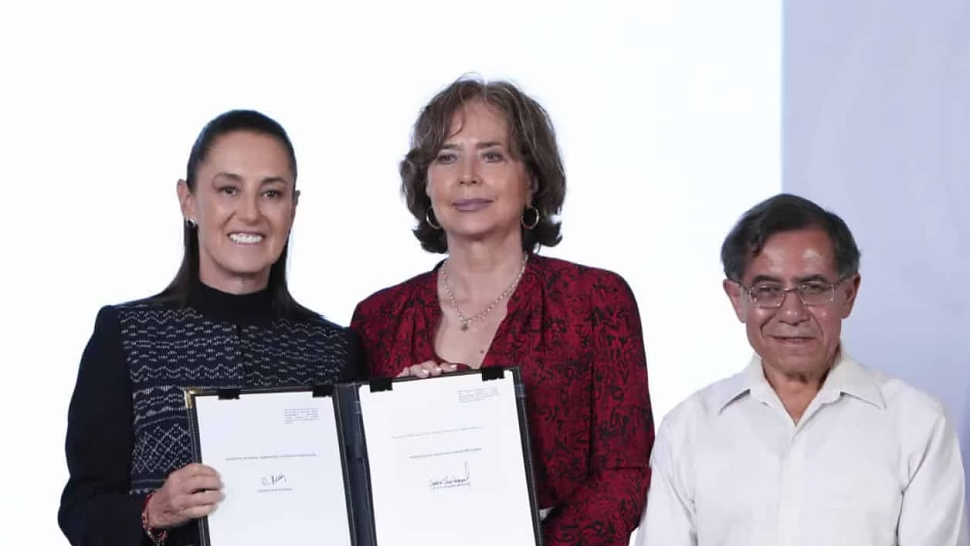
President Claudia Sheinbaum signed the decree that transfers the National Institute of Historical Studies of the Revolutions of Mexico (INEHRM) to the Secretariat of Science, Humanities, Technology and Innovation (SECIHTI). The institute becomes a decentralized public body with an academic focus.

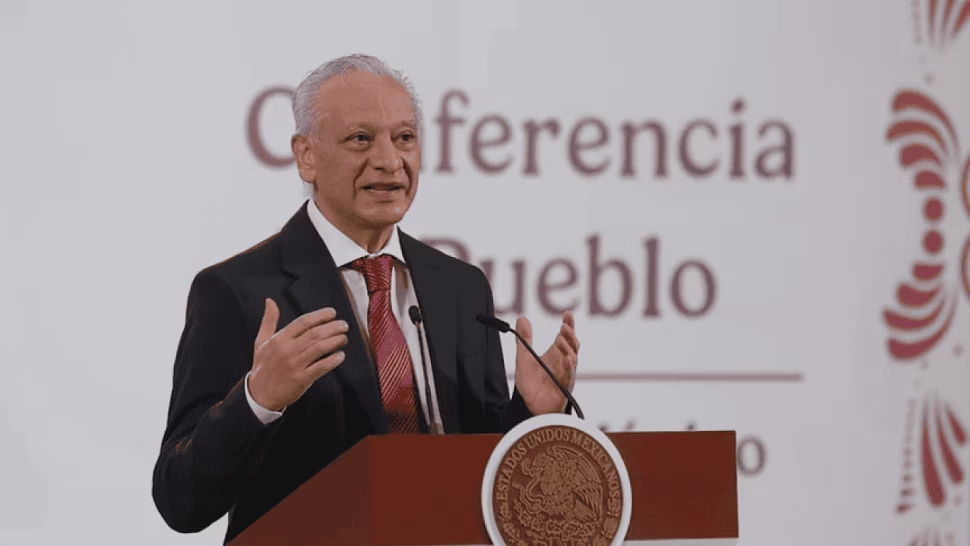
Rosaura Ruiz Gutiérrez, head of SECIHTI, explained that the new scheme will train specialists in history to strengthen national capacities in social sciences and humanities.

Felipe Arturo Ávila Espinosa, director of the INEHRM, explained that the study plans will link historical knowledge with social, economic, political and cultural problems of the country, and will address the needs of the Federal Public Administration.

Hybrid educational offer

The offer will include bachelor’s degrees in History, Social Sciences and Humanities, and Public Administration and Good Government. In postgraduate studies, master’s degrees will be added in Mexican Humanism, Gender and Feminism Studies, and Social Movements and Rescue of Historical Memory. There will also be specialties in Political Communication and History Teaching.

Graduates will cover topics such as agrarianism, health, migration, artificial intelligence, violence and human rights.

Headquarters and call

The new headquarters will be at 80 Guatemala Street, Historic Center of Mexico City. The first admission call will be launched in July, and classes will begin in September.

Continue reading

Prosecutor’s Office grants protection measures to victim of family violence

The Morelos Prosecutor's Office issued protection measures after a complaint of family violence against the former director of Pemex.

The Morelos Attorney General’s Office activated protection measures in favor of Felicia Jiménez Lavie, who filed a complaint for family violence against her husband, Víctor Rodríguez Padilla, former director of Pemex. This was reported by prosecutor Fernando Blumenkron Escobar.

The measures, the official explained, will be available when the victim requires them. The complaint was filed in Mexico City and the Women’s Secretariat of the Government of Mexico directly follows up on the case.

Investigation in progress

Until now, Jiménez Lavie has not gone to the local Public Ministry to contribute more elements to the investigation folder. This was initiated ex officio last Friday, June 26, after a video was broadcast with images of attacks against the woman.

Blumenkron assured that the portfolio continues its integration. “The proceedings have not stopped and we are going to continue to guarantee justice for the victim,” he said. In addition, he indicated that there is coordination with the Women’s Secretariat and the capital’s Prosecutor’s Office, under the care route for victims of family violence.

Among the actions carried out, the Morelos Prosecutor’s Office seeks to locate the address where the physical assault occurred, to carry out expert reports in accordance with the images of the video broadcast by the victim herself.

Continue reading

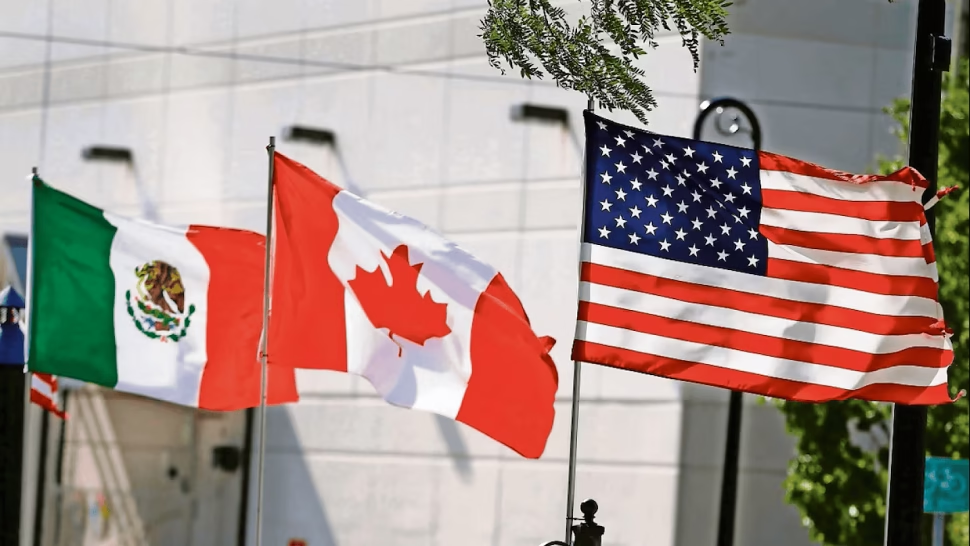
Trump does not extend T-MEC: Mexico faces annual review

US rejects automatic extension of the T-MEC; validity is reduced to 10 years with annual review.

Rejection of automatic extension

The United States decided not to automatically renew the Treaty between Mexico, the United States and Canada (T-MEC) for 16 years. This reduces its validity to a decade with an annual review. The measure generated concern among Mexican legislators.

Ricardo Monreal, coordinator of Morena in San Lázaro, explained that the treaty remains in force for another 10 years, but subject to evaluation each year. He noted that the United States presented 54 observations, including issues such as the vaquita porpoise and piracy. Mexico, for its part, raised 13 points, including clause 232 on tariffs.

“Only it will be reviewed year after year, but the Treaty is not finished, it continues for another 10 years because that is how it was signed six years ago,” declared Monreal.

The legislator warned that Donald Trump has been a constant critic of the USMCA and called for considering the benefits it has brought to the three nations.

Reactions of the opposition

Héctor Saúl Téllez, vice economic coordinator of the PAN, considered that the US position shows a lack of strategic anticipation on the part of the federal government.

“The US decision not to automatically extend the USMCA for 16 years in today’s review is not the end of the treaty, but it does reveal a lack of strategic anticipation by the federal government,” he stated.

Téllez recalled that Article 34.7 of the agreement had been known since 2018. Reaching July 1 without a clean extension represents a risk that, he said, should have been avoided.

The annual review will allow adjustments, but uncertainty about the future of regional trade persists. Mexico and Canada will seek to maintain the stability of the agreement for the next ten years.

Continue reading