CDMX Prosecutor’s Office collaborates in investigation of homicide of Colombian DJs

The authorities confirm the tragic identity of the bodies found, while the investigations focus on their final journey from Polanco.

Justice Coordinates, While Tragedy Unites (Ironically) Two Prosecutor’s Offices

In a twist that no one saw coming, but that we all expected with that cynicism that characterizes the well-informed Mexican, the Attorney General of Justice of Mexico City, Bertha Alcalde Luján, came on stage to announce what in any functional country would be the minimum required: that her office is coordinated with her counterparts in the State of Mexico. The reason? Try to clarify the brutal murder of two Colombian musicians. Because, of course, when the victim has a certain reputation, the state machinery does let out a screech and move, even if it is based on pushing and statements to the press.

The news, wrapped in that halo of painful obviousness, confirmed what many feared: the two lifeless bodies found in the picturesque (and now sinister) municipality of Cocotitlán are indeed those of Bayron Sánchez (DJ B-KING) and Jorge Herrera (DJ REGIO CLOWN. And do you know what is the most “comforting” thing about All this? That the Attorney General’s Office of the State of Mexico already has a… surprise!… a homicide investigation open. Thank goodness, because for a moment we thought they were going to file it as “death by natural causes” after being abandoned in a field.

RelatedInvestigation advances for murder of Colombian musicians in Mexico

El Rastro Digital: From the Party in Polanco to Silence in Cocotitlán

The official narrative, which sounds more like a script for a mediocre drug trafficker series, is that simple and terrifying. It all began with a search effort that began on September 17, after the loss of contact with these two young people was reported. The prosecutor, in her statement, released the informative pearl of the century: “Indeed, we had information that these two people had been in a property in Polanco.” Wow! Polanco, that bastion of security and tranquility where the worst thing that can happen to you is that a coffee costs you the equivalent of the basic basket.

But here is the detail that changes the game, the climax of our bureaucratic tragicomedy: “there is already corroborated information that both young people left Mexico City.” They boarded a vehicle and, paying attention to the plot twist, “they left Mexico City towards the State of Mexico.” Redundancy, dear readers, is the favorite rhetorical device of institutions. As if crossing the invisible border between the capital and the neighboring state were equivalent to crossing a portal to another dimension, one where, apparently, Mexican justice is applied with… well, with the same limitations as always.

It was in that parallel dimension, specifically in the already famous municipality of Cocotitlán, where the life journey of these two young people found its end. The capital prosecutor, with a tone that almost managed to convey concern, noted: “as part of the search efforts, it was possible to corroborate the discovery of the bodies.” What efficiency, right? They managed to “corroborate” what the residents had already found. First-class detective work.

Interfiscal Collaboration: A Bureaucratic Bear Hug

The best thing about the conference was the promise of collaboration. A gem of legal-political oratory: “from the Attorney General’s Office of Mexico City we are going to collaborate with the Prosecutor’s Office of the State of Mexico in everything related to the investigation into the crime of homicide.” The repetition of “de la” is not a transcription error, it is the perfect sound representation of the labyrinthine state apparatus. It sounds like even they get lost in their own titles.

And in case anyone doubted the human warmth of the system, we were informed that the family was accompanied to identify the bodies. “We have been providing support up to here,” said the prosecutor. What a touching detail. For a moment, one can almost imagine the officials passing out coffee and cookies to the mourners, rather than, I don’t know, maybe focusing on catching the miscreants who committed the crime. But hey, emotional support is crucial… especially when criminal justice moves at a snail’s pace.

The final irony was provided by life itself, or rather, social networks. The 31-year-old urban singer, Bayron Sánchez “B-KING“, had shared a video of his last performance in Mexico on Instagram. There, with a smile from ear to ear, he thanked the Mexican public for the “warm reception” and proclaimed: “I feel happy and grateful, we are going to break it.” The presentation was on September 15. A day later, they disappeared. The contrast is so brutal that it hurts: the joy of an artist at the peak of his performance, compared to the coldness of a crime that still awaits, like so many others, a true resolution. “Break it” on stage, yes. Having your life “broken” outside of it is a tragedy that no country should allow.

Conclusion? Two prosecutors collaborating, an investigation underway, and a family devastated. The circus of justice continues its function, with tragic clowns and an audience that no longer knows whether to laugh or cry. Or, in this case, whether to trust that inter-institutional collaboration means more than a well-written press release.

Does this type of news generate indignation in you or, on the contrary, a sad familiarity? Share this article on your social networks to keep the conversation going about security and justice in the region. Explore more related content on our portal.
INEHRM becomes a research and teaching center

The INEHRM is transformed into a research and teaching center under the new secretariat.

Transformation of the INEHRM

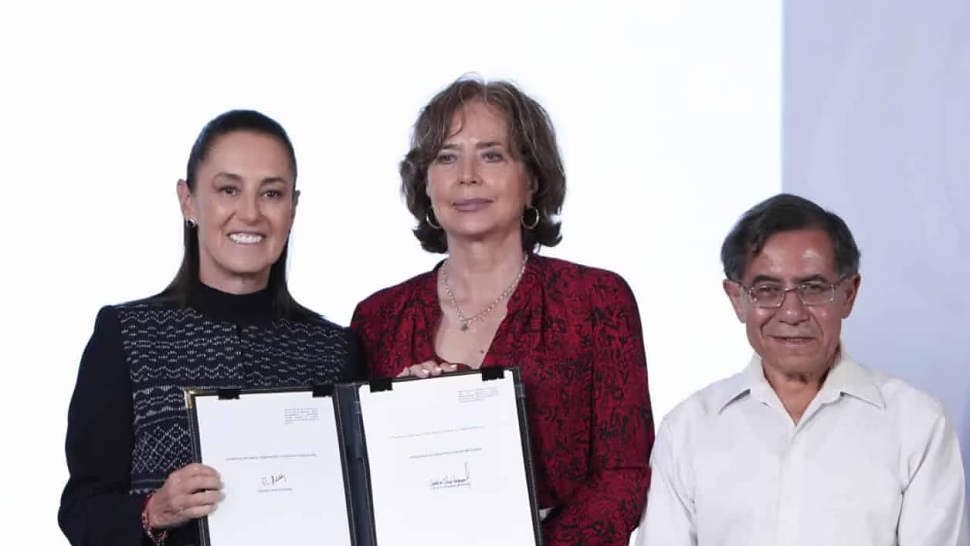
President Claudia Sheinbaum signed the decree that transfers the National Institute of Historical Studies of the Revolutions of Mexico (INEHRM) to the Secretariat of Science, Humanities, Technology and Innovation (SECIHTI). The institute becomes a decentralized public body with an academic focus.

Rosaura Ruiz Gutiérrez, head of SECIHTI, explained that the new scheme will train specialists in history to strengthen national capacities in social sciences and humanities.

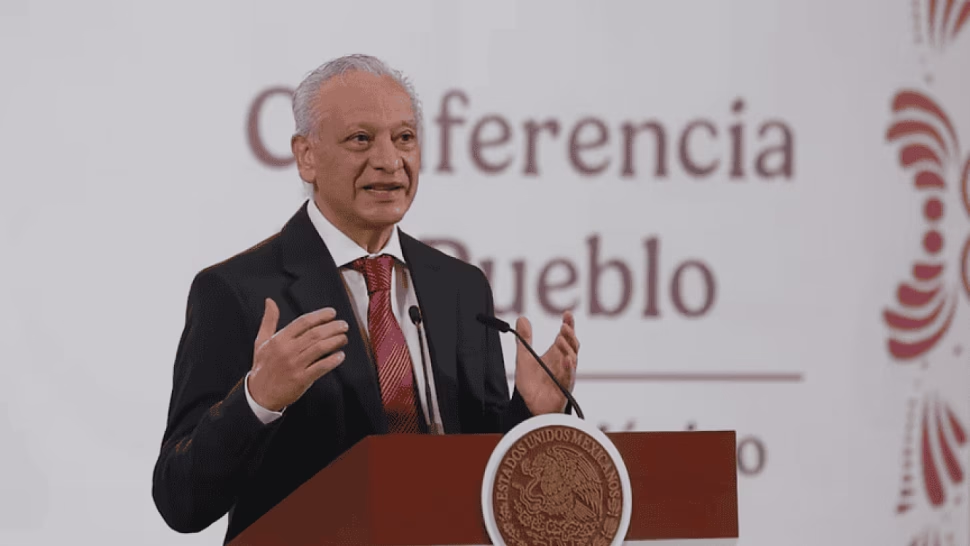
Felipe Arturo Ávila Espinosa, director of the INEHRM, explained that the study plans will link historical knowledge with social, economic, political and cultural problems of the country, and will address the needs of the Federal Public Administration.

Hybrid educational offer

The offer will include bachelor’s degrees in History, Social Sciences and Humanities, and Public Administration and Good Government. In postgraduate studies, master’s degrees will be added in Mexican Humanism, Gender and Feminism Studies, and Social Movements and Rescue of Historical Memory. There will also be specialties in Political Communication and History Teaching.

Graduates will cover topics such as agrarianism, health, migration, artificial intelligence, violence and human rights.

Headquarters and call

The new headquarters will be at 80 Guatemala Street, Historic Center of Mexico City. The first admission call will be launched in July, and classes will begin in September.

Continue reading

Prosecutor’s Office grants protection measures to victim of family violence

The Morelos Prosecutor's Office issued protection measures after a complaint of family violence against the former director of Pemex.

The Morelos Attorney General’s Office activated protection measures in favor of Felicia Jiménez Lavie, who filed a complaint for family violence against her husband, Víctor Rodríguez Padilla, former director of Pemex. This was reported by prosecutor Fernando Blumenkron Escobar.

The measures, the official explained, will be available when the victim requires them. The complaint was filed in Mexico City and the Women’s Secretariat of the Government of Mexico directly follows up on the case.

Investigation in progress

Until now, Jiménez Lavie has not gone to the local Public Ministry to contribute more elements to the investigation folder. This was initiated ex officio last Friday, June 26, after a video was broadcast with images of attacks against the woman.

Blumenkron assured that the portfolio continues its integration. “The proceedings have not stopped and we are going to continue to guarantee justice for the victim,” he said. In addition, he indicated that there is coordination with the Women’s Secretariat and the capital’s Prosecutor’s Office, under the care route for victims of family violence.

Among the actions carried out, the Morelos Prosecutor’s Office seeks to locate the address where the physical assault occurred, to carry out expert reports in accordance with the images of the video broadcast by the victim herself.

Continue reading

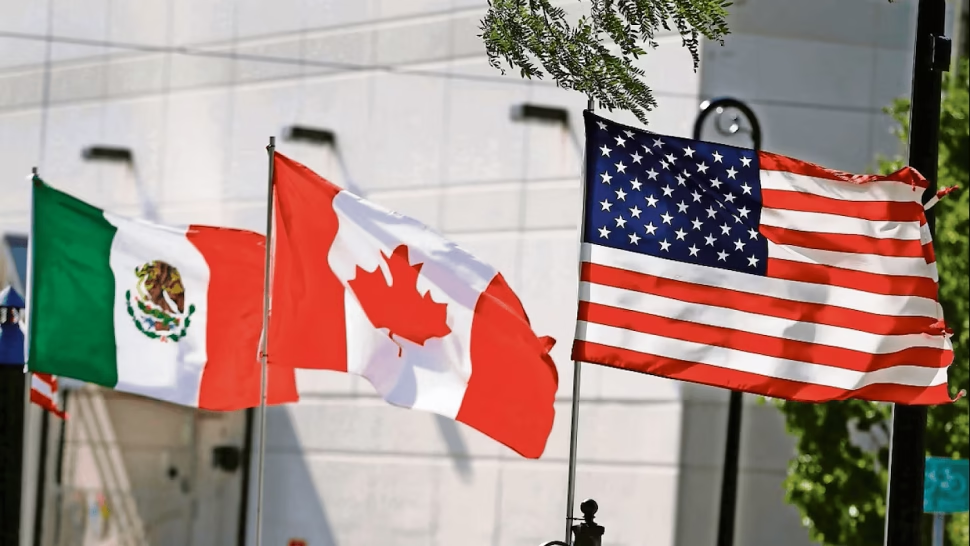
Trump does not extend T-MEC: Mexico faces annual review

US rejects automatic extension of the T-MEC; validity is reduced to 10 years with annual review.

Rejection of automatic extension

The United States decided not to automatically renew the Treaty between Mexico, the United States and Canada (T-MEC) for 16 years. This reduces its validity to a decade with an annual review. The measure generated concern among Mexican legislators.

Ricardo Monreal, coordinator of Morena in San Lázaro, explained that the treaty remains in force for another 10 years, but subject to evaluation each year. He noted that the United States presented 54 observations, including issues such as the vaquita porpoise and piracy. Mexico, for its part, raised 13 points, including clause 232 on tariffs.

“Only it will be reviewed year after year, but the Treaty is not finished, it continues for another 10 years because that is how it was signed six years ago,” declared Monreal.

The legislator warned that Donald Trump has been a constant critic of the USMCA and called for considering the benefits it has brought to the three nations.

Reactions of the opposition

Héctor Saúl Téllez, vice economic coordinator of the PAN, considered that the US position shows a lack of strategic anticipation on the part of the federal government.

“The US decision not to automatically extend the USMCA for 16 years in today’s review is not the end of the treaty, but it does reveal a lack of strategic anticipation by the federal government,” he stated.

Téllez recalled that Article 34.7 of the agreement had been known since 2018. Reaching July 1 without a clean extension represents a risk that, he said, should have been avoided.

The annual review will allow adjustments, but uncertainty about the future of regional trade persists. Mexico and Canada will seek to maintain the stability of the agreement for the next ten years.

Continue reading