Catholic leaders denounce the human impact of immigration policies
A prominent group of Catholic bishops and nuns in the United States, who operate on the front lines of the national immigration crisis, have issued severe criticism against the strict guidelines of President Donald Trump’s government. These ecclesiastical authorities argue that the policies have not only caused family separation, but have also fostered a climate of fear and deeply disrupted the life of the Catholic church in the country.
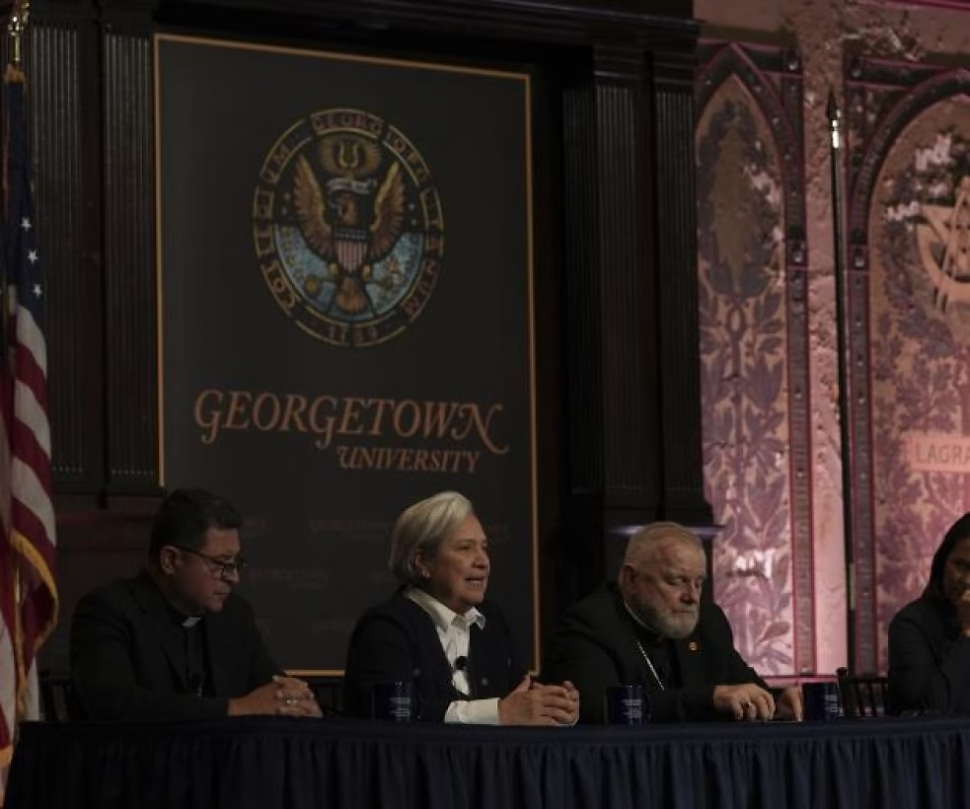
During a panel discussion held at Georgetown University, church representatives not only criticized the federal government, but also detailed the support strategies they implement to help the immigrant community. Faced with the agenda of mass expulsions and the strengthening of immigration enforcement, many families face paralyzing fear. This terror deters them from carrying out essential daily activities, such as taking their children to school, going to their jobs or even participating in religious services, due to the well-founded fear of being detained and deported.
The testimony of the ecclesiastical authorities
The auxiliary bishop of Washington, D.C., Evelio Menjivar Ayala, offered a moving testimony: “The way immigration policies are applied these days not only destabilizes the life of the individual immigrant, but of entire families, businesses, the lives of children, of entire communities, of neighborhoods”. The prelate added that he observes “pain and deep confusion” on people’s faces, expressing the hopeless question that many ask: “Where will we go if we are not welcome here?”
This situation has been aggravated by a regulatory change implemented at the beginning of Trump’s second term, which gave greater discretion to immigration agents to make arrests at educational institutions and places of worship. These spaces had historically been considered untouchable sanctuaries, a tradition that is now legally challenged by educators and religious groups.
For Bishop Menjivar, this fight is deeply personal. “For me, it is something very personal because I was a stranger and they welcomed me,” he confessed. The religious crossed the border undocumented in 1990, fleeing the civil war in his native El Salvador. Today he is a US citizen and has become the first bishop of Salvadoran origin in the country.
Humanitarian work on the border
Sister Norma Pimentel, a renowned activist for the rights of migrants on the US-Mexico border, emphasized the importance of keeping hope alive among families fighting to remain in the country. At the head of Catholic Charities of the Rio Grande Valley, a shelter in McAllen, Texas, for exhausted migrants, the nun recounted a deeply shocking experience.
When visiting immigrant families in a detention center, she found them in a “terrible condition”, a scene that moved her to tears. “I saw Border Patrol agents looking at us, and they were also moved and cried,” he narrated. “When I walked out of there, the agent turned to me and said, ‘Thank you, sister, for helping us realize that they are human beings.’”
This position is in stark contrast to the official position of the Department of Homeland Security, which has consistently maintained that there will be no enforcement-free zones for those who reside in the country illegally, have committed crimes, or attempted to undermine immigration regulations. The institution insists that its efforts are intended solely to safeguard public and national security.
A doctrinal and political divergence
American Catholic leaders, although aligned with the Trump administration on central doctrines such as opposition to abortion and same-sex marriage, have expressed profound disagreement on immigration policy. This fracture became evident when the United States Conference of Catholic Bishops (USCCB) announced the end of five decades of collaboration with the federal government to care for refugees and migrant children. The decision, described as “heartbreaking,” was a direct response to the government’s abrupt cancellation of funds.
In a significant gesture of moral authority, the late Pope Francis in February issued a rebuke of the administration’s mass deportation plans. The pontiff warned that the forced expulsion of people based solely on their immigration status deprives them of their inherent human dignity.
In the same panel, the Archbishop of Miami, Thomas Wenski highlighted an aspect often ignored in the debate: the significant economic and cultural contributions of the immigrant community to the social and economic fabric of the nation. His intervention served as a crucial reminder that, beyond statistics and policies, lies the human face of a community seeking to build a better life.
Has this analysis given you a clear perspective on a complex topic? Share this article on your social networks to amplify this crucial conversation and explore more content related to human rights and current politics.