Brazil expands meat exports to Mexico after bilateral agreement

The Brazilian visit reached agreements on tuna and avocado, but Mexico remains firm in its strict health controls for the import of meat.

Trade Agreements and Health Negotiations between Mexico and Brazil

The government of Brazil described its recent visit to Mexico as successful, highlighting that the Mexican Program Against Inflation and Scarcity (PACIC) will facilitate a stable flow of Brazilian exports of beef and pork, as well as beef and pork meal. However, the South American delegation did not achieve its main objective: for Mexico to declare it a country free of foot and mouth disease, a viral disease that affects cloven-hoofed animals.

In reciprocity, Brazil will allow the entry of Mexican tuna and avocado to its domestic market, as confirmed by representatives of the national agricultural sector. This exchange is part of an effort to balance the trade balance and diversify the products exchanged.

RelatedMexico diversifies meat exports after suspension to the US

Unwavering Posture on Health Matters

During the Global Agri-Food Forum organized by the National Agricultural Council, the Mexican Secretary of Agriculture and Rural Development, Julio Berdegué Sacristán, was categorical. He clarified that, although there is interest in deepening commercial exchange, Mexico will not modify its health protocols. “We are always interested in safe trade,” he said, underlining the priority of protecting the national health status and the health of consumers.

As part of the rigorous procedures, Mexican inspectors will be sent to audit meat plants in Brazil during the month of September. The objective of these audits is to verify compliance with Mexican and international standards, which will allow the renewal and granting of new export permits. According to Juan Hinojosa, senior vice president of Stonex Financial, fourteen meatpacking plants will be evaluated.

Strategic Implications and Concerns of the Local Sector

The trade opening towards Brazil, within the framework of the PACIC, has already had a quantifiable impact. An analysis by the Agricultural Market Consulting Group (GCMA) reveals that Brazilian participation in the Mexican beef market climbed from 2% in 2023 to a significant 34% last July, positioning it as the second most important supplier, only behind the United States. In the pork sector, Brazil maintains approximately 2% of the national market.

This growth consolidates Brazil in a dual role: as a strategic partner to ensure supply and contain inflation, and as a strong competitor for national producers. Its productive capacity is enormous: it is the world’s second producer and first exporter of beef, the fourth producer and third exporter of pork, and the third producer and first exporter of chicken.

This situation generates concern in the local livestock industry. Álvaro Bustillos Fuentes, president of the Regional Livestock Union of Chihuahua, expressed a firm position: “We must close the door to Brazil… it is better that there are support programs for infrastructure and industrialization here.” His statement reflects widespread concern about external competition and the desire to strengthen self-sufficiency and the internal value chain.

The future of this trade relationship will be discussed in the review process of the Economic Complementation Agreement (ACE 53), a dialogue that, according to Berdegué, will extend until October 2026. It is crucial to note that the PACIC is not a permanent or generalized instrument, and there is no interest in a bilateral free trade agreement with Brazil at this time.

There is also speculation in the sector about a re-export strategy. Given the proximity and access to the US market, the possibility of Brazil using Mexico as a platform to subsequently send its meat products to the United States is being analyzed, which adds another layer of geopolitical complexity to these agreements.

Was this analysis of international trade agreements useful to you? Share it on your social networks to inform more people and explore our global economy section to stay up to date with the dynamics that shape the markets.

Morena calls for a total recount in Colombia and supports Iván Cepeda

Morena questions the validity of the result in Colombia and demands a full recount of votes.

Rejection of the result and call for transparency

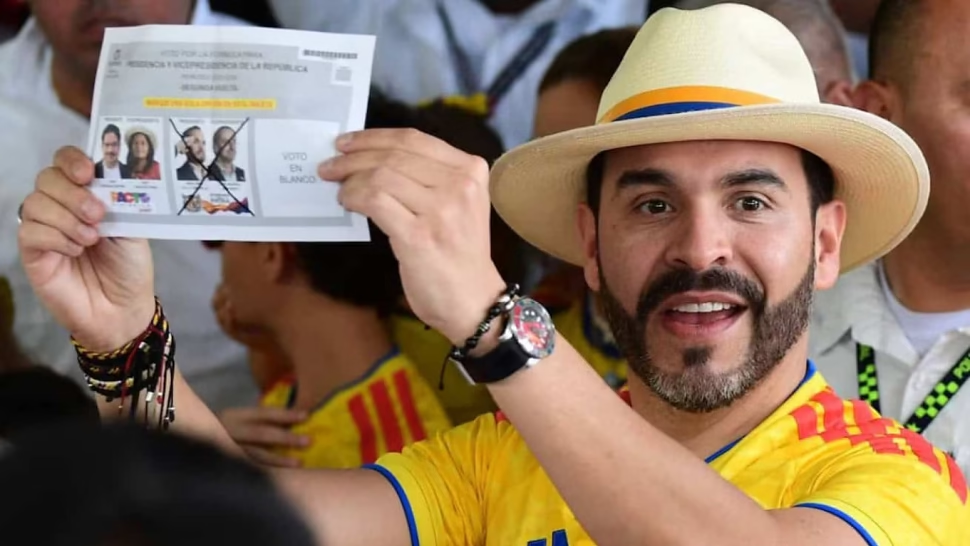
The Morena party expressed its disagreement with the result of the second presidential round in Colombia, where the conservative Abelardo de la Espriella was declared the winner. In a statement, the leadership of the Mexican ruling party expressed its support for the leftist candidate Iván Cepeda, whom it described as an honest profile and committed to progressive causes.

According to the statement, the Colombian electoral process was marked by accusations of a dirty war and pressure from external actors. Morena considered it “worrying” that the result was closed with a minimal difference. The reported advantage, less than 1% of the votes, forces – from their perspective – a total recount to guarantee certainty and transparency.

The party maintained that the legitimacy of the process must be based on the complete count of votes and respect for the popular will. In addition, he made reference to electoral history in Latin America to underline the importance of review mechanisms in closed elections. He called for avoiding narratives of early triumph without final scrutiny.

Solidarity with the Cepeda movement

Morena expressed his solidarity with Iván Cepeda and his political movement, and warned about the advance of right-wing forces in the region. He reiterated that, while the official counts are not concluded, absolute respect for the will of the Colombian people must prevail.

Continue reading

Merlin, the duck of the Cup, tours CDMX

The Peking duck with sandals and a Mexican shirt unleashes a tour of key venues in the capital.

An unexpected tour

The Merlin duck, a Peking breed, went viral after appearing at the 2026 World Cup celebrations. Its distinctive features: small sandals to protect its legs, a National Team shirt and an evident closeness to its family. That video prompted a series of visits that its owners, the Gómez family, documented on social networks.

The logs of these tours show that the bird went to emblematic places in the Mexican capital. At the National Palace, he entered the Treasury Room during the morning conference, where he caught the attention of the staff and attendees.

It also went through the Mexican Institute of Industrial Property (IMPI), where the family processed the official registration of the animal’s name to ensure exclusive commercial rights to its image.

Institutional recognition

Merlin visited the Netflix Mexico offices in Mexico City. Their presence generated digital interactions among the streaming platform’s workers. In addition, the ESPN and TV Deportes networks integrated it into their programming and special coverage around the tournament.

The Atlante Club, a local sports institution, incorporated it into its institutional activities and classified it as an amulet in promotional events.

The phenomenon reached the international level: FIFA granted official access to Merlín and his family to watch the Mexican National Team’s match against the Czech Republic from a box. Thus, the duck became an unexpected ambassador of the capital during the Cup.

Continue reading

Mexican receives its seventh Embraer and expands routes

Mexicana receives its seventh Embraer E190-E2 and announces four new destinations for July.

Fleet modernization

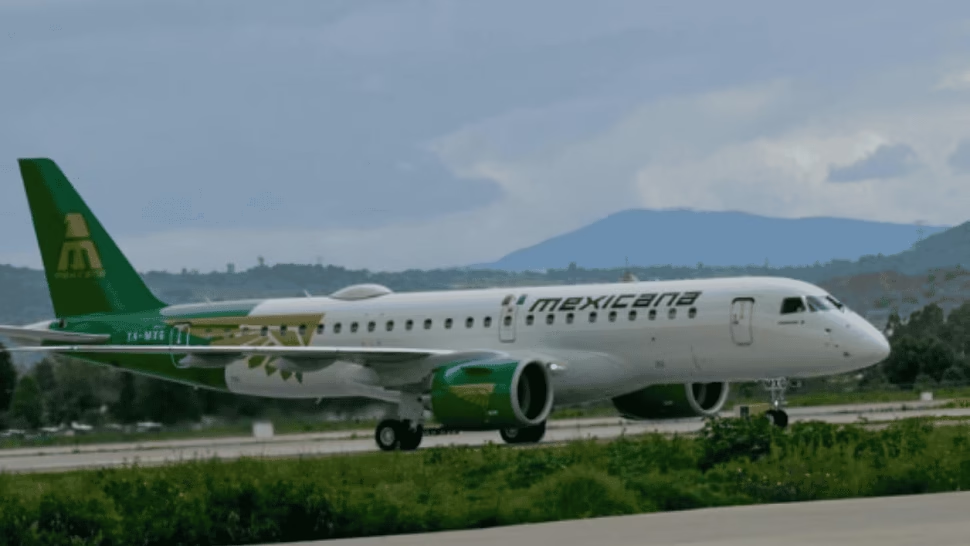
Mexicana de Aviación incorporated its seventh Embraer aircraft model E190-E2, with registration XA-MXG. The team will begin the technical and regulatory processes before the aeronautical authority to join the operation.

The airline seeks to consolidate a fleet of 20 Embraers by the end of 2027. The general director, Leobardo Ávila Bojórquez, stated that each new aircraft represents confidence and opportunities.

“Today we received our seventh aircraft of the E-2 family, an addition that strengthens our operational capabilities and confirms that Mexicana continues to grow sustainably,” he declared at the Felipe Ángeles International Airport.

The E190-E2 stands out for its efficiency: it reduces fuel consumption and polluting emissions. Its 2+2 configuration offers comfort to passengers.

The fleet increased 40% compared to the previous year, and the supply of seats grew 33%. More than one million 70 thousand passengers have flown with Mexicana.

New routes for July

Ávila Bojórquez announced the incorporation of four destinations: Tuxtla Gutiérrez (July 6), Chihuahua (July 13), Hermosillo (July 20) and the Bajío International Airport (July 27).

“Each new destination is a door that opens to generate opportunities for tourism, investment, trade and regional development.”

The airline continues to expand its presence in the national territory and strengthen connectivity between regions.

Continue reading