Anaya foresees national bankruptcy due to unsustainable public debt

A severe warning about the country's fiscal course and its consequences for the immediate future of national finances.

Analysis of the Fiscal Scenario: The Warning of an Imminent Crisis

The parliamentary leader of the National Action Party in the Upper House, Ricardo Anaya, has issued a stern warning about Mexico’s fiscal trajectory. Its analysis focuses on the financial cost associated with servicing the national public debt, which, according to official projections for the fiscal year 2026, will reach the historic figure of 1.6 trillion pesos. From a technical perspective, this amount, allocated almost entirely to the payment of interest and not to the amortization of capital, represents an unsustainable burden on public coffers. Anaya argues that this dynamic leads inexorably to a scenario of technical bankruptcy for the Mexican State, an event with profound implications for economic and social stability.

The diagnosis presented indicates that the current administration, headed by the party in power, Morena, is leading the nation towards brutal debt whose character is fundamentally unsustainable. The analogy used by the senator is particularly illustrative: debt service is equivalent to the minimum payment on a credit card, where only the interest generated is covered, perpetuating and aggravating the principal balance. According to the data handled, the projected expenditure for 2026 is unprecedented in the last three and a half decades, marking a critical turning point in the management of the country’s public finances.

“At this rate they are going to bankrupt the country, because they are not borrowing to invest in growth, but to cover interest and patches, and when the bill arrives, there will be no money for social programs, medicines, education or security”

The Consequences for Economic Development and the Middle Class

This position is echoed by other analysts and legislators. Senator Alejandra Barrales, representative of the Citizen Movement party, complements this analysis by estimating that the indebtedness projected by the Ministry of Finance and Public Credit (SHCP) for the 2025-2026 biennium will have a suffocating effect on the middle class. The legislator emphasizes that the core of the problem lies in the disconnection between the volume of debt contracted and the generation of substantive economic growth. In macroeconomic terms, when debt is not linked to productive investment in infrastructure, human capital or technological innovation, its ability to generate the future cash flows necessary to honor the debt is severely compromised.

RelatedAnalysis supports the sustainability of Mexican public debt

The situation described sets up a dangerous vicious cycle: new loans are intended to cover pre-existing debt commitments, not to create new wealth. This practice, known in economic theory as a debt Ponzi scheme, increases the country’s vulnerability to external shocks, such as fluctuations in international interest rates or a global slowdown. The government’s ability to implement social policies, maintain public investment in strategic sectors and guarantee basic services such as health, education and security would be irremediably diminished as an increasingly larger portion of the federal budget is allocated to interest payments.

The analysis concludes that an immediate change is required in the State’s financing policy. The priority must be to reorient spending and credit towards investments that expand the productive base of the economy and strengthen public finances in the long term, thus avoiding the gloomy prognosis of a crisis of national solvency. Transparency in debt management and informed public debate are crucial elements to confront this structural challenge.

Are you worried about Mexico’s economic future? Share this analysis to spark a necessary conversation about our financial stability, and explore more economic policy content in our dedicated section.

Passenger trains: Mexico City-Querétaro and Pachuca would start in 2027

Federal government advances in six passenger train routes; two would begin operations in 2027.

Advances in the passenger and freight railway network

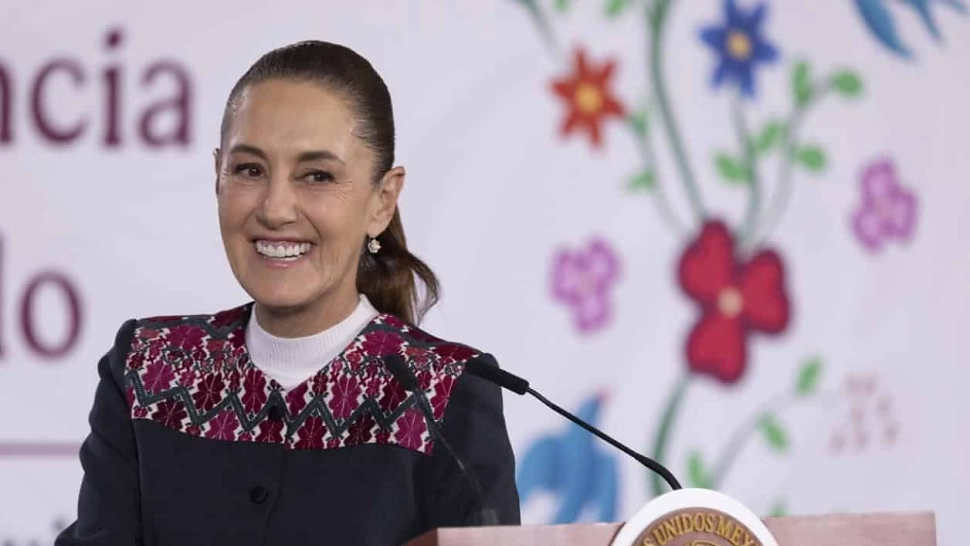
President Claudia Sheinbaum reported that the construction of passenger trains is advancing significantly. The Mexico City-Querétaro and Mexico City-Pachuca routes will be inaugurated in 2027, while other lines such as Saltillo-Nuevo Laredo and Querétaro-Irapuato continue to be developed.

“We are very advanced. The other sections to Guadalajara and Nuevo Laredo will be put out to tender this year or carried out by the Ministry of Defense,” he stated during the morning conference. The complete project includes an investment of 750 billion pesos.

Right of way and community work

Edna Elena Vega Rangel, Secretary of Agrarian Development, reported that 28 million 452 thousand 804 square meters of right of way have been released. Of that total, 72% corresponds to historical right of way, 14% to social property and 14% to private property. To serve the communities, 268 social tables were held, 95 assemblies with more than 4,500 attendees and 987 plots were acquired.

Andrés Lajous, head of the Train Agency, explained that clearings, embankments and drainage works are being carried out on the Querétaro-Irapuato and Saltillo-Nuevo Laredo sections. In Monterrey, 30 thousand tons of steel are already manufactured and 9-kilometer viaduct projects are being developed. In addition, the manufacturing of sleepers began: 330 thousand for Querétaro-Irapuato, 430 thousand for Saltillo-Monterrey and 490 thousand for Monterrey-Nuevo Laredo.

Tenders and first trains

Phase 2 of bidding for the Mexico City-Saltillo and San Luis Potosí-Saltillo sections began. Six stations, three auxiliary buildings and maintenance bases will be put out to tender. The first AIFA-Pachuca train will arrive in Mexico on July 25 and this month the construction of the first unit of the northern trains begins.

In the metropolitan area of ​​Querétaro, three vehicular underpasses, four overpasses and 11 pedestrian overpasses are considered, among other works.

Participation of the Sedena and progress by section

General Gustavo Ricardo Vallejo Suárez reported that 33,072 personnel participate in railway work, of which 6,380 are women, with 7,000 units of machinery. Nearly 800 kilometers of basic engineering have been developed in the first four sections.

The specific advances are: Mexico City-Pachuca at 37.06% (121 km of new roads, 10 km of viaducts, 10 work fronts); Mexico City-Querétaro at 19.22% (232.42 km, 14 fronts).

As for the Mayan cargo train, it reaches 54.05% progress. Intermodal complexes are built in Palenque, Mérida, Progreso and Cancún. A multimodal complex is planned for 2027 in Chetumal and five operations yards.

Néstor Núñez, from the SICT, indicated that the stations and auxiliary buildings are advancing, and 26 social attention tables and 36 techniques have been made to explain the coexistence of the train with the environment.

Continue reading

Roberto Lazzeri begins management as ambassador with call for cooperation

The diplomat participated in a Trump event where a 66% reduction in fentanyl was reported.

First public intervention

Roberto Lazzeri participated this Wednesday in his first public event as Mexican ambassador to the United States. It was during an event organized by Donald Trump on the National Mall for the 250th anniversary of American independence.

There he heard the message from President Trump, who highlighted a 66% reduction in the flow of fentanyl into his country. Lazzeri pointed out that these results strengthen bilateral security cooperation, promoted by President Claudia Sheinbaum based on respect for sovereignty and coordination.

A 35% decrease in overdose deaths in the United States was also mentioned, as well as the seizure of nearly 30,000 firearms. The ambassador attributed these figures to the joint work between both nations.

Trump used the event to refer to the 2026 FIFA World Cup, which will be played in North America. Lazzeri assured that Mexico contributes to the project with actions in security, connectivity and tourism, with an estimated economic benefit of more than 18 billion pesos.

Continue reading

New calendar for registration of mobile lines

More than 63 million lines already registered; new staggered term until December 2026.

The Telecommunications Regulatory Commission (CRT) postponed the mandatory registration of mobile lines. The deadline, scheduled for June 30, was extended to facilitate the process for millions of users.

New registration calendar

The new term applies only to unregistered prepaid lines. It will be staggered according to the last digit of the number. The dates range from August 15 to December 31, 2026.

So far, more than 63 million lines are registered: 40.2 million prepaid and 22.8 million postpaid. Millions are still missing.

Unregistered lines will be suspended by telephone companies within a period of up to 72 hours. During that time they will only be able to call emergencies, citizen services and their operator. Service is restored upon completion of registration.

Mexico closed 2025 with around 161.6 million active mobile lines, a penetration of more than 124% of the population. Additionally, if a line is used to commit a crime, authorities may request information directly from companies.

Continue reading