A meticulous examination of creativity and symbolism in Halloween 2025
The celebration of Halloween in 2025 constituted a sociocultural phenomenon worthy of analysis, where global celebrities displayed a repertoire of costumes that transcended mere entertainment to become a reflector of trends, humor and, in some cases, political criticism. This annual event, far from being a simple ephemeral fashion exhibition, operated as a platform for personal expression and public commentary, whose creative strategies and aesthetic choices deserve deep dissection.
Celebration strategies and featured scenarios
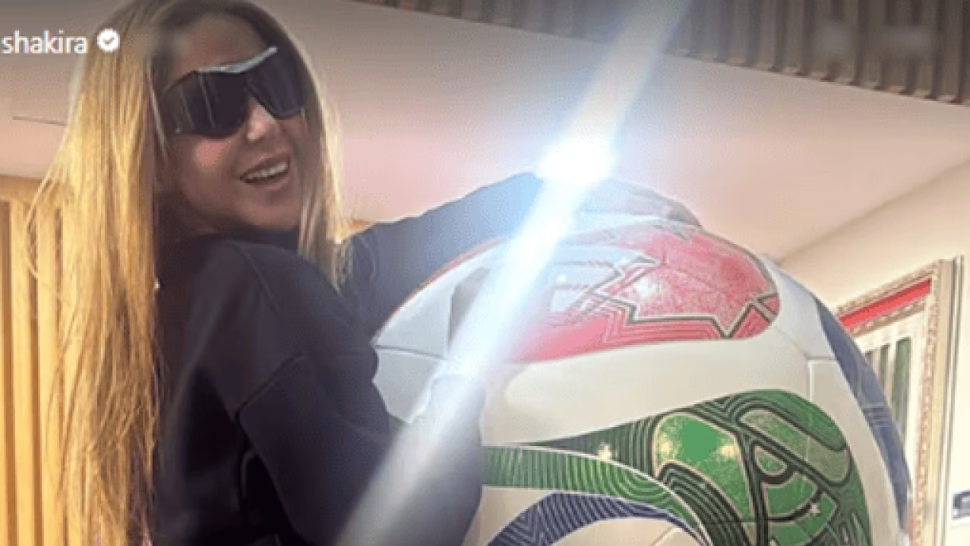
The investigation of the facts reveals that the activities took place in two main scenarios: exclusive parties and private celebrations in countries of origin. On the one hand, events such as Beliween, organized by the singer Belinda in Mexico, and the now traditional celebration of the model Heidi Klum in New York, emerged as epicenters of creativity. Klum, in particular, raised the bar with an anatomically elaborate depiction of Medusa, a figure from Greek mythology, incorporating kinetic elements such as moving snakes and an animated tongue that demonstrated significant investment in costume design and special effects. On the other hand, figures like the singer Shakira opted for a celebration in her native Colombia, integrating the family celebration with a public appearance camouflaged in a massive event, a tactic that suggests careful management of her accessible and, at the same time, reserved image.
Costumes as a vehicle for narrative and positioning
A detailed analysis allows us to identify a clear bifurcation in the intentions behind the outfits. At one end of the spectrum, you see political satire. The actor Eugenio Derbez carried out one of the most talked-about interventions, using his costume to articulate a direct criticism of the immigration policies of then-president Donald Trump. The visual composition—simulating riding on the president’s shoulders—was not a random act, but a calculated statement, consistent with his previous public positions. This case is not an isolated precedent; establishes a lineage with similar actions, such as Katy Perry‘s memorable costume as Hillary Clinton, indicating that Halloween has established itself as a space for sociopolitical commentary disguised as frivolity.
In contrast, the other predominant trend was nostalgia and tribute to pop culture. Justin Bieber‘s family embodied the Parr family from “The Incredibles”, a nod to family values and animated films. Similarly, Paris Hilton and her family recreated the universe of Peter Pan, a choice that projects an image of family unity and fantastical charm. Lady Gaga‘s choice, for her part, of a “Lady of the Garden of Eden” during her The Mayhem Ball tour in Barcelona, wearing a floral corset bodysuit and a spade accessory, reflects an ongoing artistic narrative and meticulous attention to scenic detail, transforming her private celebration into an extension of her public persona.
The impact of these elections on social networks was immediate and quantifiable. Derbez’s publications generated polarized engagement, with debates that ranged from praise for originality to concern about possible political repercussions. The photographs of Shakira and Paris Hilton, on the other hand, garnered predominantly positive and affectionate reactions, demonstrating how alignment with familiar franchises and recognizable aesthetics generates a more uniform emotional connection with the public. The conclusion that emerges from this accumulation of data is that Halloween, for public figures, is a complex communication exercise where the costume functions simultaneously as a branding tool, a personal statement and a thermometer of public opinion.
Were you intrigued by this analysis of the strategies behind celebrities? Share this article on your social networks and explore more content related to the intersection between entertainment, fashion and culture on our platform.