Américo Villarreal and SEMARNAT agree on actions for the environment

A meeting that promises more than photos for the official Instagram: what green agreements emerged?

When the governor and the secretary get together, nature (maybe) celebrates

Ah, the classic protocol photo: forced smiles, shaken hands and a background that screams “yes, we care about the planet”. This time, the protagonist was Américo Villarreal, governor with a face like “I do separate the garbage”, and Alicia Bárcena Ibarra, secretary of SEMARNAT, who probably has a cactus instead of a heart (that’s why she survives the heat of environmental politics). Together, they promised to save trees, hug animals in danger and, incidentally, coordinate efforts so that their selfies are not in vain.

What really matters: will there be action or just posturing?

Between recyclable coffees and documents printed on eco-friendly paper (ironic, we know), the meeting revolved around protecting natural reserves. Villarreal, with that air of “I am the hero that Tamaulipas deserves”, assured that his government and SEMARNAT are #TeamTierra. But be careful, it’s not just talk: they talked about specific projects, although the details are more secret than the recipe for the perfect avocado. Of course, they reaffirmed their commitment, which in political language means “wait seated, but with hope.”.

RelatedTragic accident involving Semarnat employees leaves one dead

And as memes about “meetings that could be an email” flood Twitter, one wonders: will this ultimately translate into tougher laws against deforestation or just a trending hashtag? Bárcena, an expert in speeches that sound good in international forums, made it clear that coordination is key. Villarreal, for its part, added its state touch with a “here we get in on the act” (translation: “we join in, but with a limited budget”).

The truth is that, in a world where greenwashing is an Olympic sport, this meeting at least keeps the issue on the table. I hope it doesn’t end up like those forgotten tupperware in the office: with good intentions, but no one knows what’s inside.

Are you worried about the environment? Share this note and demand real action. #QueNoQuedeEnPhotos | Explore more eco-political content here.
Venezuelans turn to social networks to find missing people after earthquakes

Earthquakes in Venezuela: families use networks to locate missing people due to the lack of official data.

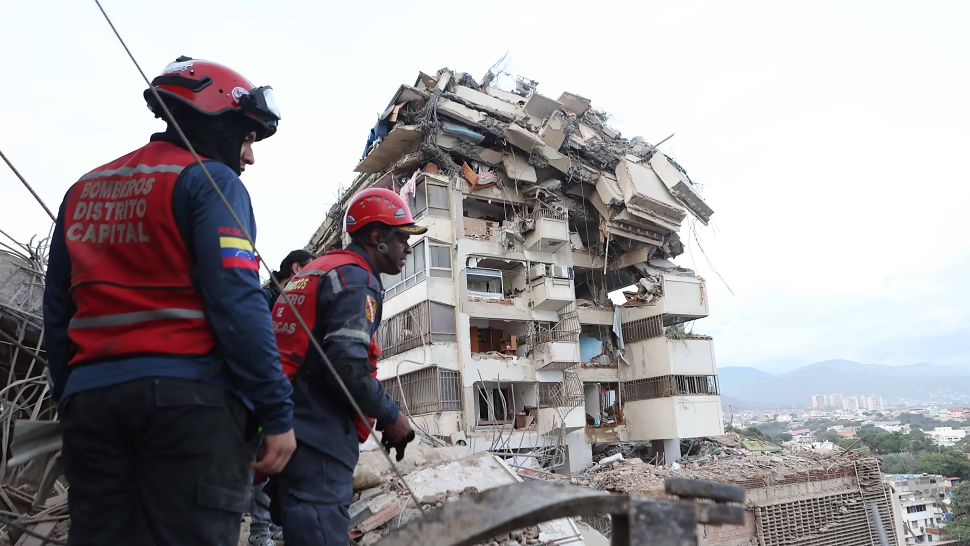
Social networks have become a key tool in the search for missing people after the two earthquakes that shook Venezuela on Wednesday night. Given the lack of official information and communication failures, families inside and outside the country have turned to digital platforms to disseminate photos, data and alerts.

Earthquakes and emergency

The earthquakes, of magnitudes 7.2 and 7.5, left hundreds dead and thousands injured, in addition to widespread damage in regions such as La Guaira and areas near Caracas. Authorities warn that the number of victims could increase as rescue efforts continue through the rubble.

Disinformation crisis

Independent online registries report tens of thousands of people unaccounted for, a figure far higher than official counts. Families of Venezuelans living abroad have shared the uncertainty of not being able to contact their loved ones due to the interruption of basic services and limited connectivity.

International organizations, including the UN human rights mission in Venezuela, have called for restoring access to social media and messaging platforms. They point out that timely information is crucial in disasters, as it can facilitate rescues and the location of people.

Meanwhile, thousands of Venezuelan migrants in countries such as Mexico, Spain, Chile and Brazil are experiencing the anguish of not knowing the status of their relatives. Distance has turned tragedy into an uncertain wait, where the only tool available is the constant dissemination of messages on networks in the hope of obtaining a response.

Continue reading

SNTE rejects violence and blockades in educational negotiations

The SNTE calls for dialogue and distances itself from the pressure tactics of the CNTE.

Position of the SNTE

The National Union of Education Workers (SNTE) rejected any form of blackmail, extortion, provocation, radicalization or violence as a negotiation method. This was expressed in a statement, in reference to the dialogue tables that the National Coordinator of Education Workers (CNTE) holds with the Ministry of Public Education (SEP).

The union stated that it does not support the use of strikes, blockades or other actions that affect third parties as a mechanism for political pressure. The position seeks to promote constructive dialogue and avoid harm to students and the community.

The SNTE statement occurs at a time of tension between the actors in the educational system. The union organization advocates peaceful and respectful methods, prioritizing the stability and well-being of students.

Continue reading

Felipe VI attends Spain-Uruguay in Guadalajara for the 2026 World Cup

The Spanish monarch arrived at La Perla Tapatia to support the team in a key duel.

The World Cup fever in Mexico also has an echo in European royalty. Felipe VI, King of Spain, traveled to Guadalajara to watch his team’s match against Uruguay in the 2026 World Cup.

The monarch arrived at the Guadalajara Stadium under a security operation. He accompanied the ‘Red Fury’ in a decisive match in the group stage. In the FIFA box, the king greeted fans and experienced the pre-match protocol.

Applause and attentive look

During the Spanish anthem, Felipe VI stood tall. The stadium screens showed their reaction to the first attacks of the team led by Luis de la Fuente. He even applauded Spain’s approaches.

Along with the king were local authorities and representatives of the federations of both countries. He also shared the stage with two leading figures in Spanish football: Iker Casillas and Carles Puyol, world champions in 2010. Both closely followed the performance of the new generation, considered one of the candidates for the title.

The royal presence in the Guadalajara stadium reinforces the connection between Mexico and Spain within the framework of a global sporting event. The visit of Felipe VI did not go unnoticed by the fans and the cameras that captured every gesture of the monarch.

Continue reading